

How to assess vendors, safeguards, and communication before outsourcing billing
Patients need a clear first point of contact for billing concerns, even when billing work is outsourced. The practice and its vendor should agree on who answers each type of question, how unresolved issues are escalated, and what information is shared. A reliable workflow for outsourced billing communications makes those responsibilities clear to staff and patients.
Outsourcing can ease administrative pressure, but patients still need timely, understandable answers about statements, insurance processing, and balances. This guide explains how to assess a vendor’s experience and system compatibility, assign communication responsibilities, review privacy safeguards, and decide which billing tasks to delegate. It also shows how regular feedback and performance reviews can help address recurring issues before they cause more confusion.
Key Takeaways
- Assign clear owners for patient billing questions and define how complex concerns move between the practice and billing team.
- Assess a vendor’s experience, system compatibility, responsibilities, and reporting before transferring billing tasks.
- Review privacy safeguards and documented procedures for accessing, transferring, and protecting patient information.
- Use regular feedback and performance reviews to spot recurring billing issues and improve the process.
- Delegate selected tasks or a broader workflow based on staffing capacity, workload, and the level of operational control your practice needs.
1. Evaluating vendor experience, qualifications, and technology
Start by mapping the work your practice may delegate. Medical billing can include eligibility checks, charge capture, coding, claim generation and submission, payment posting, denial management, and patient collections. Identify which tasks stay with your team and which move to the vendor. For example, a practice might retain patient registration while outsourcing coding and accounts-receivable follow-up. Clear boundaries prevent missed handoffs and duplicate work.
Next, assess experience against the work itself, not a broad claim of expertise. Ask how the team handles your specialties, payer requirements, coding reviews, and recurring denials. An accounts-receivable specialist performing that work daily can accumulate 2,000 hours of experience in one year. That focused practice may matter when staff must investigate aging claims, document follow-up, and distinguish a payer delay from a correction the practice needs to make.
Technology fit is a practical test. Confirm that the vendor can work with your electronic health record and practice management systems, then map how information will move between them. Integration can reduce manual data entry, while billing software may automate claim scrubbing and validation before submission. Walk through a sample claim, from appointment information to payment posting. Note where staff enter data, who reviews exceptions, and how corrected claims return to the workflow.
Software alone won’t fix communication gaps. Define who handles each decision, which channel carries routine updates, and how urgent claim issues reach the right person. A workflow for outsourced billing communications should give practice staff and billing specialists access to the same relevant patient information and documentation. For example, agree on how a missing clinical note is flagged, who supplies it, and who confirms the claim can proceed.
Put operating expectations in writing. Assign responsibility for verifying eligibility, reviewing coding, submitting claims, following up on unpaid balances, and communicating with payers. Set service-level agreements for claim submission timelines, and specify how the vendor reports progress and exceptions. Assess how the vendor keeps current with changing rules and industry standards. Request a sample report showing claim status, denials, and outstanding follow-up to judge whether it supports your team’s decisions.
Agree on a review process before work begins. Schedule regular discussions about exceptions, workflow changes, and unresolved questions. Standardize documentation and coding feedback so front-desk staff, clinicians, coders, and billers work from consistent information. This structure makes collaboration measurable: each team knows its responsibilities, handoffs are visible, and recurring errors can be traced to a process rather than passed between departments.
2. Feedback and process improvement
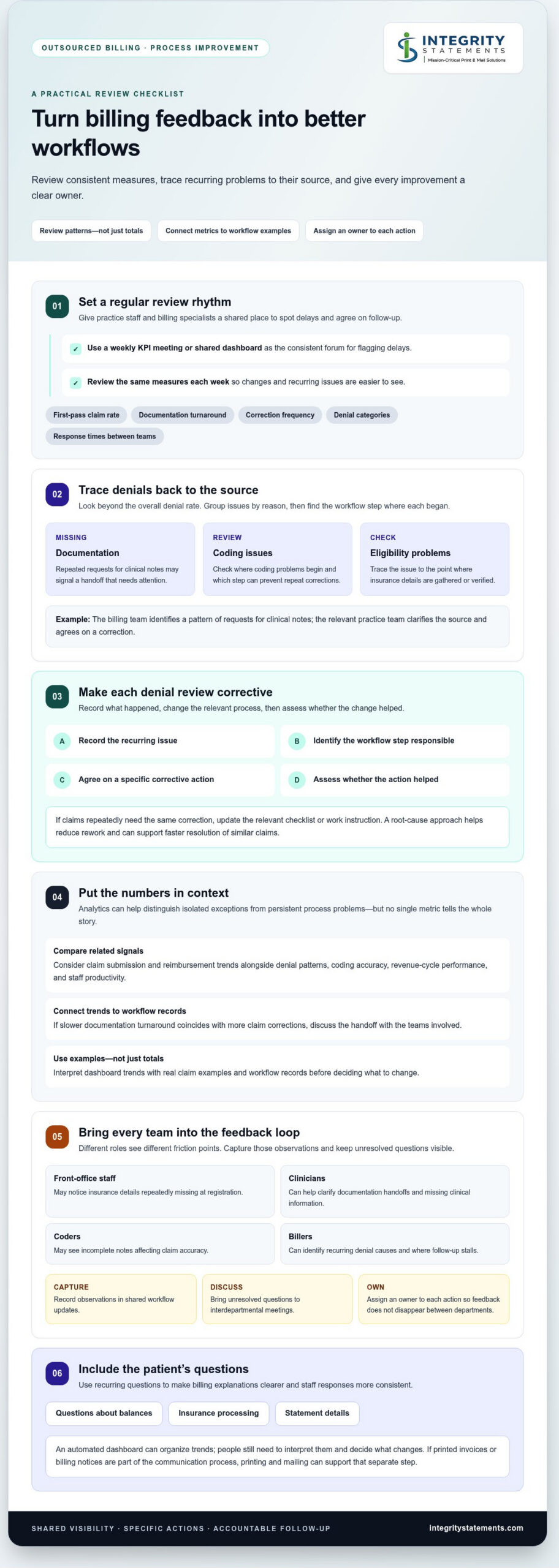
Set a regular review rhythm with the outsourced team. A weekly KPI meeting or shared dashboard gives practice staff and billing specialists a consistent place to flag delays. Review the same measures each week, including first-pass claim rate, documentation turnaround, correction frequency, denial categories, and response times between teams. Use the results to identify where claims slow down, then assign a specific follow-up action.
Look beyond the overall denial rate. Group denials by reason, such as missing documentation, coding issues, or eligibility problems, then trace each category to the step where it began. For example, repeated requests for clinical notes may point to a documentation handoff that needs attention. The billing team can identify the pattern, while the relevant practice team clarifies its source and agrees on a correction.
Make denial reviews corrective, not merely descriptive. For each recurring cause, record the issue, the workflow step responsible, the corrective action, and how the team will assess whether it helped. If claims repeatedly need the same correction, update the relevant checklist or work instruction. This root-cause approach helps reduce rework and can support faster resolution of similar claims.
Analytics can help distinguish isolated exceptions from persistent process problems. Compare claim submission and reimbursement trends with denial patterns, coding accuracy, revenue-cycle performance, and staff productivity. If slower documentation turnaround coincides with more claim corrections, discuss the handoff with the teams involved. Don’t treat a single metric as the full explanation. Connect the numbers to examples and workflow records.
Include front-office staff, clinicians, coders, and billers in feedback. Each group sees different points of friction. A front-desk employee may notice insurance details repeatedly missing at registration, while a coder may see incomplete notes affecting claim accuracy. Record observations in shared workflow updates and bring unresolved questions to regular interdepartmental meetings. Assign an owner to each action so feedback doesn’t disappear between departments.
Patient communication belongs in the review, too. Track recurring questions about balances, insurance processing, or statement details, then use them to clarify explanations and staff responses. An automated dashboard can organize trends, but people still need to interpret them and decide what changes. If printed invoices or billing notices are part of the patient communication process, invoice and billing printing and mailing can support that separate step.
3. HIPAA safeguards for outsourced billing data
Use HIPAA as the federal framework for safeguarding patient information handled during outsourced billing. For a Texas practice, build the workflow around HIPAA protections and assess applicable state privacy requirements alongside the vendor arrangement.
Before transferring data, require a signed Business Associate Agreement with the billing provider. It should define how the vendor may use and protect patient information, who is responsible for each operational task, and how concerns are raised. Outsourcing revenue-cycle management does not remove the practice’s responsibility to protect patient data, so retain oversight of access, communication, and incident procedures.
Assess safeguards as a connected set, not as a single security feature. Ask how the vendor protects information during transfer and storage, limits user access, records activity, and responds to incidents. Review safeguards such as encrypted data transfer, secure access controls, audit logging, and documented incident-response procedures. Role-based access should align each user’s permissions with their assigned billing work.
Examine how the provider’s staff access billing systems. Multifactor authentication adds a verification step at sign-in, while secure VPN connections and encrypted transfers help protect information moving between systems. Confirm that documentation is shared through secure channels and that access can be limited by role. For example, a staff member handling claim follow-up should have only the access needed for that task.
Map the data path before the first file moves. Identify which patient details travel from the practice to the vendor, where claims and supporting records are accessed, and how updates return. For each handoff, record the approved channel, authorized users, and escalation contact. This can expose weak points, such as sending sensitive documents through an unapproved channel or leaving former users with unnecessary access.
Cost structures for outsourced medical billing commonly use a percentage of collections or a flat monthly fee. The price depends on delegated tasks, claim volume, and support scope, and is provided after a quote request. Compare the model with the work transferred and the reporting needed, rather than treating the fee as a substitute for evaluating safeguards.
Use the contract and routine reviews to keep protections operational. Review access permissions when responsibilities change, examine audit records, and keep incident procedures documented. Keep patient billing communications within approved channels, and ensure staff know where to report a suspected disclosure. These controls support secure revenue-cycle work while preserving the practice’s visibility over patient information and cash flow.
4. Assessing security and communication
Share the information needed for assigned billing tasks: patient demographics, insurance details, clinical documentation, charges, coding, claim status, and payment records. Provide controlled access to relevant electronic health record and practice management systems, using secure API connections, SFTP transfers, or a cloud billing portal where appropriate.
Outsourcing risks include communication gaps that delay payments, contribute to denials, or create avoidable administrative work. Reduce these risks with named contacts, approved channels, clear handoffs, and a defined escalation path for urgent claims or patient concerns.
Map information flow before the first claim moves. Identify what the practice sends, what the billing team updates, and where each record remains accessible. For example, a claim needing a missing clinical note requires an assigned practice contact, a secure way to share the note, and confirmation of receipt. This sequence reduces duplicate requests and keeps the claim’s next step visible.
Match system access to each role. A billing specialist handling submission needs access to relevant claim details, while patient-facing staff may need statement status and payment information. Set permissions according to assigned duties, then review them when responsibilities change. Keep activity records available to review access and trace who updated a billing record.
Agree on communication rules for routine and exceptional work. Specify how the vendor reports rejected claims, missing information, payer responses, and unresolved patient questions. Establish who can answer each issue and when it must be escalated. A shared status record can show the claim, latest action, responsible person, and next step, preventing the practice and vendor from pursuing the same item separately.
Test the workflow with a sample claim and a simulated exception. Follow information from the practice system through claim submission, then see how a correction or payer question reaches the right staff member. Confirm that secure channels work, attachments reach the intended record, and both teams can identify the current owner. Record delays or unclear handoffs, then adjust the procedure before routine work begins.
Patient communication also needs clear boundaries. Clarify whether the practice or billing team responds to questions about balances, insurance processing, or statement details. Give staff consistent guidance and a route for questions that require clinical or account-specific review. When both teams use the same current information, they can reduce conflicting explanations and unnecessary callbacks.
Treat communication failures as operational signals. Track delayed responses, repeated requests, claims awaiting documentation, and unresolved patient concerns. Discuss patterns with the vendor and assign corrective actions to the team responsible for that step. Ongoing review helps maintain secure exchanges while supporting accurate claims and steadier revenue-cycle work.
5. Choosing when to delegate billing work
Consider delegation when billing work consistently competes with patient care or practice operations. If your Texas practice faces recurring vacancies, backlogs, or delayed follow-up, outsourcing can add capacity without transferring every billing responsibility.
Tasks to delegate can include coding, claim submission, denial management, reimbursement tracking, and accounts-receivable follow-up. A practice can outsource selected functions, such as coding or accounts receivable, while keeping other steps in-house. This partial approach suits teams with specific bottlenecks that want to retain control over other parts of billing.
Use operational signals to decide what to transfer. Review billing problems from the past 90 days, including claim delays, repeated errors, and incomplete follow-up, to see whether they form a persistent pattern.
In-house teams offer closer day-to-day control and direct access to practice staff. They also require resources for salaries and benefits, training, software, clearinghouse fees, IT, compliance, absences, and turnover. Outsourced teams may adjust resources as patient volume changes, but the practice may have less control over daily operations. Compare these trade-offs with your need for specialized coding, consistent claim follow-up, and clear patient communication.
Before delegating, define boundaries in writing. Specify which team owns registration data, coding review, submission, payer follow-up, denial appeals, and patient questions. For example, a practice might keep patient registration in-house but assign claim corrections and accounts-receivable follow-up to an external team. Clear ownership helps reduce duplicate work and shows where unresolved errors should go.
Choose the arrangement that addresses the actual constraint. Full outsourcing transfers the entire billing workflow to a vendor; partial outsourcing assigns selected tasks while the practice retains the rest. If denied claims are the main pressure point, target denial management and appeals. If coding capacity is the issue, delegate coding while keeping patient-facing explanations with trained practice staff.
Agree on how you’ll evaluate the arrangement before work shifts. Review days in accounts receivable, clean claim rate, denial rate, and net collection percentage, alongside staff observations about communication delays. A weekly KPI review can reveal whether delegated work is progressing and where the process still needs adjustment. To organize the patient-facing side of billing communications, plan your billing communication needs as part of the delegation process.
Integrity Statements: Custom Print & Mail
Integrity Statements supports the communication side of billing with Custom Print & Mail. If your practice manages claim processing separately but needs help delivering patient-facing materials, this service handles printed billing communications from production through mailing. Clear statements and notices give patients a consistent reference for understanding their account and deciding what to do next.
This is a practical fit when your team wants to outsource the physical preparation and mailing of billing communications, rather than revenue-cycle decisions or patient account management. Keep responsibility for content, approvals, and responses aligned with your practice’s workflow. Contact Integrity Statements to discuss how Custom Print & Mail can fit your billing communication process.
Put the Next Step in Motion
Use your next planning discussion to define what patients should experience as billing work moves between teams. Choose one communication point to improve, such as making a statement easier to understand or clarifying where a billing question should go. Document the owner, the handoff, and how the practice will gather feedback. A workflow for outsourced billing communications is most useful when staff can apply it consistently, not just when a vendor agreement is signed.
For printed patient communications, Integrity Statements offers Statement Printing and Mailing, Invoice and Billing Printing and Mailing, and Healthcare Communications Printing and Mailing. These services support the delivery of statements, billing documents, and other healthcare communications within a clearly defined process. The practice remains responsible for deciding what information to communicate and how patient questions are handled.
When you’re ready to plan the print-and-mail side of that process, contact Integrity Statements. A clear next step can help your team move forward with confidence.
Frequently Asked Questions
Who handles patients’ billing questions and concerns?
Identify the patient’s first contact and clarify which questions the billing team can resolve directly. For example, the vendor might explain statement line items, while practice staff handle disputes requiring clinical context or account decisions. Give both teams an escalation route and a shared record of the response. Patients shouldn’t have to repeat the same concern because it crossed an internal boundary.
What is the workflow for outsourced billing communications?
A workflow for outsourced billing communications assigns responsibility from the first patient inquiry through resolution. A patient may ask about an invoice, the billing team reviews the account record, and a designated practice contact handles questions requiring additional context. The team documents the response, any follow-up action, and who owns it. This traceable handoff helps prevent duplicate replies and makes unresolved concerns visible to both parties.
How do you select and onboard an outsourced billing communications provider?
Select a provider whose experience and systems fit the tasks you plan to transfer, then onboard through a documented transition plan. Name owners for patient questions, approvals, and exceptions. Walk through sample scenarios, such as a disputed balance or returned mail, and confirm where staff record outcomes. Before routine work begins, test system access and review a small batch of communications for accuracy, tone, and correct routing.
How do HIPAA, PCI DSS, and data privacy rules apply to outsourced billing communications?
HIPAA safeguards matter when a billing provider handles protected health information, and the practice should require a signed Business Associate Agreement. For PCI DSS, first map whether payment card data enters the vendor’s workflow, then define which party handles that data and the related controls. Texas practices should also account for applicable state privacy obligations. Document permitted data use, access, transfer methods, and incident escalation in the vendor arrangement.
How should companies monitor vendor performance, SLAs, and billing communication quality?
Use service-level agreements to define measurable duties, such as claim submission timelines, escalation ownership, and how unresolved patient questions are reported. Review vendor reports alongside a sample of completed communications to assess accuracy, clarity, and whether responses address the concern. Record missed commitments and corrective actions in the same review log. Patient complaints and repeated requests can reveal quality issues that claim metrics alone may not show.
What steps are needed to transition billing communications back in-house or to another provider?
Map which billing tasks and patient questions will move, assign clear owners, and document communication channels, escalation steps, and reporting expectations. Plan the data handoff by identifying what information will transfer, approved channels, and authorized users. Then review unresolved issues and update access and workflows with the practice and the new team.


