

Cost Savings of Outsourced Mail vs In-House: Which Costs Less
Print-and-mail outsourcing is estimated to reduce business expenses by 30%, so the cost savings of outsourced mail vs in-house can be meaningful. But a lower total cost depends on more than postage: staffing, equipment, upkeep, and mailing volume all affect the comparison.
It’s easy to focus on the visible costs of an in-house mailroom, such as supplies and postage, and overlook the time needed to prepare, process, and manage each mailing. Outsourcing shifts some of that work and its operating demands outside your organization, while in-house operations give you direct control over the process.
This article explains how labor and training, operating efficiencies, and equipment investments affect the total cost of each approach. You’ll also learn how to compare in-house, outsourced, and hybrid mailing options to make a practical decision for your organization.
Key Takeaways
- Compare the full cost of each approach, including labor, training, postage, equipment, upkeep, and the time staff spend managing mail.
- Map the steps in your current mailing workflow to identify manual tasks and internal capacity that could be used for other priorities.
- Assess whether outsourcing could help manage seasonal peaks or reduce the need to maintain equipment for fluctuating volumes.
- Build an annual in-house cost estimate, then compare it with outsourced and hybrid approaches using the same mailing needs.
- Consider statement, billing, healthcare, tax, and regulatory mail requirements when deciding which communications to handle through a print-and-mail service.
Comparing In-House vs Outsourced Corporate Mailing Services: Which Is More Cost-Effective?
The lower-cost option is the one with the smaller total cost for the same mailing workload. Compare labor, facilities, equipment, software, postage, processing, and staff time for each approach.
Visible Costs and Total Ownership Costs
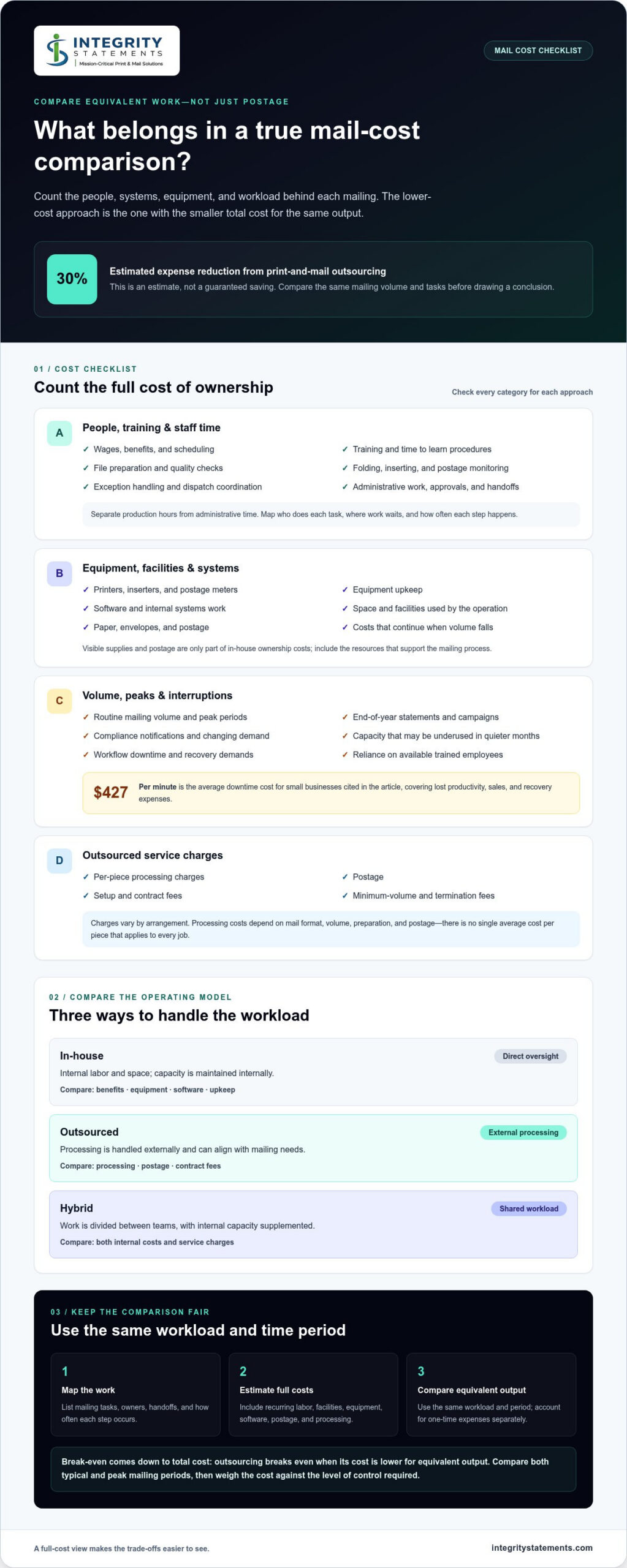
Postage, paper, and envelopes are visible expenses, but they don’t capture the full cost of ownership. Add equipment upkeep, software, staff time, facilities, and the internal systems work that supports mailing. Print-and-mail outsourcing may reduce business expenses by an estimated 30%, but compare the same volume and tasks before drawing a conclusion.
There is no single average cost per piece for outsourced mail processing in the United States that applies to every job. Processing costs vary with mail format, volume, preparation, and postage. Setup, contract, minimum-volume, and termination fees also vary by arrangement, so compare these line items with per-piece processing charges.
In-House Facilities, Staffing, and Labor
An in-house operation uses space, equipment, and staff time to prepare and manage mail. Include wages, benefits, scheduling, training, and time spent folding documents, stuffing envelopes, and monitoring postage. Account for printers, inserters, and postage meters, including their upkeep. In-house operations offer direct oversight, but costs continue even when mailing volume falls.
Workflow, Downtime, and Productivity Costs
Manual steps create opportunity costs when employees could be handling other strategic work. Map each task, from preparing files through inserting and dispatching mail, then record who performs it and how often. A broken printer, network outage, or unavailable key employee can interrupt that workflow. Downtime costs small businesses an average of $427 per minute in lost productivity, sales, and recovery expenses.
To calculate a break-even point, compare recurring in-house and outsourced costs for the same period and workload, and account for one-time expenses separately. Outsourcing breaks even when its total cost is lower for equivalent output.
Mail Volumes and Seasonal Fluctuations
Volume determines how fully an organization uses its staff and equipment. End-of-year statements, promotional campaigns, and compliance notifications can create seasonal peaks. Maintaining capacity for those periods may leave resources underused in quieter months. Outsourcing can provide processing capacity as needed, while an in-house team offers direct control over daily workflow. Compare typical and peak mailing periods, not just a single busy month.
| Option | Staff and facilities | Volume flexibility | Cost factors to compare |
|---|---|---|---|
| In-house | Internal labor and space | Capacity maintained internally | Benefits, equipment, software, upkeep |
| Outsourced | Processing handled externally | Can align with mailing needs | Processing, postage, contract fees |
| Hybrid | Work divided between teams | Internal capacity supplemented | Both internal costs and service charges |
Choose by comparing the full cost and level of control required for the same mailing workload.
In-house mailroom labor, training, and staffing
Mailroom labor involves more than handling finished pieces. Staffing plans also need to account for workflow setup, quality checks, exceptions, and dispatch coordination.
Mailroom Labor and Staffing
An in-house team manages each step directly, from receiving approved files to releasing completed mail. Traditional mailrooms need a dedicated team to sort, open, scan, and distribute incoming mail. Outbound work adds tasks such as preparing jobs, checking output, and coordinating dispatch.
To understand staffing needs, map a representative mailing from start to finish. Record who handles each task, where work waits for approval, and which steps require another employee’s attention. For example, a billing batch may need file preparation, review, exception handling, and final release. This task-level view shows where labor adds up.
Staffing also affects scalability. An internal team must be scheduled for routine volume and periods of heavier demand. A mailing partner can process assigned work externally, reducing the need to keep every processing role within the organization. Compare oversight and handoffs as well as production hours.
Training and Mailroom Overhead
Training is an ongoing labor cost because employees need to learn job procedures, equipment use, and quality controls. When responsibilities are spread across a small group, absences or turnover can leave fewer trained people available for time-sensitive mailings. Documented procedures help maintain consistency and reduce reliance on one employee’s informal knowledge.
Mailroom overhead also includes the internal systems and coordination needed to keep work moving. Separate production time from administrative time: identify who prepares files, resolves exceptions, tracks supplies, and approves completed jobs. This makes the work visible and helps you decide which responsibilities to consolidate or assign externally.
To reduce manual labor, examine each handoff. Group recurring tasks, standardize job instructions, and remove duplicate reviews that add no meaningful control. Outsourcing print-to-mail can reduce the manual work of preparing and processing mail, along with staffing, training, and in-house systems overhead. Internal teams can then focus on approvals and exceptions that require organizational knowledge.
- List each mailing task and its owner.
- Separate routine production from review and exception handling.
- Compare the staff time required for internal work with the coordination needed for external work.
For statement-focused workflows, statement mailing workflows can be considered as one way to shift recurring production tasks outside the organization.
Outsourcing economies of scale and operational efficiencies
Outsourcing can add capacity without keeping every mailing task inside the organization. Compare the processing model with your need for internal control and backup capacity.
Outsourced mail services typically price sorting, printing, fulfillment, and postage as job components. Volume, document format, preparation needs, and mailing destination affect how each component is calculated. Postage remains separate from production and fulfillment charges.
Scale can improve efficiency when a provider combines mail from multiple businesses. Presorting by ZIP code can qualify mail for discounted postage, while commingling combines mail into a larger batch for additional postage savings. These efficiencies depend on how the mailing is prepared and whether it qualifies.
Consider this sequence when assessing an outsourced workflow:
- Identify which communications need printing, sorting, fulfillment, and delivery.
- Separate recurring mail from seasonal or regulatory batches.
- Compare outsourced processing and postage with the equivalent internal workload.
Mail-handling arrangements for sensitive information also involve security, privacy, compliance, and liability considerations. The U.S. Department of Health and Human Services says the HIPAA Privacy Rule requires appropriate safeguards for protected health information. Define responsibilities for handling that information and account for the safeguards and oversight required by your organization.
Internal operations can preserve direct control over file release, review, and mailing schedules. That control may matter for communications requiring close coordination with employees and other business processes. It also means internal staff must maintain capacity if equipment or a key employee becomes unavailable.
Outsourcing can serve as a backup rather than a complete replacement. Organizations can assign selected regulatory communications or seasonal campaigns externally, or use print-to-mail capacity when internal resources are stretched. This approach retains some control inside while reducing pressure on employees during peak periods.
A hybrid model divides work between internal teams and an external operation. For example, a company might retain routine mail internally and route a seasonal campaign to outside processing. A global insurance company improved efficiency and cut costs by 40% after adopting hybrid mail operations and automated processes. That case illustrates one outcome, not a universal saving.
Choose a model by matching control requirements, workflow capacity, mailing volume, and postage opportunities. If internal teams can manage predictable work but struggle with peaks, a backup or hybrid approach may fit. If coordinating two operations adds complexity, a simpler division of tasks may work better.
Projecting annual in-house expenses
Build an annual estimate by totaling staffing, postage, equipment, supplies, maintenance, and supporting technology. Compare a full year of operations, not just one mailing.
In-house costs include employee wages and benefits, postage, paper and envelopes, equipment purchases or upkeep, and supplies. Printers, inserters, and postage meters each have their own maintenance and replacement needs.
Mailroom Staffing and Postage Expenses
Staffing costs include wages, benefits, scheduling, and ongoing training for employees handling mail. Track time spent preparing files, checking output, resolving exceptions, and monitoring postage. Calculate postage by multiplying the pieces mailed by the applicable rate for each mail class and format.
For a current projection, separate postage from labor and record the mailing date, piece count, and class. Postage rates can change, while staffing costs depend on the work and schedule required. Track recurring mail and seasonal campaigns separately so a peak period doesn’t distort the baseline.
Equipment, Supplies, and Maintenance Expenses
Equipment expenses include printers, inserters, and postage meters, plus paper, envelopes, and other supplies. Separate purchases from recurring maintenance to show both capital needs and operating costs. Devices used for multiple mailing types may also require internal technology support, setup, and upkeep. These expenses arise from maintaining capacity, not from each mailed piece.
Use invoices, supply records, and maintenance logs to calculate annual totals. Include repairs and downtime-related disruption in the equipment review, then note which devices are critical to uninterrupted mailing. This helps distinguish equipment used for routine work from capacity kept mainly for occasional high-volume jobs.
Use a consistent worksheet to avoid overlooking indirect expenses. Add wages and benefits, training, postage, supplies, equipment, maintenance, and facility overhead. Divide the annual total by annual pieces mailed to estimate internal cost per piece. Treat this as an internal planning measure, not a quoted service price.
For example, compare a regular billing run with an end-of-year statement batch. Record each batch’s volume, employee hours, postage, materials, and equipment time. This shows whether fixed expenses are spread across enough mail during quieter periods or whether seasonal demand requires extra capacity.
Finally, compare annual totals for the same mailing volume and required controls. Include security procedures and technology support for sensitive documents, along with the flexibility needed during peak periods. A clear expense model shows which costs are fixed, which rise with volume, and where internal resources carry the greatest operational load.
Avoiding mailroom equipment and infrastructure investment
In-house mailing requires equipment, workspace, and ongoing maintenance. Outsourcing can shift some of that investment outside the organization, especially when mail volume varies throughout the year.
A basic mailroom may depend on printers, inserters, and postage meters. Each device needs upkeep, supplies, and staff who can operate it. Organizations also need space for equipment and materials. These costs support internal capacity even when fewer communications are mailed.
Outsourcing print-to-mail can help avoid capital expenditures on mailroom equipment and infrastructure. It can also reduce the need to add staff for seasonal increases. For example, an organization with a large annual statement run can outsource that batch instead of expanding its in-house setup to handle peak volume.
Assess equipment needs by separating everyday requirements from peak-period capacity:
- List printers, inserters, postage meters, and supporting supplies used for each mailing type.
- Record which equipment supports routine communications and which is needed mainly during seasonal peaks.
- Identify maintenance, workspace, and staffing requirements tied to each device.
This inventory helps distinguish essential internal infrastructure from capacity that could be handled externally. It also makes overhead easier to compare: an in-house operation carries equipment and facility costs, while outsourced processing can scale without the same investment in additional equipment or personnel.
Volume is central to the decision. If mailing demand is steady, existing equipment may be used regularly, making internal capacity practical. If demand rises sharply for end-of-year statements or regulatory communications, outsourcing can provide flexibility without permanently expanding the mailroom. The aim is to match capacity to actual work, not maintain unused equipment by default.
Organizations handling sensitive communications should include the operational requirements for protecting files and controlling access. Consider how documents move through internal systems, are prepared for printing, and are managed after mailing. These processes need oversight whether equipment is in-house or production is outsourced.
Compare the investment avoided with the work that remains internal, including file preparation, approvals, and coordination. This creates a clearer view of how outsourcing affects both equipment overhead and employee responsibilities. For mailroom capacity planning, discuss your mailing requirements as you assess which work belongs inside your organization.
Integrity Statements: Statement Printing and Mailing
Integrity Statements provides Statement Printing and Mailing for organizations deciding whether recurring statement production belongs in-house or with a print-and-mail provider. Outsourcing can be a practical option when internal teams want to reduce equipment demands or move mailing tasks out of their regular workflow.
The same decision may apply to Invoice and Billing Printing and Mailing, Healthcare Communications Printing and Mailing, and Tax Forms & Regulatory Mail Printing and Mailing. Consider which communications require the most internal coordination, need consistent handling, or add pressure during seasonal peaks. These details help clarify whether outsourcing fits your operation.
To discuss your organization’s mailing needs, contact Integrity Statements.
Make Your Next Mailing Decision With Confidence
Before deciding where the work belongs, define what your organization needs from its mailing operation. Identify the communications involved, the responsibilities you want to retain internally, and the process changes that matter most. With those priorities clear, you can assess the cost savings of outsourced mail vs in-house operations against practical needs, not assumptions.
Integrity Statements supports organizations with Statement Printing and Mailing, Invoice and Billing Printing and Mailing, and Healthcare Communications Printing and Mailing. These services can suit recurring or sensitive communications that need a dedicated print-and-mail workflow. Organizations with limited or irregular mailing needs may find it more practical to keep the work internal.
Use your priorities to guide a focused conversation about the right scope for your communications. Contact Integrity Statements to discuss mail services and take the next step toward a clear, considered decision.
Frequently Asked Questions
In-house or outsourced: which makes sense for your team?
Choose in-house mailing when employees need direct control over changing documents or approvals. Outsourcing can suit teams that want production handled externally, especially for recurring business communications. Texas organizations can compare how often work changes, who must approve each mailing, and whether internal staff can handle exceptions. The right fit supports the necessary oversight without adding unnecessary workflow steps.
The Hybrid Approach: Best of Both Worlds?
A hybrid model can work when different mail types need different handling. For example, a Texas business might keep urgent notices under internal review while assigning routine invoice batches to an external print-and-mail service. Set clear boundaries for file approval, corrections, and final release so employees know when responsibility transfers. This preserves internal involvement in selected decisions while assigning defined production work externally.
How much can businesses save by outsourcing mailroom operations versus handling mail in-house?
Print-and-mail outsourcing is estimated to reduce business expenses by 30%. The cost savings of outsourced mail vs in-house operations depend on the work included in the comparison, such as file preparation, printing, fulfillment, postage, and internal oversight. Use equivalent mailing volumes and tasks in both estimates. A reduction in production expenses won’t represent the full financial effect if important internal work remains outside the calculation.
What factors determine whether outsourcing mail is cost-effective for a business?
Cost-effectiveness depends on mailing volume, how steady that volume is, preparation requirements, postage opportunities, and the internal work that remains. For example, a utility sending recurring notices may find regular batches easier to plan than sporadic communications that need frequent revisions. Also account for approval steps and how sensitive documents move through the organization. Compare actual workflows, not just the number of pieces mailed.
What are the costs of postage discounts and presort services for outsourced versus in-house mail?
Presorting mail by ZIP code can qualify a mailing for discounted postage, and commingling can create additional savings by combining businesses’ mail. In-house operations need to account for the preparation involved in qualifying mail; outsourced processing may include those tasks in its service charges. Pricing depends on volume, format, preparation, and postage, and is provided through a quote request.
What are the pros and cons of outsourced mail services compared with an in-house mailroom?
Outsourcing can shift production tasks and equipment needs outside the organization, while in-house mailing offers direct oversight of daily work. An internal team may be preferable when frequent changes require close coordination. External processing can help with a defined mailing program or a capacity gap. Before choosing, identify which approvals and exceptions must stay internal, then clearly assign the remaining workflow.
How can a business estimate its total cost of ownership for outsourced versus in-house mail?
Build two estimates using the same mail types and schedule. For the in-house model, tally employee time, benefits, supplies, postage, equipment upkeep, and facility overhead. For the outsourced model, include processing, fulfillment, postage, and any internal coordination that remains. Separate recurring expenses from one-time equipment needs, then compare totals across routine and peak periods. This shows whether a seemingly cheaper option leaves out work or capacity your team still needs.


