

Comparing Print and Mail Service Providers in Texas
The provider with the broadest print catalog isn’t necessarily the right fit for business-critical mail. Statements, invoices, and healthcare communications must move accurately from document production through processing and mailing, with sensitive information handled carefully at every step. That’s why comparing print and mail service providers in Texas should start with transactional-mail experience, not print breadth alone.
When comparing providers, look beyond print quality and delivery expectations. Ask who manages each stage, how document accuracy is supported, and whether the workflow fits your organization’s needs across Texas. A general commercial printer and a transactional-mail specialist may handle those responsibilities differently.
This guide offers a practical framework for comparing providers on transactional-mail experience, workflow ownership, security, and organizational fit. You’ll learn how to assess support for recurring statements, invoices, healthcare communications, and tax or regulatory mail, and how printing, processing, and mailing fit together. The goal is to help you choose a partner for critical communications with a clear understanding of the work involved.
Key Takeaways
- Start with the communications you send, how often you send them, and how sensitive the information is.
- Compare workflow ownership, data handling, quality checks, and reporting to see who is responsible at each stage.
- When comparing print and mail service providers in Texas, distinguish general commercial printing and marketing mail from recurring transactional-mail support.
- Use a checklist to map document types, volume patterns, internal stakeholders, and transition needs before assessing provider fit.
- Integrity Statements provides print and mail services for statements, invoices, healthcare communications, tax forms, regulatory mail, and customer notices.
Comparing Texas Print and Mail Providers Starts With the Mail You Need to Send
A print and mail provider coordinates document production with the steps needed to prepare physical mail. Workflows vary. Some providers focus on printing or promotional materials, while transactional-mail specialists handle communications generated from business data and sent repeatedly. For these documents, dependable results depend on correct content, consistent handling, and clear responsibility throughout the process.
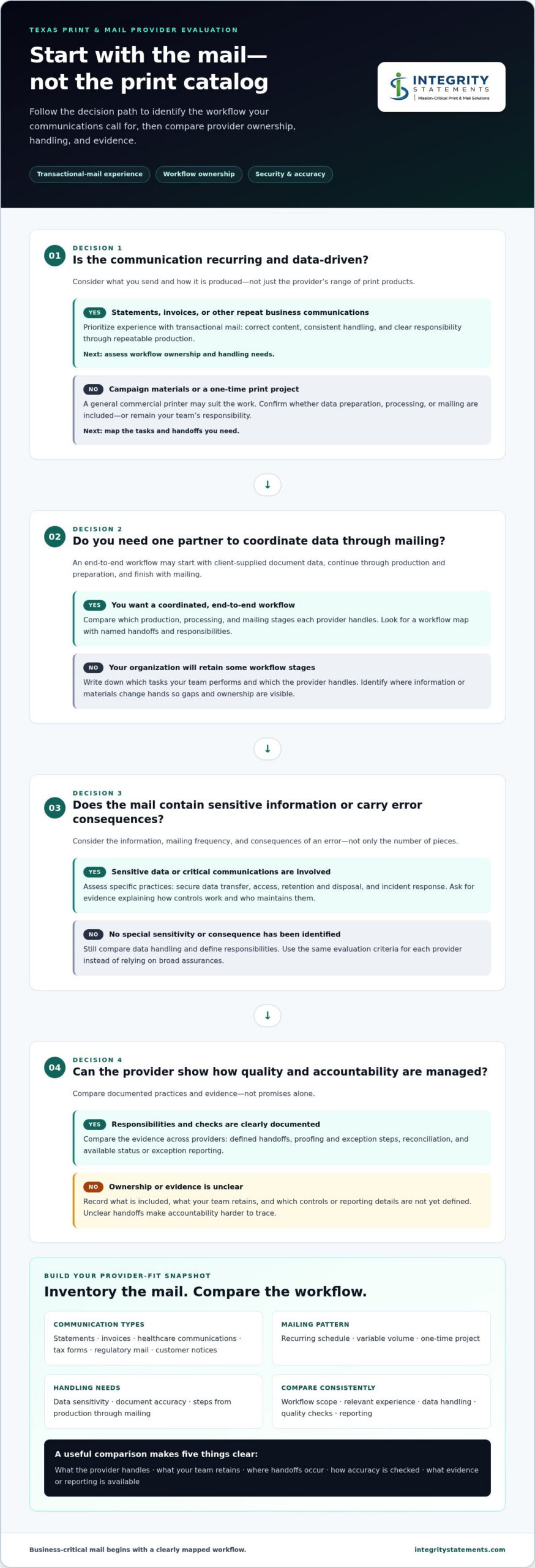
Begin by separating recurring business mail from campaign materials and one-time print projects. A brochure is designed to attract attention; a statement or invoice must deliver the right information to the intended recipient as part of a repeatable business process. Comparing print and mail service providers in Texas is more useful when your criteria reflect the mail’s purpose and sensitivity, rather than the provider’s print catalog.
Comparison framework: Assess transactional-mail experience, workflow ownership, data handling and security, accuracy controls, and fit with your document types and recurring workload.
Which business communications need a specialist?
Statements and invoices are recurring, data-driven communications. Each document must reflect the correct account or billing information. Healthcare communications, tax forms, regulatory mail, and customer notices serve different purposes, but all benefit from careful handling and repeatable production. Consider the sensitivity of the information, how often you mail, and the consequences of an error, not just the number of pieces.
For example, an invoice run may require consistent document assembly, while a healthcare communication may contain information that needs careful handling. A tax form or regulatory notice has a different purpose from a customer update. Listing these differences helps you identify which documents need a controlled, repeatable mail workflow.
What does end-to-end print and mail service mean?
An end-to-end workflow can start with client-supplied document data, continue through production and preparation, and finish with mailing. A coordinated partner connects these stages and makes responsibilities and handoffs clear. Buying printed materials alone is different: your organization may still need to manage data preparation, processing, or mailing separately. Define the workflow you need before comparing what each provider includes.
Map each communication from source data to mailpiece. Note which tasks your team performs, which the provider handles, and where information or materials change hands. This outline helps reveal gaps and gives you a practical way to assess accountability without assuming every provider follows the same process.
Before comparing provider types, create a short inventory of the mail itself:
- Purpose: Billing, healthcare, tax or regulatory communication, or customer notice.
- Pattern: Recurring schedule, variable volume, or one-time project.
- Handling needs: Data sensitivity, document accuracy, and the steps from production through mailing.
This inventory turns a broad search into an operational comparison. It also helps distinguish a provider suited to occasional commercial print work from one focused on recurring, business-critical communications.
Compare Texas Providers on Workflow Ownership, Security, and Accuracy
Compare how information moves from your organization through production and mailing, where checks take place, and who owns each handoff. For statements, invoices, healthcare communications, or regulatory mail, a clear process helps prevent assumptions from taking the place of accountability.
Use the same criteria for each provider. Record what is included, what your team retains, and what evidence explains the provider’s stated controls.
| Area | What to compare | Useful evidence |
|---|---|---|
| Workflow scope | Which production, processing, and mailing stages are handled? | A workflow map with named handoffs and responsibilities |
| Communication types | Experience with recurring statements, invoices, healthcare communications, tax forms, regulatory mail, and notices | Examples of relevant document workflows |
| Data handling | How data is transferred, accessed, retained, and disposed of | Written procedures and defined access practices |
| Quality checks | How documents and mailing preparation are reviewed | Documented proofing, exception, and reconciliation steps |
| Reporting | What status or exception information is available | Sample reports or a description of reporting responsibilities |
Documented handoffs reduce ambiguity. If one party accepts a data file, another processes it, and a third prepares it for mailing, each transition should have a defined owner. If an issue arises, your organization can trace the process and identify who is responsible for investigating and resolving it.
How to assess security and sensitive-data handling
Assess security through specific practices, not broad promises. Compare access controls, secure data-transfer methods, retention and disposal practices, and incident-response procedures. Look for evidence that explains how each control works and who maintains it. A general claim of being “secure” or “compliant” doesn’t describe the safeguards used in the workflow.
For healthcare communications, HIPAA responsibilities depend on the organization’s role, the information involved, and applicable requirements. Define responsibilities between your organization and the provider, including how sensitive information is protected and how incidents are handled. Don’t assume that a provider’s statement about security represents a particular certification or satisfies your organization’s obligations.
How to assess accuracy and process accountability
Review how the provider handles proofing, output review, exceptions, and reconciliation. A process should make clear how discrepancies are identified, held for review, and tracked through resolution. Define who investigates an issue found during production and who follows up if it is identified during mailing preparation. Clear boundaries make accountability easier to maintain.
Transactional-mail quality is accuracy across data, documents, and mailing preparation. Compare the controls behind each step, not just the finished printed piece.
Review transactional print and mail services from Integrity Statements, a provider focused on business-critical communications.
Match Provider Types to Your Texas Organization’s Mail Workload
Provider categories are a useful starting point, but the right fit depends on the work your mail supports. A one-time brochure project has different demands from a recurring invoice cycle or a sensitive healthcare communication. Compare each provider’s focus with your document purpose, production frequency, data sensitivity, and the teams that need to coordinate the work.
In Texas, recipient distribution and internal structure also matter. An organization mailing across multiple regions may have teams supplying data, approving documents, and answering recipient questions in different locations. Map those roles alongside the mail flow to see whether the provider’s scope supports your organization’s actual handoffs.
| Provider type | Likely strengths | Considerations and examples |
|---|---|---|
| General commercial printer | Broad support for conventional business print projects | Common examples include brochures, business cards, and branded materials. A broad print catalog alone doesn’t establish recurring transactional-mail expertise. |
| Marketing-mail provider | Work centered on promotional mail and campaign distribution | May suit promotional postcards or other campaign pieces. Compare its scope with your needs if mail is data-driven, recurring, or sensitive. |
| Transactional-mail specialist | Focus on repeatable business communications and connected production-to-mail workflows | Relevant examples include statements, invoices, healthcare communications, tax forms, regulatory mail, and customer notices. Assess fit against your document and workflow requirements. |
When a general commercial printer may fit
For a defined print project, a general commercial printer can be a practical match. Business cards, a brochure, or branded materials for an event may call primarily for print production and design coordination. Those projects differ from recurring mail generated from account or customer data. A wide selection of print products shows breadth, but not necessarily how a provider manages transactional workflows.
When transactional-mail expertise matters more
Statements and invoices often connect directly to billing and customer-service processes, so a missed or inconsistent production cycle can affect work beyond the mailroom. Healthcare communications, tax forms, and regulatory mail may contain sensitive information and require careful document handling. As frequency and operational importance rise, compare workflow experience, repeatability, and clear responsibility alongside print capability.
Provider fit depends on communication risk and workflow, not print variety. Use that distinction to decide which capabilities matter most instead of treating every provider category as interchangeable.
Then consider the route from your internal teams to recipients. Identify who supplies and approves content, who coordinates mailing, and who handles recipient questions. For Texas-wide organizations, reflect how those responsibilities work across locations, not just at a central office. If multiple teams contribute, a clearly defined provider role can help keep handoffs consistent.
Some organizations use different provider types for different projects. Align each workload with its requirements: promotional print with campaign needs, and recurring business communications with the controls and continuity those workflows demand. This makes comparing print and mail service providers in Texas a more grounded decision based on the work your organization needs done.
Use This Texas Print and Mail Provider Evaluation Checklist
A consistent requirements brief makes provider responses easier to compare and helps expose gaps before they become transition problems. Before comparing print and mail service providers in Texas, document the work, controls, responsibilities, and continuity needs that matter to your organization.
Build a clear requirements brief
Start with the communications in scope, then capture how each is produced today. Include source data, approval steps, mailing frequency, typical volume patterns, and exceptions that can affect production. Identify internal owners for security, finance, compliance, and customer communications so requirements and decisions involve the right teams.
- 1. Inventory communications. List statements, invoices, healthcare communications, tax forms, regulatory mail, and customer notices. Note document types, recipient groups, frequency, and how volumes change over the year.
- 2. Map the workflow. Record how data is prepared and approved, which teams provide files or content, and how work moves through production and mailing. Mark handoffs and responsibilities across Texas locations or departments.
- 3. Assess controls. Document data-handling expectations, quality checks, exception processes, and the information your organization needs for oversight. Distinguish a stated capability from evidence of how the control works.
- 4. Compare scope. Use the same requirements for each response. Distinguish included services from optional work, and compare operational responsibilities alongside contract scope and reporting.
- 5. Plan transition. Outline transition owners, testing needs, stakeholder approvals, and continuity planning. Establish how open issues will be tracked and who will coordinate decisions before production moves.
This sequence keeps different questions separate. A provider may describe a capability, but your comparison should also show what the agreement covers, what evidence supports the process, and who is accountable for each task. For statement workflows, include secure data handling and production controls in the brief, then compare them with your organization’s requirements.
Compare proposals and plan continuity
Evaluate responses against the same documented workflow instead of relying on broad service descriptions. For billing, record how invoice data is supplied, reviewed, and prepared for mailing, along with the roles of your finance and customer-service teams. A transition plan should identify what will be tested, who approves the results, and how existing communications continue during the changeover.
For added context as you define requirements, review the guidance on secure statement printing and mailing services and invoice printing and mailing. Use these topics to sharpen your workflow questions, then apply the same checklist to each provider response.
With requirements, evidence, scope, and ownership recorded in one place, your team can compare operational fit consistently. To discuss how business-critical print and mail services support recurring communications, connect your requirements to the documents and workflow you’ve mapped.
How Integrity Statements Supports Business-Critical Mail in Texas
Provider comparisons are most useful when they lead back to the work your organization needs done. Integrity Statements is a privately owned transactional-mail business founded in 1994. Its focus is business-critical communications, where document accuracy, careful handling, and a dependable workflow matter alongside print production.
For organizations comparing print and mail service providers in Texas, a useful question is whether a provider’s work aligns with recurring business documents and the processes they support. Integrity Statements provides print and mail services for statements, invoices and billing, healthcare communications, tax forms and regulatory mail, customer notices, and custom business communications.
A specialist focus for recurring business communications
These document types support different organizational needs. Statements and invoices connect to financial and billing processes. Healthcare communications serve healthcare-related business needs, while tax forms and regulatory mail support reporting and notice workflows. Customer notices communicate operational information to recipients. Considering each category helps clarify which services are relevant to your organization.
Transactional-mail specialization differs from general commercial printing because recurring communications involve more than a finished printed piece. Apply the same comparison criteria: understand the provider’s role across printing, processing, and mailing; clarify responsibilities; and consider how the work fits your document types and internal workflow. These are practical points to discuss, not assumptions about a provider’s controls or service details.
Move from provider comparison to a practical conversation
Before discussing a project, define the communications in scope and the service you need. Note document types, recurring patterns, data sources, internal approval roles, and the production and mailing steps you want coordinated. This brief connects your organization’s requirements with relevant services and gives the conversation a clear operational starting point.
For example, an organization reviewing invoice and billing communications can outline how documents relate to its finance process and which teams prepare or approve them. A team responsible for healthcare or regulatory mail can identify the documents and workflow under consideration. Sharing this context keeps the discussion focused on the actual communications, rather than a general print-products list.
Integrity Statements provides transactional print and mail services for business communications, including financial, healthcare, tax, regulatory, and customer-notice documents. Use the comparison framework to identify your priorities, then bring those requirements into a conversation about the workflow and scope that fit your organization.
Discuss your print and mail requirements.
Put Your Mail Requirements Into Motion
Your next step can be a concise working brief. Choose one communication workflow and write down what a successful partnership needs to support, including the teams involved, the information each team provides, and the outcome recipients should experience. This turns comparing print and mail service providers in Texas into a decision grounded in your organization’s priorities.
Use the brief to start a focused conversation about fit. A clear view of the work connects your document needs with an appropriate print, processing, and mailing scope, while giving internal stakeholders a shared starting point. Keep the discussion focused on practical ownership and a workflow your teams can understand.
Integrity Statements provides transactional-mail services for business-critical communications. Discuss your print and mail requirements to take the next step toward a well-defined mailing workflow.
Frequently Asked Questions
How do I compare print and mail service providers in Texas?
Compare providers using the same written requirements and a consistent scoring method. Include the documents in scope, expected mailing patterns, internal approvals, and how exceptions should be handled. If a statement run includes inserts or account-specific content, note those requirements so proposals address the same workflow. Comparing print and mail service providers in Texas this way makes differences in scope and responsibility easier to identify.
What is the difference between a commercial printer and a transactional-mail provider?
A commercial printer commonly serves projects such as brochures, business cards, and branded materials, while a transactional-mail provider focuses on recurring business communications. The distinction is about the work, not just the company label. A business may need brochures for an event and invoices each month. Treat those as separate requirements, then consider whether each workflow involves data processing, recurring coordination, or sensitive-information handling.
Is a Texas print and mail provider required to be HIPAA compliant?
HIPAA obligations depend on the organizations involved, the information handled, and each party’s role under applicable requirements. If a workflow includes healthcare communications, document the information involved and the responsibilities assigned to your organization and provider. Review relevant safeguards and agreements with your compliance or legal team for your specific situation. A general statement about security isn’t, by itself, proof of a particular certification or that every obligation is met.
Can one provider print and mail statements, invoices, and tax forms?
Yes, a provider may support multiple business document types, but evaluate each workflow on its own requirements. An invoice process might use account data and billing approvals, while a tax form workflow may have different content, timing, or review needs. Create a separate scope for each document type, then identify common steps and distinct controls. This helps clarify whether shared production arrangements fit your organization’s needs.
How much does outsourced print and mail service cost?
Pricing varies with the work included, such as document format, print specifications, mailing volume, processing needs, and postage. To compare proposals fairly, provide the same assumptions for each workflow and ask for a clear description of production and mailing scope. Also account internally for staff time and tasks that may remain with your organization. Avoid comparing headline totals if proposals include different services or assumptions.
What happens if a mailed statement contains an error?
The response depends on how the issue arose and which responsibilities your organization and provider agreed to handle. An incorrect account detail may originate in source data, while a missing page could be found during document review. Define how potential errors are logged, who investigates each type, and how affected communications are managed. Clear escalation steps help teams respond consistently and preserve a record of decisions.
How should a business transition recurring mail to a new provider?
Plan the transition around the existing communication calendar and assign an owner for each decision. Document current file sources, approval deadlines, recipient groups, and known exceptions. Before changing live production, agree on test materials, review criteria, and sign-off roles across operations, finance, security, and compliance. For Texas organizations with teams in multiple offices, establish one escalation path so issues reach the right people promptly.


