

Retirement plan statement mailing in Texas: delivery choices
Paper delivery remains part of retirement plan communications, even when electronic statements are available. For retirement plan statement mailing in Texas, proposed regulations would require defined contribution plans to provide one paper statement per year for plan years beginning after December 31, 2025, subject to exceptions. The SECURE 2.0 Act of 2022 amended ERISA to require defined benefit plans to provide at least one paper benefit statement every three calendar years, unless an exception applies, according to the U.S. Congress.
That distinction matters: a plan’s obligations depend on its type, delivery method, and whether a participant has chosen electronic delivery. Keeping these details aligned helps administrators manage statement distribution clearly and consistently.
This article explains paper statement requirements, how electronic delivery fits, and what participant preference tracking needs to capture. It also describes how professional statement printing and mailing can support accurate, dependable delivery when paper statements are required.
Key Takeaways
- Understand how electronic delivery and paper statement requirements can differ by plan type and participant preference.
- If a statement doesn’t arrive, contact the plan to ask about delivery and request paper notices when needed.
- Learn what details a retirement statement can help you review when assessing your plan information and benefits.
- See how professional statement printing and mailing can support consistent delivery of important plan communications.
Can retirement plan statements be delivered electronically instead of by mail?
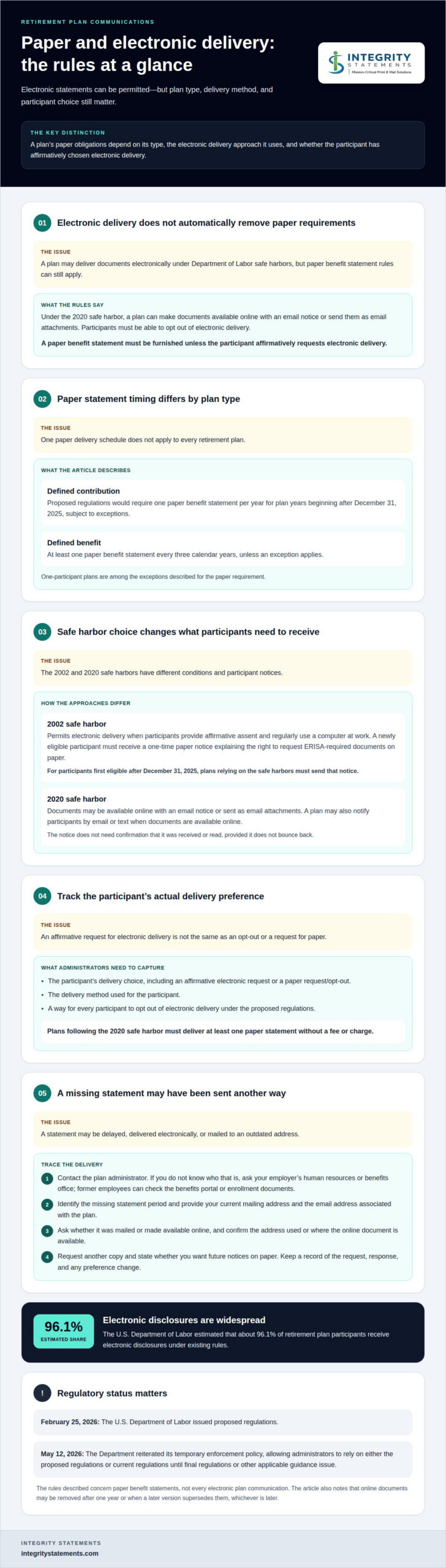
Yes. Retirement plans can deliver statements electronically under U.S. Department of Labor safe harbors, but paper rules still matter. The SECURE 2.0 Act of 2022 amended ERISA’s disclosure provisions through Section 338, according to U.S. Congress. Whether paper is required depends on the plan type, the delivery method, and the participant’s election.
The 2002 safe harbor permits electronic delivery when participants provide affirmative assent and regularly use a computer at work. A newly eligible participant must receive a one-time paper notice explaining the right to request ERISA-required documents on paper. For participants first eligible after December 31, 2025, plans relying on the safe harbors must send that notice. This notice helps participants understand how to choose paper delivery.
The 2020 safe harbor gives plans another electronic option: make documents available online with an email notice, or send them as email attachments. Plans using this approach must let participants opt out of electronic delivery. Under this safe harbor, a paper benefit statement must be furnished unless the participant affirmatively requests electronic delivery. A plan may notify participants by email or text when documents are available online. The message does not need confirmation that it was received or read, provided it does not bounce back.
The paper statement requirements differ by plan type. Defined contribution plans would provide one paper benefit statement per year, while defined benefit plans provide at least one every three calendar years, unless an exception applies. The proposed defined contribution rule applies for plan years beginning after December 31, 2025, subject to exceptions. One-participant plans are among the exceptions described for the paper requirement.
The U.S. Department of Labor issued proposed regulations on February 25, 2026. Its temporary enforcement policy, reiterated May 12, 2026, allows administrators to rely on either the proposed regulations or current regulations until final regulations or other applicable guidance issue. These rules concern paper benefit statements, not every electronic plan communication.
For preference tracking, administrators need to distinguish an affirmative request for electronic delivery from an opt-out or paper request. Plan records should reflect each participant’s choice and the delivery method used. This distinction is central to retirement plan statement mailing in Texas, where electronic delivery does not remove every paper obligation.
Under the U.S. Department of Labor’s proposed regulations, every participant must have a way to opt out of electronic delivery. Plans following the 2020 safe harbor must deliver at least one paper statement without a fee or charge. Online documents may be removed after one year or when a later version supersedes them, whichever is later. The U.S. Department of Labor estimated that about 96.1% of retirement plan participants receive electronic disclosures under existing rules.
The Pension Rights Center recommends that retirement plan participants keep receiving paper copies of important plan documents to help preserve evidence of benefit rights.
Who should I contact if my retirement plan statement was not delivered?
Start with the retirement plan administrator, who manages plan communications. If you don’t know who that is, contact your employer’s human resources or benefits office for the administrator’s details. Former employees can look in the plan’s benefits portal or enrollment documents for the same contact. A statement may be delayed, delivered electronically, or mailed to an outdated address, so identify the delivery route before assuming it was never issued.
When you reach the administrator, describe the missing statement and ask for its status. Provide the statement period, your current mailing address, and the email address associated with the plan. Ask whether the statement was mailed or made available online. If it was mailed, ask which address the plan used. If it was sent electronically, ask where the document is available and how the plan notified you.
- Confirm which statement period is missing and whether a newer statement is available.
- Ask the plan administrator to confirm the delivery method and destination on record.
- Request another copy and state whether you want future notices on paper.
- Keep a record of your request, response, and any delivery preference change.
If the plan has announced that paper notices will stop, contact the plan to request that they continue. Plan administrators must provide paper benefit statements upon request. Make the request directly to the administrator and specify that you want a paper statement. If you have already chosen electronic delivery, ask how to change your preference and whether the missing statement can also be mailed.
Your employer’s benefits office can help identify the right plan contact, but the plan administrator handles statement requests. Be specific: name the missing statement, its reporting period, and your preferred delivery method. If you submit your request through a portal, save the confirmation. If you call, note the date and the representative’s instructions. These details make follow-up easier if the statement still doesn’t arrive.
For retirement plan statement mailing in Texas, start by tracing the statement through the plan administrator. Request a paper copy if that is your preference, and confirm that the plan has recorded your current delivery choice. A delivery problem is different from a benefit dispute. If the statement arrives but its figures or benefit information seem incorrect, ask the administrator that separate question and request an explanation.
What information is included in a retirement plan statement?
A retirement plan statement summarizes a participant’s benefits or account information for a stated reporting period. Its contents vary by plan type. A defined contribution statement may organize information around an individual account, while a defined benefit statement may describe a pension benefit. The plan’s terms and statement format determine the details presented.
For a defined contribution account, review the balance and activity for the period. The statement may show contributions, investment allocations, and changes in account value. For example, compare the beginning and ending balances and check whether contributions appear for the period shown. Participant-directed defined contribution plans provide quarterly statements to participants and beneficiaries.
Investment details can explain how an account is allocated. A statement may group holdings by investment option and show each option’s share of the account. This helps participants understand the account’s composition, rather than seeing only a total balance. Pay attention to the reporting period: a balance is a snapshot, while transactions show activity over time.
A defined benefit statement focuses on the plan’s pension benefit, not an individual investment account. It may describe the benefit earned under the plan and the terms used to explain it. Review the assumptions and benefit timing alongside the plan’s explanations. A projected amount and an amount currently payable may represent different concepts, so check the labels and dates.
- Reporting period: Identify the dates covered before comparing statements.
- Account or benefit summary: Note the balance or pension information shown.
- Activity: Review listed contributions, transactions, or benefit changes.
- Investment allocation: For an account-based plan, see how holdings are grouped.
- Plan contact details: Use the statement’s instructions when asking about an entry.
Compare statements from consecutive periods using the same labels and dates. If an account balance changed, review the listed contributions and investment information before drawing conclusions. If a pension figure looks different, note the benefit description and reporting date. These checks help you frame a focused question for the plan administrator without assuming all plans use identical terms.
Accurate statement production depends on presenting the plan’s data clearly and consistently across each participant’s document. For organizations coordinating retirement plan statement mailing in Texas, professional statement printing and mailing can support the preparation and distribution of these communications.
When a defined benefit plan terminates, its submission includes an actuary’s certification of the adjusted funding target percentage for the last 2 years, including the year of termination, and Form 6088, Distributable Benefits from Employee Pension Benefit Plans. A Form 5310 determination letter application must include Form 8717 and the appropriate user fee, a completed Procedural Requirements Checklist from Form 5310, and copies of the plan document and all amendments adopted since the last favorable determination letter.
If a qualified retirement plan has not distributed its assets, it is considered an ongoing plan and must continue to meet qualification requirements, including amending its plan document for changes in law.
Integrity Statements: Statement Printing and Mailing
Integrity Statements provides statement printing and mailing for organizations distributing retirement plan communications. When paper statements are required or participants prefer mailed copies, this service supports the print-and-mail process. Plan administrators remain responsible for plan information and delivery preferences.
Organizations can provide approved statement files and recipient data for printing and mailing. Clear source information and accurate mailing details help ensure each statement is matched to the intended participant and address. This is a practical option when internal teams need support distributing recurring, business-critical statements.
To discuss statement printing and mailing for retirement plan communications, contact Integrity Statements.
Make Reliable Delivery Part of the Plan
Participant communication works best when delivery choices are treated as an ongoing part of plan administration, not a one-time decision. As enrollment, addresses, and preferences change, clear processes help keep statement distribution aligned with participants’ needs. For organizations managing retirement plan statement mailing in Texas, dependable production and delivery can support this broader communication process.
Integrity Statements provides statement printing and mailing, invoice and billing printing and mailing, and healthcare communications printing and mailing. These services help organizations distribute essential documents to their audiences. Contact Integrity Statements to discuss whether statement mailing fits your communication needs.
Contact Integrity Statements today to discuss statement printing and mailing. A clear next step can help your team move forward with confidence.
Frequently Asked Questions
How often must retirement plan statements be mailed to participants?
Mailing frequency depends on the plan type and delivery rules; statement frequency and paper delivery are not identical. Participant-directed defined contribution plans provide quarterly statements, while proposed rules would require one paper statement per year for defined contribution plans, subject to exceptions. Defined benefit plans generally provide a paper benefit statement every three calendar years under SECURE 2.0, unless an exception applies. A participant’s electronic-delivery election also affects paper delivery.
What federal laws govern mailing retirement plan statements in Texas?
Federal ERISA disclosure rules and the U.S. Department of Labor’s electronic-delivery safe harbors govern retirement plan statements in Texas. The SECURE 2.0 Act of 2022 amended ERISA’s disclosure provisions through Section 338, according to U.S. Congress. The DOL established electronic disclosure safe harbors in 2002 and 2020. These frameworks address how plans furnish required documents, including when electronic delivery is used and when paper statements remain relevant.


