

A Smoother Print Mail Vendor Switch Starts with Clear Expectations
A vendor switch is won before the first file moves. To switch print mail vendors smoothly, assess a prospective partner’s experience, capacity, reporting, and fit for your communications. Then align internal stakeholders on responsibilities, requirements, and timing before production begins. Treat the transition as a managed handoff, with schedules and approval points made explicit.
Changing vendors can feel complicated because production, data, approvals, and delivery all need to stay coordinated. A clear plan helps protect continuity and gives each team a shared view of what must happen, and when. This guide explains how to assess a print mail partner, coordinate the people involved, and set practical expectations for production and mailing. You’ll also learn how to prepare for the handoff so the work can move forward with fewer surprises and greater confidence.
Key Takeaways
- Compare print mail partners by relevant experience, capacity to handle changing volumes, and the clarity of their reporting.
- Map production steps against mailing and delivery needs so recurring communications and campaign mail have workable schedules.
- Give every stakeholder a clear role, and keep the right people included as decisions, approvals, and handoff details progress.
- State the reason for the switch, the expected outcomes, and the timeline in writing to give everyone a shared plan.
1. Evaluating printing partners for experience, scalability, and reporting
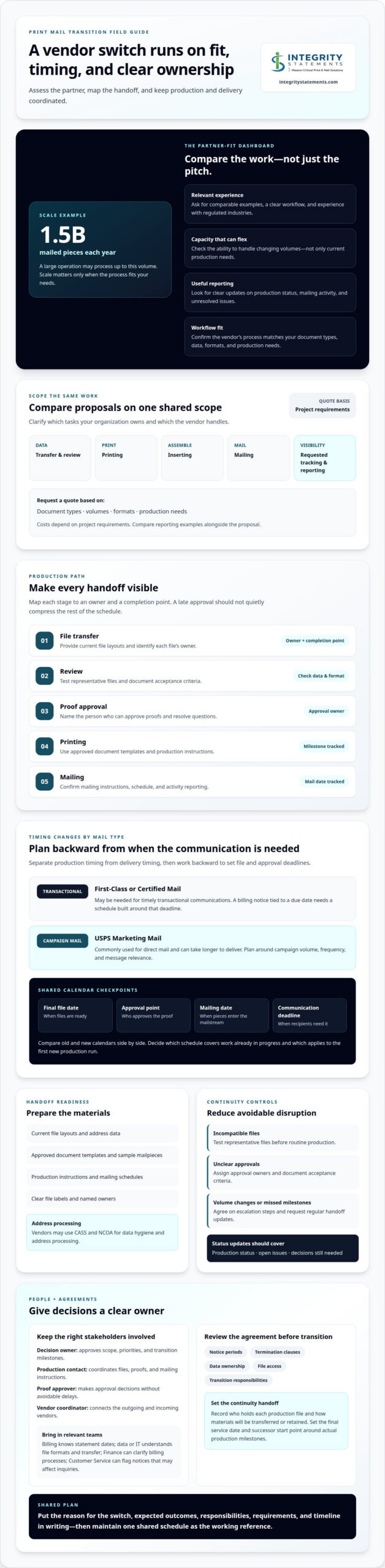
Begin by matching each vendor’s experience to the communications you send. For statements, invoices, or regulated notices, ask for examples of comparable work and a clear production workflow. Look for a proven track record, experience with regulated industries, long-term client relationships, and capacity to handle changing volumes. A large operation may process up to 1.5 billion mailed pieces each year, but scale matters only if its process fits your needs.
Compare proposals against the same scope: data transfer and review, printing, inserting, mailing, and any requested tracking or reporting. Clarify which tasks your organization owns and which the vendor handles. Costs depend on the project requirements, so request a quote based on your document types, volumes, formats, and production needs. Compare reporting examples as well: useful updates should make production status, mailing activity, and unresolved issues easy to understand.
For USPS Marketing Mail, eligibility depends on USPS rules for postage, mailpiece design, and minimum quantity requirements. Address processing also matters: print and mail vendors may use CASS and NCOA for data hygiene and address processing. Before transition work begins, gather current file layouts, address data, approved document templates, sample mailpieces, production instructions, and mailing schedules. Label each file clearly and identify its owner.
Common disruptions include incompatible files, unclear approvals, unexpected volume changes, and missed production milestones. Reduce these risks by testing representative files, documenting acceptance criteria, assigning approval owners, and agreeing on escalation steps. Request regular status updates during the handoff that cover open issues and decisions. A test run can reveal formatting or data problems before routine production depends on the new workflow.
Review the existing agreement for notice periods, termination clauses, data ownership, file access, and responsibilities during the transition. Record which party holds each production file and how materials will be transferred or retained. Set a final service date and a successor start point around actual production milestones, not assumptions. This gives both vendors and internal teams a shared continuity plan while the new partner demonstrates its process.
Choose a partner with decades of experience, and ask whether analytics and campaign reporting can help evaluate response rates and return on investment. A direct mail vendor may also handle data processing and guide clients through postal regulations and bulk-mail discounts.
2. Production schedules and delivery timing
Start with a calendar of every mailing, then work backward from when recipients need each communication. Monthly statements follow a recurring schedule, while direct mail campaigns can vary in volume and frequency. Map each production stage, including file transfer, review, proof approval, printing, and mailing. Assign an owner and completion point to each stage so a late approval does not quietly compress the rest of the schedule.
Separate production timing from delivery timing. Transactional communications may need timely USPS First-Class or Certified Mail services, while direct mail commonly uses USPS Marketing Mail, which can take longer to deliver. That difference affects when a file must be ready and when a piece should enter the mailstream. A billing notice tied to a due date needs a different schedule from a campaign planned around a seasonal message.
During the vendor change, compare the old and new production calendars side by side. Mark the final file date, approval point, mailing date, and any deadline tied to the communication. Decide which schedule applies to work already in progress and which applies to the first production run under the new arrangement. This helps prevent duplicate processing or a gap between vendors.
Plan around the audience, too. A seasonal campaign should arrive while its message remains relevant; a recurring statement should fit the organization’s billing cycle. Work backward from the intended arrival date, allowing time for review and corrections before mailing. Confirm who can approve a proof and who communicates schedule changes, so decisions do not wait in an unattended inbox.
Keep one shared schedule as the working reference. Update it when an approval, file, or production milestone changes, and notify the people responsible for the next step. If your team is coordinating recurring statements or campaign mail, a coordinated print and mail workflow can help connect production planning with the communication’s intended timing.
Coordinate production and mailing schedules so materials arrive when the audience is most receptive. Make arrival timing part of the plan, not a final checkpoint. Transactional communications are often sent on a regular schedule, such as monthly statements, while direct mail is usually campaign-based with varying volume and frequency.
3. Copying all relevant stakeholders
A vendor transition can stall when an approval or decision sits with one person. Create a stakeholder list before the first handoff and give each person a defined role. For example, name the owner for production instructions, the approver for proofs, and the contact coordinating the outgoing and incoming vendors. This makes actions visible and gives questions a clear destination.
Include people who control different parts of the workflow. A billing manager may know statement dates, while a data or IT lead understands file formats and transfer steps. Finance can clarify billing processes, and customer service can flag notices that may affect customer inquiries. Involve the people needed for each decision so important updates stay useful rather than becoming background noise.
- Decision owner: approves scope, priorities, and transition milestones.
- Production contact: coordinates files, proofs, and mailing instructions.
- Data contact: manages source files and transfer questions.
- Business stakeholder: identifies timing or content needs for statements, invoices, or notices.
Use a shared email thread for decisions that affect several teams. Include relevant stakeholders when confirming a file handoff, approving a proof, or changing a mailing date. Keep the subject line specific, such as “April statement proof approval,” and state the required action near the top.
Separate updates from decisions. A status note can summarize completed work, open questions, and the next owner; a decision request should name the approver and the response needed. Record the final decision in the thread or a shared transition log. If a proof needs revision, capture the change, owner, and effect on the next production milestone.
Keep the distribution list current as responsibilities shift. Remove people who no longer need operational updates, and add new owners before their tasks begin. A brief handoff message can identify the incoming contact, their responsibilities, and when they take over. This prevents important approvals or production questions from reaching an inactive inbox.
4. Stating the purpose, expectations, and timeline clearly
Open the transition brief with the reason for changing vendors. Name the problem to solve, such as improving schedule visibility or accommodating a different mix of communications. Then define what must remain consistent, including document content, mailing frequency, and approval requirements. A specific purpose helps teams make decisions against shared priorities.
Describe the expected result in observable terms. For example, state that each monthly statement run needs an approved proof, a named approver, and a scheduled mailing date. Clarify what the new vendor will handle and what your organization will provide. Include file formats, version control, and who can authorize changes. These details turn broad expectations into steps teams can track.
How long does a print and mail vendor transition typically take? There is no single schedule for every transition. The timing depends on the work involved, file readiness, approval timing, production requirements, and how the handoff aligns with existing mailing cycles. Map those dependencies first, then set dates around the actual handoffs.
- Purpose: State why the change is happening and what it should improve.
- Scope: Identify communications, files, and responsibilities included.
- Milestones: Set dates for file delivery, review, approval, and first production.
- Escalation: Name the person who resolves a missed handoff or open decision.
Record assumptions alongside the timeline. If proof approval must happen before printing, show that dependency instead of listing unrelated dates. Set a review point after the first production run to capture issues and assign follow-up actions. Share the same brief with internal teams and vendors, then update it when an approved change affects a milestone.
Clear expectations make the transition plan easier to act on. Plan your print and mail transition around defined responsibilities, production needs, and timing.
Integrity Statements: Custom Print & Mail
Integrity Statements provides Custom Print & Mail for organizations planning a vendor transition or coordinating ongoing print and mail communications. It’s a natural fit when you need a tailored approach and clearly defined production requirements and expectations.
Bring your communication goals, file requirements, approval process, and timing priorities into the conversation. These details help define the work and how Custom Print & Mail can support your print and mailing needs.
Contact Integrity Statements to discuss your print and mail needs.
Make the next transition a deliberate one
A vendor change is also an opportunity to build a more dependable working relationship. Use the transition to clarify what your organization needs from print and mail communications and how the process should support those needs over time. A practical plan for how to switch print mail vendors smoothly should prepare teams to manage future changes, not just complete the immediate handoff.
As you move forward, keep continuity in focus for the people who rely on each mailing. Clear ownership and agreed expectations help teams make decisions confidently as workflows evolve. Integrity Statements provides Statement Printing and Mailing, Invoice and Billing Printing and Mailing, and Healthcare Communications Printing and Mailing.
If you’re ready to discuss your organization’s print and mail needs, contact Integrity Statements today. Take the next step with a clear plan and a steady path forward.
Frequently Asked Questions
What should you look for when choosing a print and mail vendor?
Choose a vendor whose process fits your document types, data needs, and exception-handling requirements. Consider how the vendor handles a corrected file, a content change, or a rejected record; these situations reveal whether responsibilities are clear. Review a sample status report to see how it distinguishes completed work from unresolved issues. For a Texas organization, account for mailing destinations and audience needs when evaluating operational fit.
What are the steps for transitioning print and mail services to a new vendor?
Move in controlled stages: document the current workflow, align file formats, test a representative batch, and review results before routine production begins. Set a final production point with the current vendor and a clear start point for the new one, so every mailing has an owner. Keep an issue log for mismatched records or proof corrections, noting who approves each fix. Include delivery expectations for Texas mailings, then review the first completed run and make any needed adjustments.


