High-volume letter printing and mailing turnaround times
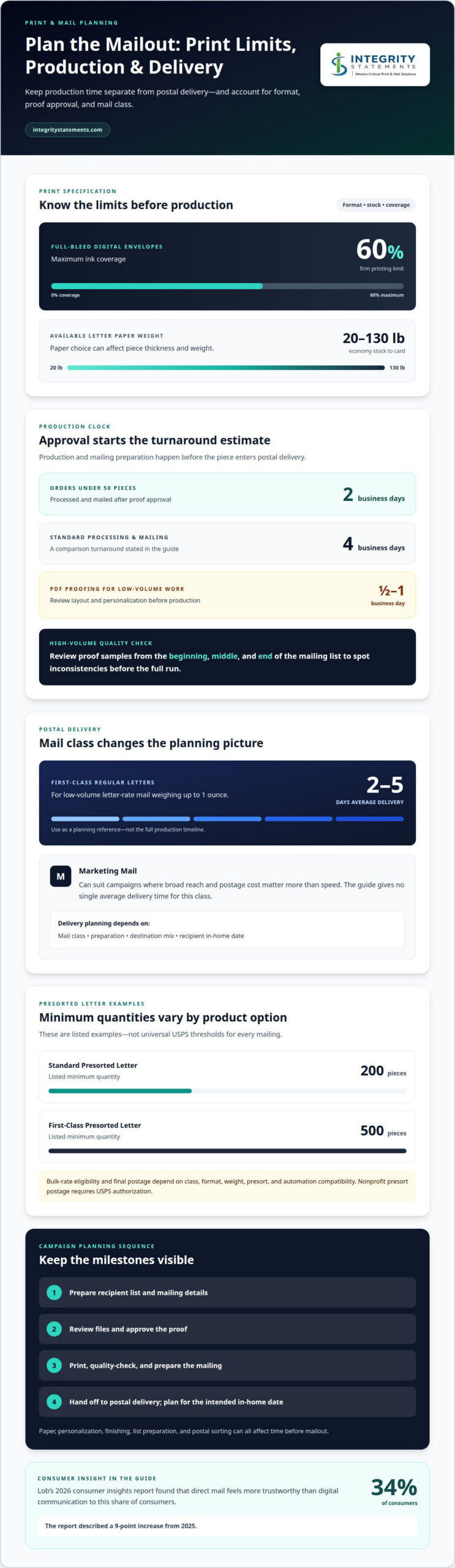
Full-bleed envelopes have a firm printing limit: digitally printed full-bleed envelopes allow a maximum of 60% ink coverage. For high-volume letter printing and mailing, that’s one detail to account for alongside the mail format, personalization, and time needed to produce and dispatch the campaign.
A large mailing needs a predictable schedule, but production time and postal delivery time are separate. Print specifications and the level of personalization also affect how the mailing is prepared.
This guide covers print limitations, letter and envelope personalization, and factors that shape production turnaround. It also explains how First-Class and Marketing Mail fit into planning, helping you set a realistic schedule for your mailing.
Key Takeaways
- For low-volume regular letter-rate mail up to 1 ounce, allow an average of 2-5 days for First-Class delivery when planning the mailing schedule.
- Build proof approval into the timeline: standard processing and mailing is four business days, while orders under 50 pieces are processed and mailed within two business days after approval.
- Match the format to the message: available choices include 16 paper stocks, several envelope sizes, and black-only or color printing on one or both sides.
- For a high-volume run, reviewing proof samples from the beginning, middle, and end of the list can help catch inconsistencies before mailing.
First Class and Marketing Mail delivery times
First-Class Mail and Marketing Mail serve different campaign priorities. For low-volume regular letters, First-Class letter-rate postage covers mail up to 1 ounce, with average delivery in 2-5 days. Treat that as a planning reference, not the full production timeline: printing, addressing, approval, and mailing happen before postal delivery.
Marketing Mail can suit campaigns where broad reach and postage costs matter more than speed. Presorted, automation-compatible mail may qualify for reduced rates under USPS Marketing Mail and First-Class Mail. Bulk rates can therefore be lower than standard First-Class rates when eligibility and preparation requirements are met. The mailing class, format, weight, presort, and automation compatibility affect the final postage.
Marketing Mail delivery time has no single average stated here. Plan around the mail class, preparation, destination mix, and the date recipients need the piece. A postcard promoting a seasonal offer, for example, needs enough lead time to arrive before the promotion ends. Postcards and letters may require different preparation, so align the format with the delivery goal.
Lob’s 2026 consumer insights report found that 34% of consumers said direct mail feels more trustworthy than digital communication, a nine-point increase from 2025. That finding can inform campaign planning, but it doesn’t replace audience, message, or timing decisions.
For HIPAA-sensitive mail, protect healthcare data throughout production. A secure workflow should limit access to the mailing list and connect data handling, personalization, proofing, and dispatch. When comparing print-and-mail vendors, review sample quality, data safeguards, and a quote that reflects volume, format, postage class, and personalization. Confirm how each production stage is coordinated, from approved files through mailing, so responsibilities and timing are clear.
For high-volume direct mail, schedule list preparation, proof approval, printing, and postal handoff around the intended in-home date. Prepare the mailing list with consistent recipient fields, including names and complete mailing addresses, to support accurate addressing and sorting. Keep milestones visible to everyone involved in the campaign.
Are there any printing limitations that should be noted when selecting this product?
Printing limitations depend on format, paper, piece thickness, and mailing class. Review quantity, sheet count, and postcard specifications together before setting the production schedule.
Letter Quantities and Sheet Counts
A letter run’s quantity determines how many pieces enter production, while sheet count affects each piece’s thickness and weight. The available letter format can use paper from 20 lb economy stock up to 130 lb card. A multi-sheet correspondence package may therefore need different handling from a single-sheet letter. Align the approved file, paper choice, and finished piece before upload, so the production plan reflects the actual mailer.
Mailing Capacity and Minimums
Minimum quantities vary by mailing product and class; they are not a single USPS threshold for every mailing. Listed examples include a 200-piece minimum for Standard Presorted Letter mail and a 500-piece minimum for First-Class Presorted Letter mail. These figures describe those specific product options, not universal requirements. A smaller sending quantity may call for a different postage route than a presorted bulk run.
Postcard size and coating also affect production choices. Choose a format that suits the message, leaves a usable address area, and meets the requirements of the intended mail class. A template can help keep artwork and mailing information consistent across a campaign.
Bulk Mail Requirements
USPS presort and automation-compatible formats may qualify for reduced rates under USPS Marketing Mail and First-Class Mail. Nonprofit presort postage requires USPS authorization. Bulk mailing requirements depend on class, preparation, format, and eligibility, not quantity alone. Account for these conditions in the approved setup before applying postage.
To compare nearby options, assess which print-and-mail services handle your format, quantity, and postal preparation needs. For a clear comparison, consider sample quality, data safeguards, and how each quote accounts for paper, personalization, and postage. A print-and-mail service overview can help clarify how these production choices fit a campaign.
Production capacity and turnaround time
Production timing starts with approved files and ends when the mail enters postal delivery. For a reliable schedule, plan separately for proof approval, printing, mailing preparation, and mailout.
High-Volume Production Workflow
A coordinated workflow moves from file review to proofing, production, quality checks, and mailing preparation. For a large run, review proof samples from the beginning, middle, and end of the mailing list to spot inconsistencies across personalized pieces. Resolve issues before the full run proceeds. Clear approval points also keep the schedule aligned with the intended send date.
PDF proofing gives you a chance to review layout and personalization before production begins. Proofing for low-volume work typically takes between half and a full business day. Once the proof is approved, set the production schedule according to volume, format, and mailing requirements. If an error appears, pause the affected stage, identify the cause, and correct the file or setup before continuing.
Capacity and Mailout Speed
Turnaround depends on more than the number of pieces. Paper choice, personalization, finishing, list preparation, and postal sorting all shape the time needed before mailout. A standard processing and mailing turnaround used for comparison is four business days. Orders under 50 pieces are processed and mailed within two business days after proof approval.
Production timelines are separate from postal delivery. High-volume work may require additional coordination to ensure consistent handling from proof review through dispatch. Choose a target mailout date, then plan backward from approval and production milestones. For example, prepare a time-sensitive customer notice’s mailing list and approved content early enough for production and postal preparation.
At each stage, track the approved version, piece count, and corrections. This creates a clear record if the proof and finished mailer do not match. A defined correction step helps contain errors before affected pieces move to mailing, while keeping the rest of production organized.
What services do high-volume letter printing and mailing companies offer?
A complete mail campaign can combine printing, personalization, envelope selection, and postal preparation. These choices shape how each piece looks and reaches recipients. A billing letter, for example, may need a window envelope, while an announcement may suit a plain envelope.
Print options can support different messages without changing the campaign’s core workflow. The available letter mailing product includes 16 paper stocks, four envelope formats, and black-only or color printing. Print can appear on the front or both sides of a letter, depending on the design and information required.
- Envelope formats: #10, A1, A9, and A10 options support different piece sizes and uses.
- Printing: Black-only or color printing can appear on the front or both sides of the letter.
- Addressing: Window envelopes display the address on the letter, while plain envelopes offer a more personal presentation.
- Postage: A First-Class stamp can be added to each mailed piece.
Personalization connects each letter to its recipient, for example, by placing an individual address in a window envelope. For a high-volume run, proof samples from the beginning, middle, and end of the mailing list help assess consistency across personalized pieces. Coordinate the design, envelope, and message to keep the mailing cohesive.
Service scope may also include preparing files for production, printing the approved content, inserting letters, addressing envelopes, and arranging mailout. A campaign with a folded announcement might use an A9 or A10 envelope; those formats can hold a folded announcement or flat card. The finished piece’s format and postage class should guide preparation.
Choose options around the communication’s purpose: statements and notices need clarity, while an announcement may call for a more personal envelope. Plan your print-and-mail campaign around the format, personalization, and postal handling your audience needs.
Integrity Statements: Custom Print & Mail
Integrity Statements provides Custom Print & Mail for organizations managing recurring or specialized letter campaigns. It can coordinate professional printing and mailing around the needs of your communication.
For routine financial correspondence, Statement Printing and Mailing and Invoice and Billing Printing and Mailing support essential customer communications. Healthcare Communications Printing and Mailing serves healthcare-related mail needs. The right service depends on the documents and the purpose of the mailing.
To start planning, share the document type, intended recipients, mailing quantity, and schedule. These details help establish the project scope and production requirements.
Contact Integrity Statements to discuss your print-and-mail needs.
Set Your Next Mailing in Motion
A dependable campaign starts with a clear purpose: what recipients need to understand and what action the communication supports. Let that purpose guide the message, audience, and production priorities. For recurring correspondence, a consistent process can keep future campaigns aligned as documents and recipient needs change. Bringing these priorities together early gives production planning a practical starting point.
Integrity Statements supports business-critical communications with Statement Printing and Mailing, Invoice and Billing Printing and Mailing, and Healthcare Communications Printing and Mailing. These services help organizations coordinate essential documents with their mailing needs. If you’re planning high-volume letter printing and mailing, share the communication type and campaign goals to start a focused discussion.
Contact Integrity Statements to discuss your mailing needs and the right next step. A well-planned communication can help your organization send important information with greater clarity and confidence.
Frequently Asked Questions
Can I see or approve a proof before anything mails?
Yes. The production process includes file review and proof approval before mailing proceeds. The team reviews data, formatting, and document details so you can check the approved version before production. For example, a statement campaign can review personalized fields and layout together, giving the production team a clear version to use for the run.
Can businesses automate recurring or high-volume mailings?
Recurring campaigns can use variable data printing to personalize documents. Files can be transferred through a portal, SFTP, API, or another approved method. This supports repeatable statement or invoice production without requiring your organization to print and mail each batch internally. Prepare the campaign files and production requirements for each run.
How Does This Process Keep Every Piece Accurate at Volume?
File review, data validation, and production quality controls support accuracy. Variable data printing places recipient-specific information in each document, while the team checks formatting and details before printing, inserting, and mailing. For a Texas organization sending customer notices, this structured review helps identify file or layout issues before they affect a larger mailing.
How Does a Team Get Started With This Kind of Production Run?
Start by defining the document type, recipient data, and mailing goals. Transfer files through a portal, SFTP, API, or another approved method. The team then reviews and validates the files before production. For example, a financial services team preparing statements can provide its campaign files and requirements for review before printing, insertion, and mailing begin.
How Much Volume Can This Kind of Production System Actually Handle?
Practical capacity depends on the document type, data requirements, personalization, and mailing preparation. A uniform batch of letters differs from a campaign with multiple versions or recipient-specific content. Share the expected piece count and production details to scope the workflow. Integrity Statements uses production equipment to print, insert, and mail business communications.
How do I track my letters after they are mailed?
Tracking and reporting are available on request as part of the mailing process. They can help an organization review campaign-level information after postal entry. For example, a team sending recurring customer communications can request reporting for its internal records. Include reporting needs in the mailing plan, especially when several departments rely on the same campaign information.