
Dental Practice Statement Mailing in Houston: Postage Costs
The mailer format is one of the main factors that affects postage for dental practice statement mailing in Houston. Postcards, brochures, and letters can have different mailing costs because size, weight, and mailing method affect how each piece is handled. Compare the finished mailpiece, not just the number of patients receiving it.
It’s reasonable to focus on postage when planning patient communications, but format also affects how much information fits and how the message is presented. This guide explains how mailer type and physical specifications influence postage, without relying on a one-size-fits-all estimate.
Learn what to compare across postcards, brochures, and letters, how to prepare a mailing for a useful cost estimate, and how statement printing and mailing can support a consistent process from document preparation through delivery.
Key Takeaways
- Postage depends on the finished mail piece and mailing choices, so assess the complete format before estimating a campaign budget.
- Compare postcards, brochures, and letters by how much information they need to carry and how their physical design affects mailing.
- Consider USPS mailing options alongside delivery timing to choose an approach that suits the purpose of each patient communication.
- Statement printing and mailing can help dental practices manage document preparation and distribution as a coordinated process.
Dental direct mail postage costs
Postage depends on the finished mailpiece and mailing method, not simply the number of patients on a list. For a Houston dental practice, a statement folded into an envelope differs from a flat promotional piece in size, weight, and preparation. Those details determine which mailing options fit and how costs are calculated.
Start with the complete item. Include the statement, any insert, the envelope, and the address panel in your sample. Page count alone won’t show the final weight or dimensions. Adding a payment slip or another sheet, for example, can change the assembled piece. Measure and weigh the sealed or folded mailer before comparing postage estimates.
Next, identify the mailing purpose. Patient statements are account communications, while a postcard announcing a practice service is promotional mail. The message and format affect which mailing methods are suitable. Keep those purposes separate when planning a budget, so a campaign estimate doesn’t stand in for recurring billing mail.
Use this sequence to prepare a useful estimate:
- Finalize the format. Choose the envelope, paper, folds, and inserts before assessing postage.
- Confirm the destination list. Count the intended recipients and review how addresses are organized.
- Compare mailing methods. Consider the available postal class and preparation requirements for the finished piece.
- Recalculate after edits. A revised insert or envelope can change weight, size, and handling.
Quantity affects the total mailing budget because each piece requires postage. The per-piece calculation also depends on format and mailing preparation. A practice sending statements to patients across Houston should organize recipient addresses before estimating the full batch. This makes the planned quantity and delivery list part of the same calculation.
Address quality also matters. An outdated or incomplete address can prevent a statement from reaching its intended recipient, wasting the postage assigned to that piece. Review patient address records before creating the mailing file, and resolve formatting inconsistencies before printing. This preparation helps the practice estimate costs for mail that is ready to enter the postal stream.
For a useful comparison, request estimates based on the actual assembled sample, recipient count, destination list, and intended mailing method. Compare options using the same specifications. An estimate based on a different envelope or insert isn’t an equivalent cost comparison. Recording these inputs gives the practice a repeatable basis for budgeting future statement mailings.
Postcards, brochures, letters, and other mailers
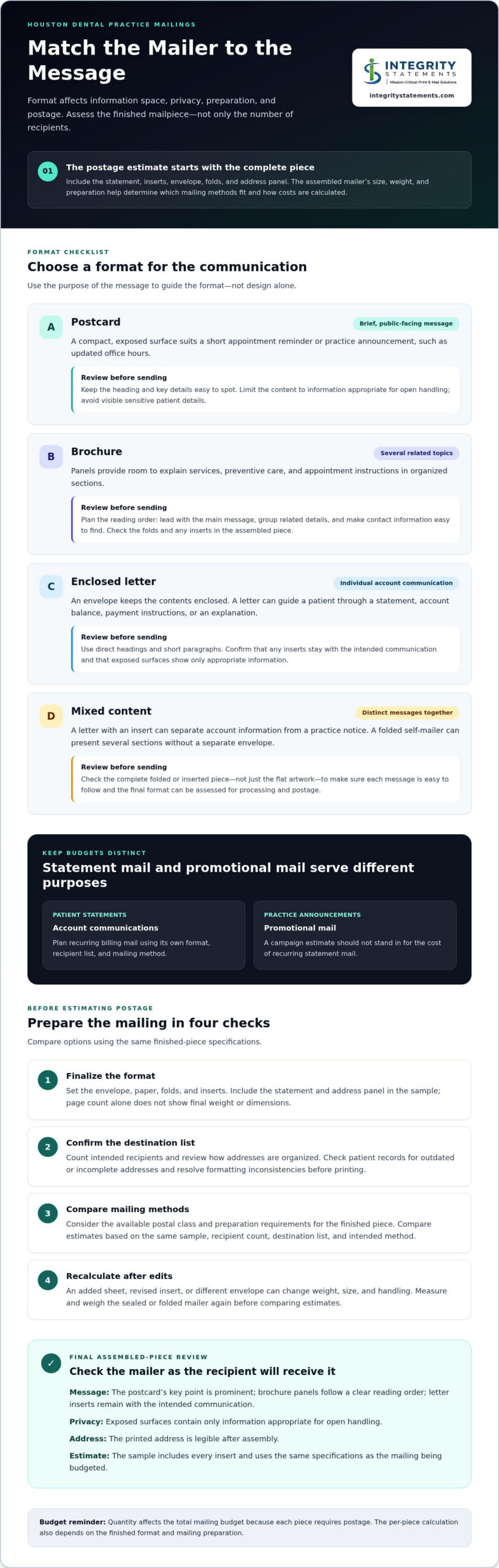
Choose a mailer by matching its format to the message, not by design alone. A postcard can present a brief appointment reminder or practice announcement. A brochure can explain several services, while a letter can carry an individual statement or detailed account information. Each format offers a different balance of space, privacy, and presentation for a Houston dental practice.
Postcards put the message on an exposed, compact surface. They suit short notices with a clear heading, concise details, and a simple next step. For example, a practice announcing updated office hours can make the key information easy to spot. Keep the content focused, and avoid placing sensitive patient details where they’re visible during delivery.
Brochures provide more room for organized information. A practice could use panels to explain preventive care, introduce services, and share appointment instructions. Plan the reading order before designing the folds: lead with the main message, group related details, and make contact information easy to find. Extra panels and inserts affect the final assembled mailpiece.
Letters work well for personalized communications and statements that need a clear sequence. An envelope keeps the contents enclosed, and the letter can guide the reader through an account balance, payment instructions, or an explanation. Use direct headings and short paragraphs so patients can find relevant details without searching through promotional material.
Other formats can combine these functions. A letter with an insert can separate account information from a practice notice. A folded self-mailer can present several sections without a separate envelope. In either case, review the complete piece after folding or inserting it. The finished format, not the flat artwork, determines how it will be handled.
Before choosing, compare the formats against the communication’s purpose:
- Brief public-facing message: Consider a postcard with limited, non-sensitive information.
- Several related topics: Use a brochure with clear sections and a planned reading path.
- Individual account communication: Consider an enclosed letter organized around the patient’s statement.
- Mixed content: Separate distinct messages with an insert or dedicated sections.
Prepare a physical sample and review its folds, inserts, envelope, and printed address together. This helps reveal whether important content is obscured or difficult to follow. It also gives the mailing team a complete piece to assess for processing and postage before production begins.
Staff members should always maintain a complete view of the assembled piece before it is sent. Match the final review to the format: check that the postcard’s key message remains prominent, brochure panels read in sequence, and letter inserts stay with the intended communication. Keep exposed surfaces limited to information appropriate for open handling, and confirm that the address is legible after assembly. Integrity Statements states that it can manage dental practice statement mailing campaigns of 100 to 200,000 mailers in Houston. A practice can use that range as a planning reference when deciding whether to coordinate a smaller mailing or a larger campaign, while ensuring the selected format and content fit the intended audience.
What are the USPS mailing options and delivery times for Houston dental practices?
For dental practice statement mailing in Houston, choose a USPS service based on the communication’s urgency and format. A routine account statement and a time-sensitive patient notice may need different mailing approaches. The selected service, mailpiece preparation, and destination routing all influence delivery timing. Decide when patients need the information, then match the mailing method to that purpose.
USPS service choices differ in speed, handling, and eligibility. A practice sending regular statements can prioritize a predictable mailing cycle. A notice tied to an upcoming appointment may call for a faster service option. The final mailpiece matters too: an envelope, postcard, or folded piece may have different preparation requirements.
Delivery timing isn’t the same for every Houston address. The route, processing, mailing date, and chosen USPS service affect when a piece arrives. For example, a statement mailed to a local patient and one sent farther away don’t follow identical routes. Build the practice’s schedule around the selected service and destination list.
Use this sequence to choose an approach:
- Set the purpose. Decide whether the mail contains a routine statement, an appointment notice, or time-sensitive information.
- Set the required arrival window. Identify when the recipient needs the message, then select a service aligned with that timing.
- Match the format. Review whether the item is an envelope, postcard, or folded mailpiece before preparing it.
- Plan the mailing date. Work backward from the intended arrival period, allowing time for preparation and postal processing.
Houston practices can group mail by purpose and schedule. Monthly statements, for instance, can follow a consistent production and mailing cycle, while a separate patient notice can use a schedule suited to its purpose. Keeping these batches distinct helps staff apply the right service and avoid mixing routine and urgent communications.
Before releasing a batch, confirm that the address file is organized and the mailpiece is complete. Assemble a statement with its insert before selecting a service, because the finished piece determines its mailing characteristics. Keep the mailing date, chosen USPS service, and intended delivery window together in the practice’s records. These details provide a clear reference for the next billing cycle and help staff plan patient communications consistently.
Integrity Statements: Statement Printing and Mailing
Integrity Statements provides Statement Printing and Mailing for dental practices managing recurring patient account communications. It’s a practical next step when preparing statements, coordinating print production, and organizing outgoing mail have become routine operational tasks. Practices can also use Invoice and Billing Printing and Mailing for related billing documents, or Healthcare Communications Printing and Mailing for other patient communications.
Before a mailing, organize the statement content, recipient information, and selected mail format. Clear inputs help align document preparation with the practice’s communication needs. Practices handling several document types can also use Tax Forms & Regulatory Mail Printing and Mailing.
Contact Integrity Statements to discuss statement printing and mailing for your practice.
Build a More Consistent Mailing Process
A reliable dental practice statement mailing process in Houston starts with a repeatable plan. Set a clear workflow for preparing documents, organizing recipient information, and scheduling each mailing. That structure helps your team manage recurring communications with greater clarity and provides a practical foundation for improving future cycles.
Integrity Statements offers Statement Printing and Mailing, Invoice and Billing Printing and Mailing, and Healthcare Communications Printing and Mailing. These services can support practices managing patient statements alongside other business-critical communications. Consider the work involved in your next mailing cycle, then identify which tasks would benefit from a coordinated print-and-mail process.
Contact Integrity Statements to discuss mailing for your practice. A clear next step can help you move forward with confidence.


