

Insurance Policy Declaration Mailing Service: A Business Buyer’s Guide
What if the biggest risk in an insurance policy declaration mailing service isn’t postage, but a correct document sent to the wrong policyholder? Reliable fulfillment connects approved files with controlled printing, assembly, and dispatch planning. When those steps and responsibilities aren’t clear, address errors and mismatched documents can be harder to prevent.
If you’re responsible for recurring mailings, you need to know what your team owns, what the print-and-mail partner handles, and how the work is reviewed. This guide walks through the stages of declaration mailing and the practical criteria to assess, from file handling and production checks to postal options and scheduling.
You’ll also learn how to define responsibilities and plan a workable Texas process without adding unnecessary tasks for internal teams. Integrity Statements provides print-and-mail fulfillment for business-critical communications, including policy declaration mailings, through a clearly scoped workflow tailored to each project.
Key Takeaways
- An insurance policy declaration mailing service handles physical fulfillment, while the insurer remains responsible for approving policy content and recipient information.
- Map the mailing from approved data through file transfer, production, review, and dispatch so each decision has a clear owner.
- Compare services by documented scope, document handling, review steps, privacy practices, delivery options, and reporting.
- Set Texas mailing requirements around purpose, recipients, approved files, volume, schedule, and delivery preferences before production begins.
- A clearly scoped print-and-mail workflow can help manage recurring declaration mailings while keeping internal responsibilities defined.
What an Insurance Policy Declaration Mailing Service Actually Handles
A declarations page summarizes key details of an insurance policy. Mailing it is a separate operational task: the insurer approves the documents, and a print-and-mail partner manages their physical production and dispatch. Depending on the project, that work can include printing, preparing documents for insertion, addressing pieces using approved recipient records, and sending them through the selected postal process. The partner does not decide what coverage a policyholder has.
An insurance policy declaration mailing service prepares and dispatches insurer-approved policy documents; it doesn’t set policy terms or determine coverage. The insurer or administrator remains responsible for approving policy content, recipient data, and mailing specifications. The print-and-mail partner handles the fulfillment tasks defined in the project scope.
That handoff deserves care. Pairing a document with the wrong recipient or address can cause confusion and require corrective work. Privacy also matters because these communications contain personal and policy-related information. A repeatable workflow, named responsibilities, and clear review points help organizations manage recurring mailings consistently. Integrity Statements provides secure processing for business-critical communications, with a focus on accuracy and timely delivery.
What information appears on a declarations page?
Common fields include the named insured, policy number, effective dates, and details about the covered property. A page may also show coverage types, limits, deductibles, and premiums, but the information and format vary by policy and insurer. An insurance policy contains the terms that define the agreement, while the declarations page presents selected policy details. For authoritative interpretation of a specific document, consult the insurer or policy administrator.
Where mailing support begins and ends
Mailing support begins with materials the insurer has approved for production. Depending on the project scope, fulfillment may include receiving approved files, printing documents, preparing and enclosing them, applying recipient addresses, and dispatching the mailpieces. Define each handoff in advance: who approves the content, who supplies and validates recipient records, and who sets production and mailing instructions.
Those tasks are distinct from underwriting, coverage decisions, policy interpretation, and policy servicing. A mailing partner supports document fulfillment; the insurer or administrator remains the authority on policy matters. For broader context on how business documents move through outsourced fulfillment, see the statement printing and mailing services guide.
How Insurance Policy Declaration Mailings Move from File to Mailbox
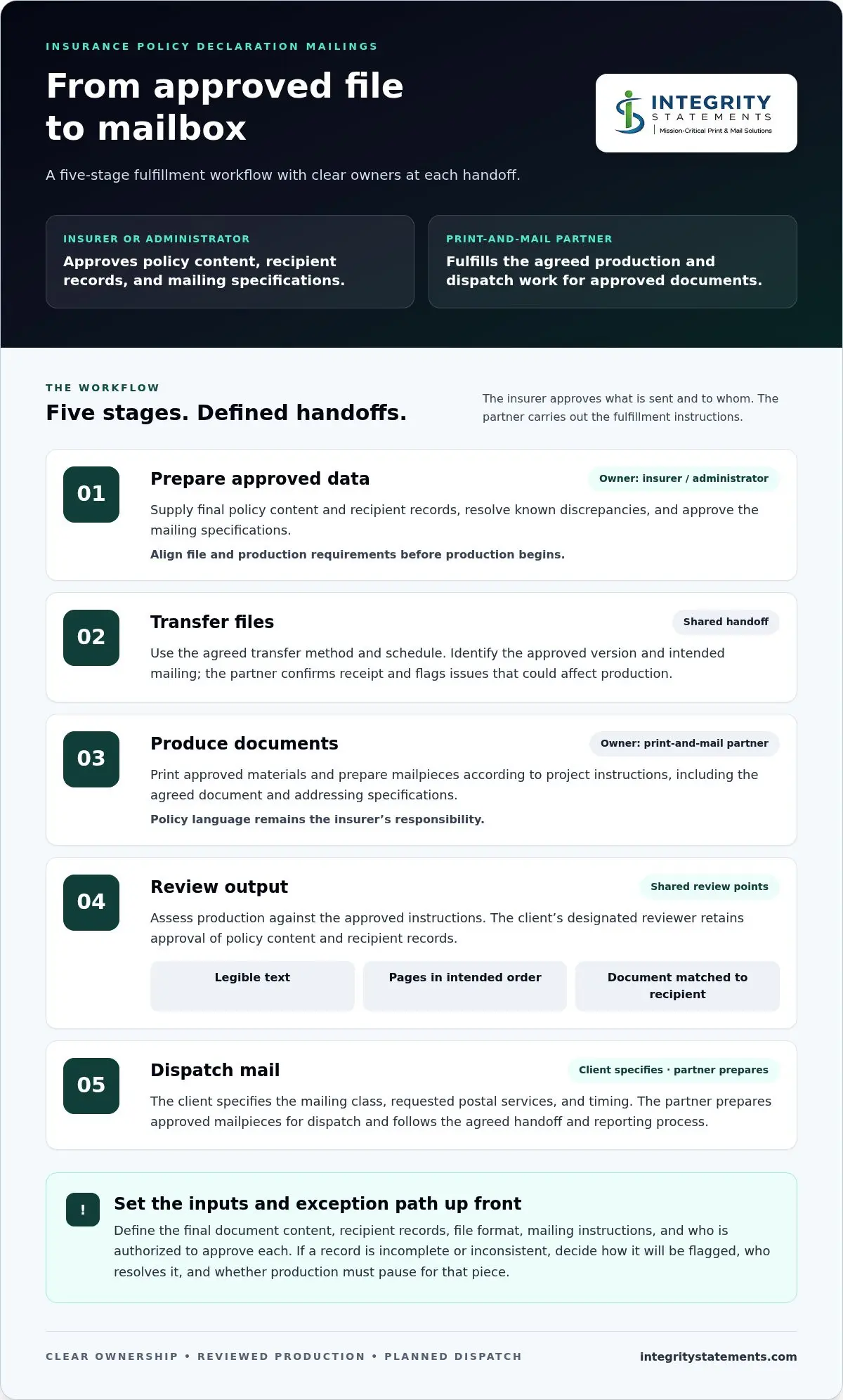
A dependable workflow makes handoffs visible. The insurer or policy administrator approves policy content and recipient records; the print-and-mail partner follows the agreed production and dispatch instructions. The insurer approves what is sent and to whom; the partner manages the defined fulfillment work that moves approved documents into the mailstream.
An insurance policy declaration mailing service can be organized into five stages, with a decision owner at each step:
- Prepare approved data. The insurer or administrator supplies final policy content and recipient records, resolves known discrepancies, and approves the mailing specifications. Before production, the partner and client align on file and production requirements.
- Transfer files. Both organizations follow an agreed method and schedule for transferring production files. The insurer or administrator identifies the approved version and intended mailing; the partner confirms receipt and flags issues that could affect production.
- Produce documents. The partner prints the approved materials and prepares the mailpieces according to project instructions. The insurer remains responsible for policy language, while the partner follows the agreed document and addressing specifications.
- Review output. The partner and client use defined review points to assess production against the approved instructions. The client’s designated reviewer retains approval of policy content and recipient records.
- Dispatch mail. The client specifies the mailing class, requested postal services, and timing. The partner prepares the approved mailpieces for dispatch and follows the agreed handoff and reporting process.
Prepare recipient data and approved policy files
Before production, define the inputs: final document content, recipient records, file format, mailing instructions, and the person authorized to approve each. Policy language should come from the responsible insurer or administrator, not the mailing partner. If a record is incomplete or inconsistent, decide how it will be flagged, who will resolve it, and whether it must be corrected before the affected piece is produced. A documented hold-and-resolution path helps limit avoidable rework.
Review production and plan postal dispatch
Focus reviews on practical checks tied to the approved job: whether text is legible, pages appear in the intended order, and each document is matched with the intended recipient. Decide how exceptions will be reported and who can authorize corrections or release the mailing. Then align dispatch with the selected mailing class, schedule, and requested postal services. For more on delivery visibility, see the secure mail tracking for business documents guide.
Clear stages make recurring work easier to coordinate without implying that any process is error-free. Organizations planning physical fulfillment can explore how Integrity Statements’ print-and-mail services can be scoped around their document workflow.
How to Compare Insurance Declaration Mailing Services
Outsourcing doesn’t mean giving up control. The insurer can retain approval authority while the partner’s responsibilities are clearly defined. Compare documented workflows and accountability, not broad claims such as “secure” or “accurate” without a clear description of the work behind them.
Use the same criteria for each service under consideration. This keeps the review focused on what happens to the documents, how decisions are made, and what information comes back to your team.
| Area | What to assess |
|---|---|
| Scope | Which tasks are included, from file receipt and printing through preparation and dispatch, and which remain with the insurer? |
| Document handling | How are approved files, page order, inserts, and recipient records addressed in the project workflow? |
| Review steps | What production checks are defined, who reviews exceptions, and who approves release? |
| Privacy practices | How does the partner describe handling sensitive information, and which responsibilities are assigned to each organization? |
| Delivery options | Which mailing classes, timing choices, or requested postal services fit the project? Separate these from core print-and-mail tasks. |
| Reporting | What dispatch or project-status information is provided, and how are exceptions or changes communicated? |
Which controls and responsibilities should buyers assess?
Trace the workflow from file transfer to dispatch. A useful project description identifies who supplies approved files, who handles production, where review occurs, and who authorizes mailing. It should also explain how incomplete files, changed instructions, or other exceptions reach the responsible decision-maker. For sensitive information, look for specific descriptions of handling practices and assigned responsibilities rather than relying on general assurances.
Record how approval decisions and file changes are communicated. The insurer or administrator should retain authority over policy content and recipient records; the partner should follow the agreed fulfillment scope. That division lets internal teams maintain oversight while delegating defined production tasks.
How to match service scope to mailing needs
Compare each proposed scope against the actual mailing: document format, recipient volume, frequency, and postal preferences. A one-time mailing may need a clearly bounded project plan; recurring volumes benefit from predictable file handoffs, review responsibilities, and scheduling expectations. Consistency helps teams plan workload while allowing for differences between mailings.
Keep optional delivery services distinct from printing, preparation, and dispatch. This makes it easier to understand what the core fulfillment work covers and which postal choices affect the plan. For adaptable project considerations, the custom print and mail solutions guide provides broader context. Integrity Statements provides business-critical print-and-mail services and can shape a project scope around defined requirements.
Plan a Texas Insurance Declaration Mailing with Clear Requirements
A clear project brief helps Texas organizations coordinate internal approvals, production, and delivery without leaving key decisions to assumption. Before planning a mailing, distinguish its business purpose from any legal or insurance obligations that may apply. Requirements can depend on the document and circumstances, so verify applicable postal rules and insurance obligations with current authoritative sources, such as the relevant postal authority or Texas regulator. This checklist is for organizing a mailing, not interpreting legal requirements.
Give each decision an owner. The insurer or administrator should approve policy content and recipient information; designate separate owners for production review and final mailing authorization where appropriate. A print-and-mail partner can then work from defined instructions while your organization retains control of policy decisions and release approvals.
Build a mailing brief before production
Capture the working details in one brief: mailing purpose, approved document version, source of recipient data, expected volume, schedule, and required postal handling. Name the approver for policy content and the reviewer for a production sample, and specify who can authorize the full run. If recipient information is incomplete, returned, or changed, record how the issue will be routed and resolved before affected pieces proceed.
- Purpose and audience: Identify why the documents are being mailed and which recipient group is in scope.
- Approved materials: Record the final content version, file format, recipient-data source, and any production instructions.
- Volume and timing: Estimate the mailing quantity and coordinate the production schedule with the internal release date.
- Review and authorization: Assign content approval, sample review, exception decisions, and final mailing approval to named roles.
- Delivery preferences: Document the preferred mailing class and any requested postal services, then verify current requirements.
This brief is especially useful for recurring mailings. It gives teams a stable starting point while allowing them to record changes to volume, recipient scope, content, or timing for each project. Clear ownership of changes can reduce confusion and avoidable rework.
Account for Texas service coordination
For Texas-based organizations, local coordination can help align internal release plans with the physical fulfillment schedule. Share key dates, review responsibilities, and mailing preferences early, then plan production around the organization’s communication schedule. Integrity Statements provides print-and-mail services for business-critical communications, with project scope shaped around the documents and workflow.
Keep the schedule practical: allow time for internal content approval, sample review, resolution of data exceptions, production, and dispatch. Do not treat a mailing calendar as proof that a legal deadline has been met; verify relevant obligations independently with authoritative sources. A clearly scoped print-and-mail project for your declaration workflow can define responsibilities from approved files through dispatch.
Partner with Integrity Statements for Policy Declaration Print and Mail
Policy declaration mailings involve more than putting pages into envelopes. They require a clear handoff between the organization that approves policy documents and the partner managing physical fulfillment. Integrity Statements provides print-and-mail fulfillment for insurance policy declarations, helping organizations plan the mailing around approved documents, recipient records, and project-specific requirements.
Integrity Statements has focused on transactional print and mail since 1994. Its secure processing approach emphasizes accuracy and timely delivery. The work is scoped to physical production and mailing tasks, while the insurer or administrator retains authority over policy language, coverage decisions, and recipient approvals. Clear boundaries help keep the workflow accountable from file handoff through dispatch.
What a project discussion can establish
A project discussion can turn broad requirements into a practical scope. Establish the document type, mailing purpose, expected volume, release timing, and contacts responsible for approval. Clarify how approved files and recipient records will be handed off, what production review is expected, and which postal preferences should guide dispatch.
The scope should distinguish client-owned decisions from outsourced tasks. The insurer or administrator approves policy content and recipient information; the print-and-mail partner follows agreed production and mailing instructions. With those roles set, the project can define:
- Who supplies and approves final content and recipient records.
- Which production review points and sample approvals are required.
- How changes or exceptions are routed to the responsible decision-maker.
- What mailing preferences and dispatch information are part of the scope.
A defined scope gives both teams a shared reference for file handoffs, reviews, and postal dispatch. It also helps internal staff plan around release dates without shifting policy authority to the fulfillment partner.
Move from evaluation to a defined workflow
Bring your mailing requirements and operational priorities into the planning conversation. For example, a recurring declaration mailing may need a consistent schedule and approval path, while a one-time project may call for a scope tailored to a specific document set and release date. The workflow should reflect the actual project, not an assumed standard process.
As a privately owned and operated transactional mail business, Integrity Statements brings experience with business-critical communications and a practical focus on precise handling. Share your project requirements to discuss a policy declaration mailing project and establish a clear path from approved files to mail dispatch.
Set the Next Mailing in Motion
Give your next declaration mailing a clear starting point: identify the upcoming release, the person responsible for approvals, and the details that need to be settled before production begins. That planning step can turn a recurring task into a defined workflow with clear ownership, timing, and handoffs.
An insurance policy declaration mailing service should fit the way your organization prepares and releases documents, while leaving policy decisions with your team. Integrity Statements supports Texas organizations with print-and-mail fulfillment for business-critical communications, including policy declaration mailings. A focused project discussion can establish a scope that reflects your documents, mailing requirements, and operational priorities.
Discuss your policy declaration mailing requirements and take the next step toward a workflow your team can manage with confidence.
Frequently Asked Questions
What is an insurance policy declarations page?
An insurance policy declarations page is a policy-specific summary of selected details, such as the insured’s name, policy period, covered property, and listed coverage information. It helps readers locate key facts without replacing the full policy wording. For example, a homeowner may use it to identify the insured address and effective dates, then consult the policy or insurer about exclusions, conditions, or how coverage applies.
Can an insurance policy declarations page be mailed instead of emailed?
Yes, a declarations page can be sent as a printed document when the insurer’s process and requirements for that document allow it. The appropriate delivery method can depend on the type of communication, the policy, and applicable rules. Don’t assume that requirements for a declarations page also apply to a cancellation or nonrenewal notice. Texas organizations should have the insurer or policy administrator determine the proper method for each document.
How does an outsourced declaration mailing service work?
An outsourced insurance policy declaration mailing service handles physical fulfillment using documents and recipient information approved by the insurer or administrator. The organization defines the project scope, supplies the approved materials, and retains authority over policy decisions. The mailing partner performs the agreed print-and-mail tasks. For example, a business can plan a renewal batch while keeping changes to policy terms and customer records with its authorized internal team.
Is a declarations page the same as proof of insurance?
No, they serve different purposes, though a declarations page may show details that help explain a policy. Proof of insurance is a document or card intended to demonstrate that coverage exists, often for a specific transaction or request. A declarations page provides a broader policy summary. Since a recipient may require a particular proof document, ask the insurer or administrator which document is suitable for the situation.
What should a business review before sending policy declarations by mail?
Before release, verify that the approved version is being used, recipient records are current, and the mailing scope matches the intended audience. Review a production sample for legibility, page order, and correspondence between each document and its recipient. Align the schedule with internal release plans and decide how exceptions will be handled. Texas businesses should separately verify applicable postal or insurance requirements with authoritative sources.
What happens if a mailed insurance declaration is returned or has incorrect information?
A returned piece or discovered error should be routed to the insurer or administrator responsible for the recipient record and policy content. The mailing team can follow the project’s exception process, such as recording the issue and holding a piece from further production when instructed. The authorized organization determines whether information needs correction and approves any replacement document or mailing. Keep the decision and next step clear for everyone involved.


