
Property Tax Notice Mailing Service Texas: Secure 2026 Fulfillment Guide
A notice sent to the wrong owner can create more than a frustrating correction. For Texas taxing entities, high-volume property tax mailings carry real stakes: sensitive data must be handled securely, records matched accurately, and notices prepared on schedule. A dependable property tax notice mailing service Texas jurisdictions can trust helps bring those details into a controlled process.
It’s understandable to worry about errors, statutory deadlines, and the work involved in managing printing and postage in-house. Integrity Statements provides print and mail services for business-critical documents, including tax forms and regulatory notices. A carefully planned workflow can take the mailing from approved files through production and dispatch, while giving your staff clear handoffs and visibility.
This guide explains how to plan 2026 notice fulfillment, protect sensitive information, prepare addresses, and build accuracy into the notice-to-owner workflow. You’ll also learn what to consider around Texas deadlines and delivery requirements, so your team can manage the mailing cycle with greater control.
Key Takeaways
- Understand how Texas property tax notices fit into the annual tax cycle and why careful planning matters at each stage.
- Learn how to evaluate security practices and secure file transfers for sensitive taxpayer information.
- Compare the operational demands of in-house fulfillment with outsourcing high-volume mailings to a property tax notice mailing service Texas jurisdictions can rely on.
- See how address hygiene and presorting can help reduce undeliverable notices and manage postage more efficiently.
- Explore how print and mail support can help appraisal districts and counties bring greater control to notice fulfillment.
Navigating Texas Property Tax Notice Requirements in 2026
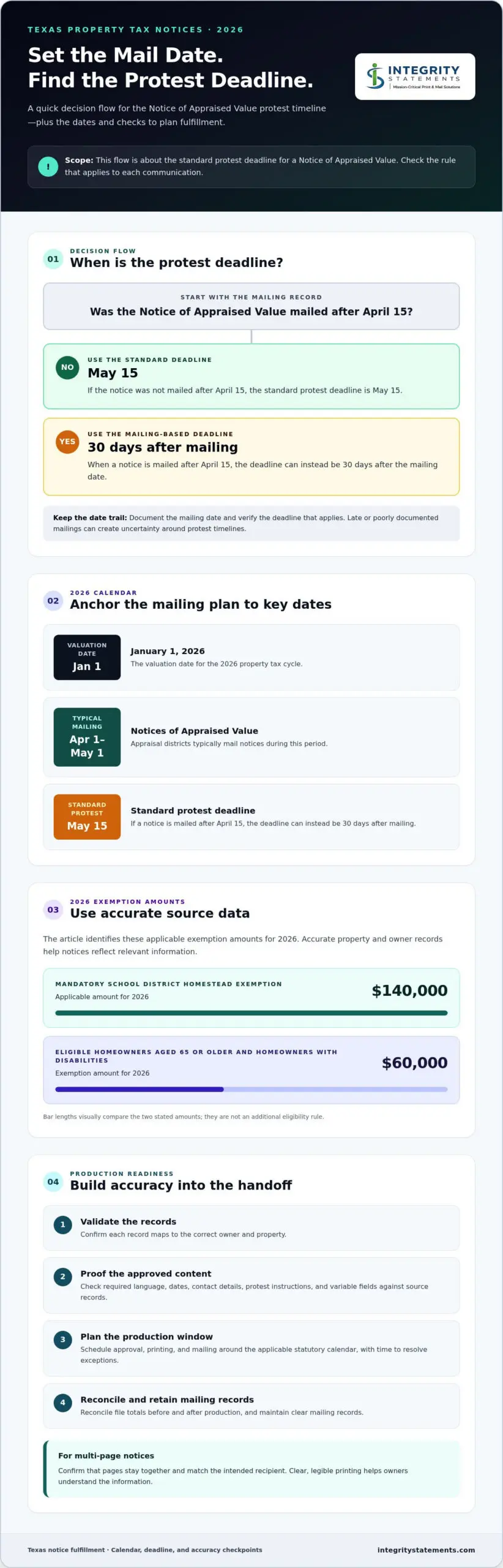
Property tax notice fulfillment is a legal and operational responsibility, not simply a print run. Texas rules govern what taxing authorities communicate and how certain notices reach property owners. The Notice of Appraised Value is especially important: it tells an owner how the appraisal district valued the property and gives them an opportunity to review the information and, if needed, protest. Errors in the recipient, property details, or mailing record can make that process harder for everyone involved.
The broader legal framework continues to evolve. The 2019 Texas Property Tax Reform provides useful historical context, while changes effective from the 2025 tax year affect exemptions and other parts of the system. For 2026, the applicable exemption amounts include a $140,000 mandatory school district homestead exemption and a $60,000 exemption for eligible homeowners aged 65 or older and homeowners with disabilities. Accurate source data matters so notices reflect the relevant property and owner information.
Key Deadlines for Texas Appraisal Districts
January 1, 2026, is the valuation date, and appraisal districts typically mail Notices of Appraised Value between April 1 and May 1. These are planning milestones, not separate residential and business deadlines. The standard protest deadline is May 15; if a notice is mailed after April 15, the deadline can instead be 30 days after mailing. Late or poorly documented mailings can complicate protest timelines and create uncertainty for property owners and jurisdiction staff.
Prepare for the peak before files reach production. Set a schedule for data validation, document proofing, approval, printing, and mailing, with time reserved to resolve exceptions. Confirm that each record maps to the correct owner and property, and reconcile file totals before and after production. A property tax notice mailing service Texas jurisdictions use should support a controlled handoff from data preparation to mail entry, with production timing planned around the applicable statutory calendar.
Statutory Requirements for Notice Content
Notice requirements depend on the document and the governing rules, so use the current authorized form and approved content rather than relying on last year’s template. Review required language, dates, contact details, protest instructions, and variable fields against the source records. For multi-page notices, confirm that pages stay together and match the intended recipient. Clear, legible printing helps owners understand the information and supports transparent public administration.
Postmark records deserve the same attention as document accuracy. A payment, application, or report sent by first-class mail is timely when postmarked on or before its due date, and this timing rule also applies to common carriers such as FedEx. That rule concerns those submissions, not a blanket deadline for every notice mailing. Maintain clear mailing records and verify the rule that applies to each communication. Careful data checks, approved content, and a documented production window help jurisdictions protect taxpayer rights while keeping the annual cycle orderly.
Security Standards for High-Volume Tax Document Mailing
Property tax notices combine personally identifying information with property and valuation details. Protecting that data means securing more than the file transfer: controls must continue through document processing, insertion, and dispatch. When evaluating a property tax notice mailing service Texas jurisdictions can trust, look for clear, documented practices for access, data handling, and production controls.
Understanding SOC 2 Compliant Mailing
A SOC 2 examination evaluates controls relevant to areas such as security and confidentiality. It gives clients information about how controls are designed and, depending on the examination, how they operated during a defined period. It isn’t a promise that incidents or errors are impossible. A SOC 2 compliant mailing house should be able to explain how its documented practices govern access, data handling, and production workflows.
For appraisal districts, the practical value is consistency. Defined procedures can limit unnecessary access, establish responsibility for file handling, and make exceptions easier to investigate. Before production, use an agreed secure transfer method, restrict file access to authorized personnel, and reconcile received records against the approved mailing count. When sensitive information is emailed by Texas state agencies or their vendors, encryption requirements include FIPS 140-2 standards. That specific requirement should not be mistaken for a universal rule governing every file transfer or every local jurisdiction.
Quality Control in Transactional Printing
Security must hold on the production floor, too. Controlled entry, role-based access, and monitored work areas can help protect documents and data from unauthorized handling. Clear procedures for staging, handling, and disposing of misprints reduce the chance that a notice is exposed or paired with the wrong recipient. These controls complement digital safeguards rather than replacing them.
At high volume, a correct data file can still become a mailing error if pages are out of sequence or inserted into the wrong envelope. Camera verification systems can compare document identifiers during insertion, while a 2D barcode workflow can help match a notice set to its intended envelope. These are process controls to plan for, not substitutes for validating source data and testing the job setup. Define how the system flags mismatches and how staff resolve exceptions before mail is released.
A “zero-error” goal is best treated as an operational discipline, not a guarantee. Build checkpoints around file intake, sample review, page integrity, envelope matching, and final count reconciliation. Keep production records that support investigation of a questioned mailing; the specific detail captured depends on the workflow and applicable requirements.
Integrity Statements provides print and mail services for business-critical communications, including tax forms and regulatory notices. For districts planning tax and regulatory mail, secure tax notice printing and mailing brings document production and physical fulfillment into one workflow.
Outsourcing vs. In-House Processing for Texas Jurisdictions
For a Texas jurisdiction, the cost of mailing notices in-house extends beyond paper and postage. Staff time, equipment, maintenance, supplies, floor space, training, and the capacity needed for a seasonal workload all factor into the decision. A property tax notice mailing service Texas jurisdictions use can consolidate production and mailing into a managed workflow, while allowing district staff to focus on valuation work, taxpayer questions, and appeals.
In-house processing offers direct control, but that control comes with operational responsibilities. A printer or inserter that sits idle outside peak season still requires upkeep, and a surge in annual volume can force teams to rearrange regular duties or bring in temporary workers. New staff must learn the workflow quickly, increasing the need for supervision and quality checks. Outsourcing can provide access to dedicated production capacity without requiring the district to build its own seasonal operation.
Operational Efficiency and Risk Mitigation
Small process gaps can have outsized effects: a data file may be imported incorrectly, pages may be matched to the wrong account, or a staff member may miss a step under deadline pressure. Manual handling can make these tasks more dependent on individual attention. Automated printing and inserting workflows can reduce repetitive touchpoints, but no process should be treated as infallible. Reconciliation, exception handling, and clear approval responsibilities remain essential.
Outsourcing also doesn’t transfer a jurisdiction’s statutory duties or remove its accountability for approved data and content. Instead, a defined service arrangement can assign production tasks, establish handoff points, and clarify how exceptions are reported and resolved. District teams retain oversight while a specialized partner manages print and mail execution. That division can give staff more time for core responsibilities without losing visibility into the mailing process.
The Financial Case for Outsourcing in 2026
Compare the full cost of in-house production with the planned cost of outsourced fulfillment, not just the price of a machine or a single mailing. In-house capital expenditure may include printing and inserting equipment; ongoing operational expenditure can include maintenance, labor, training, paper inventory, and storage. Outsourcing changes the cost structure by reducing the need to maintain dedicated mailing capacity internally. The right comparison depends on the jurisdiction’s volume, staffing model, and existing infrastructure.
Specialized print and mail operations may use high-speed inkjet printing and intelligent inserting to process large jobs efficiently. Those technologies can support variable-data documents and consistent matching when workflows are properly configured and monitored. They are most useful when paired with sound file preparation and checkpoints, rather than treated as a substitute for oversight. The in-house versus outsourced statement printing comparison offers a framework for weighing these operational tradeoffs.
Integrity Statements provides transactional print and mail services for tax forms and regulatory communications. For Texas jurisdictions weighing the two models, high-volume tax notice printing and mailing offers a practical way to manage fulfillment while keeping district priorities in view.
Meeting Deadlines and Optimizing Postage for Property Tax Notices
Mailing plans need to account for both delivery timing and postage preparation. Texas property tax notices may generally be sent by regular first-class mail unless a specific notice requires certified mail. The correct method depends on the notice and applicable rules, so build the mailing schedule around the required delivery method, the jurisdiction’s deadline, and time for data and production checks.
USPS rates changed effective July 12, 2026. The rates listed for that change include a $0.82 First-Class Mail stamp, a $0.78 metered letter rate, and a median rate of approximately $0.692 for First-Class presort letters. Presort pricing depends on eligibility and preparation, so these figures are reference points, not a guaranteed rate for a particular mailing. A property tax notice mailing service Texas jurisdictions rely on can coordinate address preparation, presorting, and mail entry as part of a planned workflow.
Ensuring Timely Delivery and Postmarking
Leave room between final approval and the required mailing date. Coordinate mail entry and documentation with the mailing operation, and maintain records that show when the job was released and entered. A payment, application, or report sent by first-class mail is timely if postmarked on or before its due date; this also applies to common carriers such as FedEx. That rule is not a blanket deadline for every notice, so distinguish the mailing’s purpose and governing requirement.
First-class presort can offer a lower rate than an individual stamped letter when the mailing meets postal preparation requirements. For smaller jurisdictions, commingling combines compatible mail from multiple senders to create a larger presort pool. This may make presort more practical, while requiring careful segregation and reconciliation so each jurisdiction’s records and mail remain distinct. Returned notices also need a defined process: capture the return, update the relevant record through authorized procedures, and route exceptions for follow-up.
Data Cleansing and Address Hygiene
Address quality affects whether notices reach owners and how much staff time is spent handling returned mail. CASS-certified address processing standardizes and checks addresses against USPS reference data, supporting accurate sorting and postal preparation; it doesn’t establish that an individual still lives at that address.
National Change of Address (NCOA) is a USPS-linked address update resource that helps identify reported moves and match eligible records to updated addresses before mailing. Use address cleansing before finalizing files, then review unmatched or conflicting records instead of silently forcing a match. This can reduce avoidable returns and the “lost notice” risk, though it can’t guarantee delivery or resolve every ownership discrepancy.
Clear handoffs matter: finalize the data, resolve exceptions, approve proofs, prepare the mail, and retain entry records. To simplify high-volume tax notice fulfillment, plan secure property tax notice printing and mailing with Integrity Statements.
Integrity Statements: Your Texas Partner for Secure Notice Fulfillment
Texas appraisal districts and counties need a fulfillment process that respects the importance of every notice, every data field, and every deadline. Integrity Statements provides transactional mail solutions for business-critical communications, including tax forms and regulatory notices. For Texas organizations managing high-volume print and mail, the team offers an accountable approach to document production and fulfillment.
A secure transition isn’t just a change in where documents are printed. It’s a carefully planned handoff that aligns data, approved content, production requirements, and mailing schedules. Integrity Statements creates custom print and mail solutions around clients’ communication needs, helping turn a demanding annual cycle into a more organized fulfillment process. Precision matters throughout, from preparing files for production to managing the final mailing workflow.
A Local Solution with National Capabilities
Texas jurisdictions work within state tax and regulatory requirements, while each has its own records, templates, approval steps, and seasonal demands. A sound process makes those requirements explicit rather than relying on informal handoffs. Learn how custom print and mail solutions can support secure, business-critical communications.
Integrity Statements’ approach is calm and methodical. Start with the jurisdiction’s current workflow and identify the documents, data, and decisions that must move through production. Then establish clear responsibilities for file preparation, content approval, exception resolution, and mailing authorization. This gives district staff visibility while a print-and-mail partner manages the fulfillment work. It also creates a practical basis for reviewing accuracy and refining the process after each cycle.
Next Steps for 2026 Planning
Begin planning early enough to map requirements before the peak mailing window. A structured kickoff can cover:
- Security and data handling: Document the information involved, the approved transfer approach, and the access controls required for the project.
- Files and templates: Define record fields, document versions, page requirements, and how changes will be reviewed and approved.
- Production and timing: Set milestones for file readiness, proof review, exception handling, and mail entry based on the jurisdiction’s schedule.
- Quality checks: Agree on how records, output counts, and mailing exceptions will be reconciled and reported.
These steps give both teams a shared operating plan without assuming every jurisdiction follows the same timeline. Integrity Statements’ experience in tax and regulatory mail keeps the discussion focused on practical details that support accurate fulfillment and careful handling of sensitive information. For districts evaluating a property tax notice mailing service Texas partner, a defined workflow is the foundation for a confident transition.
To plan high-volume notice fulfillment for the 2026 tax season, discuss a custom tax notice mailing strategy with Integrity Statements.
Put Your 2026 Notice Plan on Solid Ground
The next tax cycle is an opportunity to make fulfillment more predictable. Start by mapping your internal approval steps, data handoffs, and mailing milestones, then decide which parts of production your team should manage and which are better handled through a specialist workflow. A clear plan gives your staff room to focus on public service while keeping notice production organized.
Integrity Statements provides print and mail services for business-critical communications, including tax forms and regulatory notices. For jurisdictions evaluating a property tax notice mailing service Texas partner, its custom print and mail solutions can support a secure, well-organized fulfillment process.
Begin shaping a strategy around your district’s records, templates, and seasonal requirements. Plan your 2026 tax notice mailing strategy with Integrity Statements and take the next step toward a more organized mailing season.
Frequently Asked Questions
What makes a mailing service “SOC 2 compliant” for Texas tax data?
SOC 2 compliance means a service provider’s controls for protecting information are evaluated against established trust services criteria, including security and confidentiality. It helps Texas jurisdictions assess how a provider manages access, safeguards data, and documents procedures. It doesn’t mean risk is eliminated or that every mailing is error-free. Integrity Statements provides print and mail services for business-critical communications, including tax and regulatory documents.
How does outsourcing property tax notices save money on postage?
Outsourcing can help control postage by coordinating mail preparation, sorting, and entry planning with document production. The final rate depends on factors such as the mailing’s format, volume, address quality, and eligibility for postal discounts. A jurisdiction can compare total mailing costs across past cycles, including staff time spent correcting returned mail, rather than looking at postage alone. That gives teams a clearer basis for budgeting future notice distribution.
Can Integrity Statements handle the specific forms required by the Texas Comptroller?
Integrity Statements provides printing and mailing for tax forms and regulatory documents. The taxing entity remains responsible for providing or approving the authoritative content and current version to be produced. That division helps keep production aligned with agency requirements and avoids unapproved edits to statutory language, calculations, or instructions.
What is the typical turnaround time for a high-volume tax notice mailing?
Turnaround depends on the mailing’s volume, document complexity, file readiness, and approval schedule, so there isn’t one timeline that fits every jurisdiction. A job with finalized records and an approved template can move through planning differently from one with unresolved exceptions or late content changes. Set production milestones in advance, including time for proof review and corrections, and align the mail date with the jurisdiction’s calendar.
How do you ensure that the correct notice is matched to the correct taxpayer?
Matching starts with well-structured source records and clear identifiers that connect each notice to the intended account. A practical review can use a sample to verify that names, property references, and variable fields appear together as expected before the full job proceeds. Any record that fails validation should be separated for resolution, not forced into production. These controls support accuracy without promising that mistakes are impossible.
Does your service include address cleansing and NCOA updates?
Address cleansing and NCOA updates are address-preparation steps that can be defined as part of a tax mailing workflow. Before files are finalized, determine which records may be updated, how unmatched addresses should be handled, and how changes will be reported to the jurisdiction. This helps prevent an automated address update from being mistaken for a change to ownership or tax records. The jurisdiction retains authority over its official taxpayer and property data.
Can you provide proof of mailing for every individual tax notice sent?
Mailing documentation can record a job’s preparation and dispatch, but proof for each individual piece depends on the mail class and the documentation or tracking used. A batch-level record shouldn’t be confused with confirmation that each recipient received a notice. For a Texas tax mailing, determine what evidence the jurisdiction needs for its records and retain the corresponding production and postal documentation with the job file.
What happens if there are changes to the Texas Property Tax Code mid-season?
If requirements change during a mailing cycle, pause affected production decisions until the jurisdiction identifies the applicable approved content and effective instructions. Separate notices already approved or mailed from jobs still in preparation, then document which templates or records need revision. This makes the impact easier to assess and reduces the chance of mixing versions. The taxing entity should direct legal interpretation and approve any required changes before production resumes.