

Texas Secure Print and Mail Services for Reliable Delivery
The press is only one part of a dependable mailing. Texas secure print and mail services coordinate address preparation, printing, finishing, and mailing as one workflow. For CASS-certified mailings, lists are checked against the USPS Address Matching System and receive an 11-digit delivery point ZIP code and corresponding barcode.
It’s easy to focus on printing documents and overlook the steps that shape what happens next: preparing addresses, handling returned mail, and finishing each piece for mailing. A coordinated process connects those details from the initial file through dispatch.
This article explains how address verification and returned-mail handling fit into the workflow, what folding, inserting, and sealing involve, and which project details shape coordination from print through mailing. You’ll also learn how to assess whether bundled print-to-mail support suits your organization and what to consider when planning a project.
Key Takeaways
- Plan how returned mail will be recorded and reviewed so address problems can inform future mailing lists.
- Map file preparation, approvals, production, and mailing handoff to keep project responsibilities clear from start to finish.
- Match folding and inserting choices to the document and envelope; USPS requires tabs on self-mailers to help prevent jams in mail-processing equipment.
- Consider a bundled print-to-mail workflow when coordinating separate production steps creates extra work or handoff risks.
Mailing, address verification, and returned mail
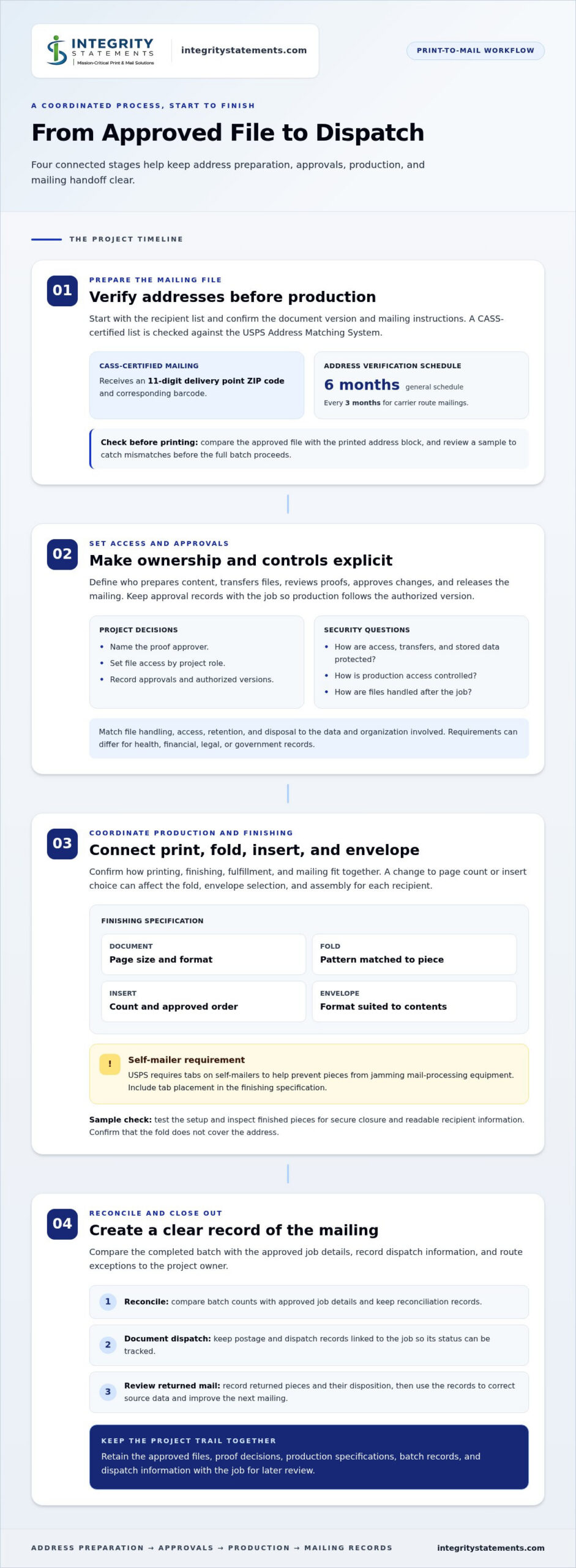
Start with the mailing list. A CASS-certified list is checked against the USPS Address Matching System, with an 11-digit delivery point ZIP code and corresponding barcode added. Address verification should occur every six months, or every three months for carrier route mailings. These steps help standardize addresses before printing and mailing begins.
For a government mailing, confirm the recipient file, required document version, and mailing instructions before production. Then compare the approved file with the printed address block. Inkjet addressing can apply recipient addresses and approved personalization directly to pieces. For example, a notice can pair a recipient’s name with the correct account reference, while a review sample helps catch mismatches before the full batch proceeds.
Look for documented security controls, not just a certification label. Ask how file access is limited, transfers and stored data are protected, production access is controlled, and files are handled after a job. Independent security certifications can support your assessment alongside written procedures for access reviews and incident response.
Which Texas and federal privacy laws apply depends on the data and organization involved. Identify whether a mailing contains health, financial, legal, or government records, then map applicable obligations to file handling, access, retention, and disposal. Don’t treat a general privacy rule as a substitute for requirements tied to a specific record type.
For HIPAA-related, financial, legal, and government documents, define who can handle files and printed pieces at each production step. Use approved files, controlled proofing, address matching, insertion checks, and batch reconciliation records. For example, a statement job can compare the intended recipient and account reference before sealing.
Outsourcing risks include exposing personal data, inserting the wrong document, or mailing to an outdated address. Reduce them by limiting shared data, checking address files, approving a sample, and reconciling batch counts before mailing. Record returned pieces and their disposition, then use those records to correct source data and improve the next mailing. Keep postage and dispatch records linked to the job so teams can track its status.
End-to-end print and mail project management
A managed project connects the approved file to finished mail instead of treating printing, fulfillment, and mailing as isolated tasks. Clear handoffs show who prepares content, approves proofs, manages production, and releases the final mailing.
Planning Texas secure print and mail services starts with defining the mailing’s purpose, recipients, document format, and approval owner. Then align file transfer, proof review, production, insertion, postage preparation, and dispatch responsibilities before the first production run.
Texas providers may have facilities in different locations. For a project, distinguish the production location from the mailing destination, then establish how files, proofs, and finished pieces move through each stage.
- Define the job. Identify the document type, recipient file, mailing schedule, and required format. A recurring notice, for example, may need a stable template and a controlled process for updating its content.
- Set access and approvals. Assign file access to appropriate project roles and name the person responsible for approving the proof. Keep approval records with the job so production follows the authorized version.
- Coordinate production. Confirm how printing, finishing, and fulfillment connect. A change to page count or insert choice can affect folding, envelope selection, and how each recipient’s materials are assembled.
- Close out the mailing. Reconcile the completed batch against the approved job details, record dispatch information, and route exceptions to the project owner. This creates a clear record for later review.
For organizations managing several document types, a written production specification can keep processes consistent. It can record file format, proof requirements, version control, insertion instructions, and who authorizes changes. For example, a revised notice should replace the approved version only after the designated reviewer signs off.
When a project needs coordinated production and mailing, Custom Print & Mail is a relevant option for tailoring the workflow to its documents and fulfillment needs.
Print Shoppe reports that attendance at public hearings for a City of Austin Public Works Department infrastructure project increased by 40%. This example offers context when defining an audience and coordinating approved materials for a mailing. Teams can retain the approved files, proof decisions, production specifications, and dispatch record together, making communication planning and fulfillment easier to review.
Folding, stuffing, and sealing
Finishing determines how each document fits its envelope and reaches the recipient. Before production, match the page size, fold pattern, insert count, and envelope format. For example, a multi-page statement may need a different fold and envelope than a single-page notice. Confirm the approved layout before folding begins.
For self-mailers, the USPS requires tabs to help prevent pieces from jamming mail-processing equipment. Include tab placement in the finishing specification, then inspect a sample for secure closure and readable recipient information. A fold that covers an address or leaves an edge unsecured can disrupt handling.
Insertion needs its own accuracy controls. Match each recipient’s document to the correct envelope, especially when a mailing includes sensitive account or healthcare information. A practical sequence is to approve the insert order, test the setup with sample pieces, and compare finished samples against the approved document and envelope.
- Check the fold. Confirm that folds align with the document design and leave the address window clear, when used.
- Verify inserts. Compare the intended insert set with the assembled sample before the full run.
- Inspect closure. Confirm tabs or envelope seals hold the piece together during handling.
- Review finished pieces. Check the address, document orientation, and visible contents against the approved sample.
Document changes can affect every finishing step. If a revised statement adds a page, reassess the fold, envelope capacity, and insert sequence before production continues. Keep the current approved sample with the job instructions so staff can compare finished pieces against one consistent reference.
For regulated mail, protect sensitive documents through controlled access during setup and assembly. Separate job materials, remove superseded versions from the work area, and reconcile completed pieces against production instructions before dispatch. These checks connect finishing accuracy with reliable mailing.
Bundled print-to-mail services
Bundling connects document production, finishing, mailing, and fulfillment in one coordinated workflow. Its value lies in managing handoffs together, so a file change can be considered before it affects the envelope or delivery.
Turnaround, Locations, and Service Range
Texas providers differ in production schedules, facility locations, and the stages they manage. Compare the stated turnaround process, where each production step occurs, and how completed mail moves toward delivery. Ask how approvals, revisions, and mailing handoffs affect the schedule. A provider managing printing through mailing can coordinate these steps, while a narrower service may require separate handoffs.
Document Printing, Mailing, and Fulfillment
Choose a provider that handles secure document printing, mailing, and fulfillment as connected tasks. Review how the workflow moves from approved files to printed pieces, assembled envelopes, and dispatch. For example, a recurring customer notice may require consistent document formatting and coordinated insertion. The key is whether one workflow covers the stages your mailing needs.
Bundling can reduce coordination work, but it doesn’t remove the need for clear job instructions. Define which file version is approved, who authorizes changes, and what happens when a document or insert changes. These decisions help production and fulfillment follow the same specifications.
Compare the full service path, not just the printing or mailing step. Check whether the proposed workflow includes file preparation, proof approval, printing, finishing, postage preparation, and dispatch. A written scope makes gaps between stages visible before production begins.
Consider how exceptions move through the process. If an envelope fails inspection or a job needs a revised proof, identify who pauses production and records approval. A defined escalation path helps teams resolve issues without losing track of the authorized version.
For a mailing that needs coordinated production and fulfillment, discuss your print-to-mail workflow and its document requirements.
Integrity Statements: Statement Printing and Mailing
Integrity Statements helps organizations prepare business-critical documents for mailing through its Statement Printing and Mailing service. It’s a practical next step when recurring statements need coordinated production and delivery.
Organizations can also use Integrity Statements for Invoice and Billing Printing and Mailing, Healthcare Communications Printing and Mailing, and Tax Forms & Regulatory Mail Printing and Mailing. These services suit billing communications, healthcare documents, and tax or regulatory mail that need a print-to-mail workflow.
Share your document type and mailing requirements with Integrity Statements to discuss the right service for your project. Contact the team to plan your print and mailing workflow.
Set Your Next Mailing Up for Clarity
Turn your mailing requirements into a clear project brief. Define the document type, recipient groups, approval owner, and desired delivery sequence. This gives your team and print-and-mail partner a shared starting point for planning Texas secure print and mail services around your communications needs.
Integrity Statements offers Statement Printing and Mailing, Invoice and Billing Printing and Mailing, and Healthcare Communications Printing and Mailing. These services help organizations prepare recurring statements, billing documents, and healthcare communications for delivery. Discuss your document and workflow with the team to identify a suitable starting point.
Bring the project scope, document format, and mailing requirements together, then contact Integrity Statements about your project. A well-defined next step can make the work ahead easier to coordinate and help your team move forward with confidence.
Frequently Asked Questions
What secure print and mail services are available in Texas?
Texas secure print and mail services can cover business documents from secure file transfer through mailing. Integrity Statements prints and mails statements, invoices and billing documents, healthcare communications, tax forms, and regulatory mail. Its workflow includes file review and validation, printing, inserting, and mailing. Secure files can be transferred through a portal, SFTP, API, or another approved method; tracking and reporting are available upon request.
What Texas and federal privacy laws apply to secure printing and mailing?
Applicable Texas and federal privacy laws depend on the data and organization. Identify whether the mailing contains health, financial, legal, or government records, then map relevant obligations to file handling, access, retention, and disposal.


