

Fort Worth Financial Statement Printing and Mailing Costs
A low quote alone can’t tell you whether statement mail will be accurate, secure, or ready for a regulatory deadline. The cost of Fort Worth financial statement printing and mailing depends on factors such as document format, print volume, mailing specifications, and the services required; pricing depends on the project and is provided after a quote request. SOC 2 and HIPAA questions need consideration beyond the price itself.
That distinction matters when statements contain sensitive information or notices carry regulatory requirements. You need to understand how production choices affect cost, what supports accurate addressing and delivery, and how to assess compliance claims without assuming that printing alone establishes compliance.
This guide explains the main factors that shape a print-and-mail quote, the role of print-ready files, and the steps involved in producing financial statements and regulatory notices. It also covers mailing accuracy and the questions that help you evaluate SOC 2 and HIPAA considerations in the context of your communication needs.
Key Takeaways
- Understand how document format, print volume, mailing requirements, and service scope shape a project quote.
- Assess compliance-related claims carefully, and distinguish secure production practices from a guarantee of regulatory compliance.
- Learn how accurate recipient data, document matching, and mailpiece checks help reduce mailing errors.
- See why print-ready files are especially useful for sensitive or highly formatted statements and regulatory notices.
- Explore a structured transition process for outsourced financial mail: discovery, setup, validation, then migration and go live.
Secure print and mailing for financial institutions
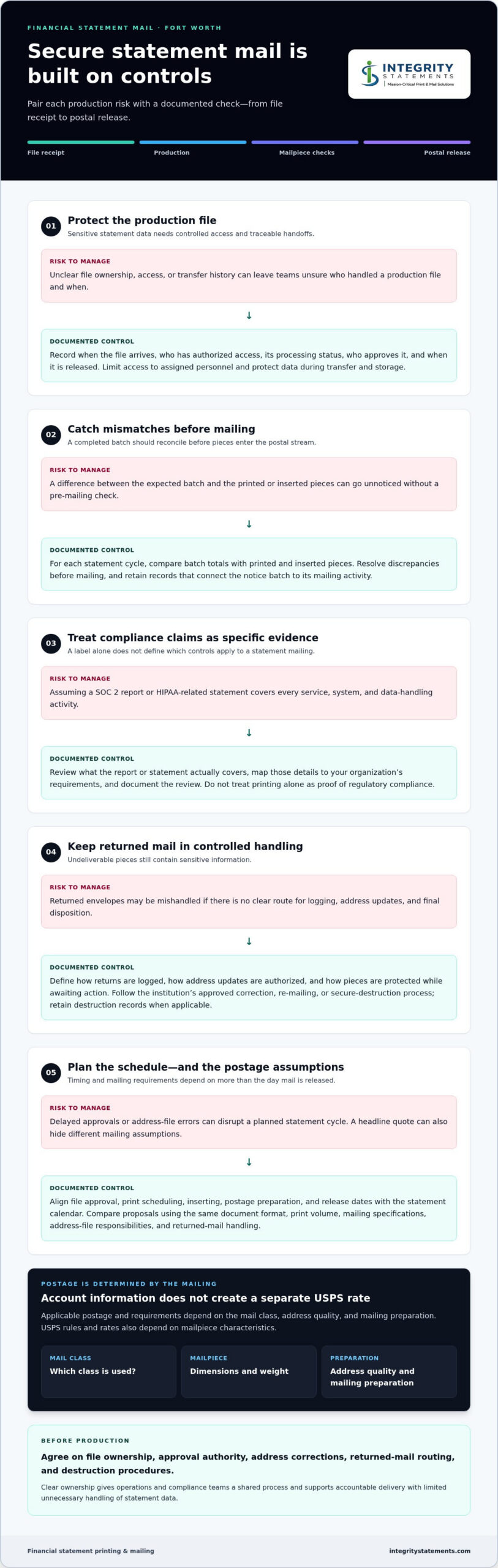
Financial institutions, including banks and credit unions, send statements that combine confidential account details with delivery deadlines. A secure print-and-mail process needs clear controls from file receipt through mailing. For example, document who receives each production file, who approves proofs, and when completed mailpieces enter the postal stream.
USPS rules and postage rates depend on the mail class and the mailpiece’s characteristics, including its dimensions, weight, and preparation. Financial statements do not have a separate postage rate simply because they contain account information. The mail class, address quality, and mailing preparation determine applicable postage and requirements.
A documented chain of custody makes every handoff traceable. Record when the production file arrives, who has authorized access, its processing status, who approves it, and when it is released to the postal stream. For each statement cycle, compare batch totals with printed and inserted pieces to catch discrepancies before mailing. Limit file access to assigned personnel and protect data during transfer and storage.
Compliance certifications and reports need careful interpretation. A SOC 2 report or a HIPAA-related statement should be assessed against the services, systems, and data handling it actually covers. Financial institutions can map those details to their own requirements, then document the review. A certification label alone doesn’t explain which controls apply to a specific statement mailing.
Undeliverable mail needs a defined route back into controlled handling. Establish how returned envelopes are logged, how address updates are authorized, and how each piece is protected while awaiting action. If a statement cannot be delivered, follow the institution’s approved process for correction, re-mailing, or secure destruction. Destruction records can document the final disposition of sensitive documents.
Timely delivery starts with production planning, not merely the day mail enters USPS. Align file approval, print scheduling, inserting, postage preparation, and release dates with the institution’s statement calendar. A delayed approval or address-file error can disrupt the schedule. Track each stage so teams can identify bottlenecks and respond before the planned release.
For regulatory notices, retain evidence that connects the notice batch to its mailing record. One financial-institution testimonial reports 100% compliance with verifiable proof-of-mailing on every regulatory notice. That testimonial describes a reported result, not a universal guarantee. Institutions can define what evidence they need, such as batch records, approval logs, or proof-of-mailing documentation.
Before production, agree on file ownership, approval authority, address corrections, returned-mail routing, and destruction procedures. These decisions give operations and compliance teams a shared process. For example, a credit union can assign responsibility for resolving address exceptions and recording final disposition. Clear ownership supports accountable delivery while limiting unnecessary handling of statement data.
Looking for a cost-effective print and mail partner?
Outsourcing can put statement production into a defined workflow with clear responsibilities. Compare the work included, continuity planning, and quote assumptions before choosing an approach.
Benefits of Outsourced Statement Processing
Outsourcing can bring file preparation, printing, inserting, and mailing together in one managed process. For organizations with recurring statement cycles, this can reduce internal production tasks and clarify responsibilities. Compare the proposed workflow with your current process: who supplies files, approves proofs, handles exceptions, and records mailing activity?
Operational continuity matters, too. A disaster recovery plan should explain how production could resume after a facility disruption, what steps protect files, and how schedule changes are communicated. Assess how the plan fits your own continuity procedures. Compliance teams can then compare responsibilities and documented controls with internal requirements.
Fort Worth Provider and Service Options
How do local financial statement printing and mailing providers compare? Assess service scope, file-handling procedures, mailing accuracy controls, and the ability to meet your production schedule. A Fort Worth organization should also distinguish a print-only arrangement from a complete print-and-mail workflow.
What financial statement printing and mailing services are available in Fort Worth? Organizations may need statement production, invoice and billing mail, healthcare communications, tax forms, regulatory notices, customer notices, or custom print-and-mail work. Match the service scope to your documents and delivery process. A credit union sending statements, for example, may need different file layouts and approval steps than a business mailing invoices.
Compare proposals using the same assumptions: document format, mailing specifications, address-file responsibilities, and returned-mail handling. This makes differences in scope clearer than comparing headline quotes alone. It also helps you determine whether a proposed workflow supports consistent output and compliance review.
Requesting a Printing and Mailing Quote
How can a business request a quote for financial statement printing and mailing in Fort Worth? Prepare a project outline that covers document types, file formats, print quantities, mailing requirements, schedule, and approval or exception-handling steps. Pricing depends on the project and is provided after a quote request. Factors include volume, document complexity, finishing, and mailing specifications.
A financial mail program can transition through four steps: discovery, setup, validation, and migration and go live. During discovery, define requirements and responsibilities. Setup establishes the files and workflow; validation checks the process before production. Migration and go live move the program into active operation.
A quote discussion can clarify those steps alongside the production scope. For a practical starting point, outline one typical mailing cycle and identify its files, approvals, and delivery needs. Then use that example to frame a statement mailing quote request and compare proposals on equivalent terms.
Automated inserting and mailpiece accuracy
Accurate production depends on matching each statement, recipient, and envelope before release. A controlled workflow starts with an approved data file, applies variable information to the correct document, and verifies that each finished mailpiece contains the intended pages. This matters for sensitive financial records: a page placed in the wrong envelope can expose another customer’s information.
Can Fort Worth providers handle variable data, folding, inserting, and postage? Yes, print-and-mail workflows can include all four, depending on project scope. Variable data personalizes each document, folding prepares it for the envelope, inserting assembles the mailpiece, and postage preparation readies it for mailing.
For variable data, start with a defined file layout and approved statement template. Confirm that key fields, such as the recipient name, mailing address, and account-specific content, map to the correct locations. A sample file can reveal missing fields or formatting differences before full production. This helps maintain consistency across statements with different balances or notices.
Folding and inserting also require clear specifications. A statement may contain several pages, an insert, or a return envelope. Define the fold, page sequence, insert rules, and envelope type in the production setup. For example, an account notice intended for one recipient must stay paired with that recipient’s statement during assembly.
Quality assurance should connect the source file to the finished mailpiece. Compare file totals with production counts, inspect setup samples, and review exceptions before mailing. During a test run, check that address windows align, pages are in the right order, and inserts follow instructions. These checks help catch production issues early.
Automation can support efficient processing, but monitoring still matters. Assign staff to review machine alerts, damaged pieces, and items that fail a match check. If a batch stops because of an exception, pause the affected pieces, identify the cause, and document its resolution before resuming. Clear procedures keep unresolved exceptions separate from completed mail.
Postage preparation depends on the mailpiece and mailing plan. Document the selected specifications, address-file responsibilities, and any presort or preparation steps in the production instructions. Changes to paper, envelopes, or enclosures can affect assembly and preparation. Reviewing the details before the mailing run helps prevent last-minute rework.
For sensitive or highly formatted statements, use print-ready files to support accuracy. Approve the final file and proof before production, then keep a record of the approved version. This control distinguishes the intended statement from later revisions and gives the organization a clear reference for quality reviews.
Financial statement and regulatory notice printing
Financial statements and regulatory notices serve different purposes. An account statement reports transactional activity, while a notice communicates a specific update or action. For either document, define the audience, approved content, layout, and mailing schedule before production. Keeping them distinct helps prevent a routine letter from being mistaken for a formal notice.
Texas Tax Code Section 351.009 requires municipalities that impose certain hotel occupancy taxes to report tax rates and revenue amounts annually. In 2017, the Texas Legislature passed Senate Bill 1221 to increase local government transparency and help the public understand municipal hotel occupancy taxes. These are municipal reporting requirements, not a general rule for private financial statements.
Fort Worth illustrates how public financial communications can use different formats. The City of Fort Worth presents its Annual Comprehensive Financial Report annually, with detailed information about the city’s financial condition and performance. Its Popular Annual Financial Report summarizes that report in an accessible format. The intended reader shapes the document’s depth and presentation.
Archived city documents also demonstrate the need to label reporting periods precisely. Fort Worth lists FY2026 investment reports for QTR-1, QTR-2, and QTR-3, plus FY2025 reports for QTR-3 and QTR-4. It also lists Annual Hotel Occupancy Tax Reports for FY2024 and FY2025. Correct period labels help readers distinguish one filing from another.
For sensitive or highly formatted statements, use print-ready files to support accuracy. Prepare the final file with approved text, data fields, page order, and layout. Compare a production proof with that version before releasing the batch. This can catch a missing page, outdated letter, or misplaced field before mailing.
Regulatory notices require disciplined version control. Assign an owner to approve the content and identify the effective version for each mailing. Keep the approved document separate from drafts, then match production records to the released version. For example, do not mix a revised fee notice with an earlier statement batch.
Organizations planning Fort Worth financial statement printing and mailing can clarify production by documenting each document type’s purpose, format, and approval path. Keep statement files separate from notices, confirm the period and recipient data, and retain the approved proof. These steps align transactional communications with their intended audience and help prevent avoidable print corrections.
Which Fort Worth companies print and mail financial statements?
Fort Worth organizations typically assess three operating models: in-house production, commercial printing with mailing, and specialized statement print-and-mail providers. The right fit depends on whether the organization needs printed documents alone or coordinated file processing, document assembly, and mailing. Compare the actual tasks included, not just the provider category or proposal wording.
A commercial printer may produce documents while mailing preparation and distribution remain separate responsibilities. A specialized provider may coordinate more of the statement workflow. In-house teams retain direct control but also manage production schedules, equipment, staff tasks, and exceptions. Map your current process first: list who prepares files, approves proofs, resolves address issues, and releases each mailing.
For Fort Worth financial statement printing and mailing, compare providers using the same project outline. Include the document format, recipient data, mailing schedule, folding and inserting needs, and returned-mail handling. Ask each provider to describe its workflow from file receipt through mailing release. A consistent scope makes differences in responsibility easier to identify.
Security and process documentation matter when handling financial records. Review how a provider manages file access, production approvals, and handoffs between processing stages. Ask what records support batch reconciliation and how exceptions are documented. If a provider cites a certification or audit report, assess its scope and relevance to the services and systems involved. A label alone does not explain the controls used for your program.
Use a sample statement cycle to assess operational fit. Walk through a typical file, proof approval, production run, and mailing release. Identify who approves changes and how corrected files are handled. This can reveal gaps before a recurring program moves into production and gives finance, operations, and compliance teams a shared understanding of their roles.
Compare proposals for scope, implementation steps, communication, and continuity planning. A lower quote may cover fewer tasks, while a broader service may combine responsibilities currently split across teams. Review what each proposal includes and how project changes affect the workflow. Compare totals only when assumptions for documents, inserts, mailing preparation, and exception handling match.
Before selecting a provider, document the decision criteria and assign owners. A practical checklist can cover file transfer, proof approval, quality review, mailing records, and returned-mail procedures. Compare each proposed workflow against that checklist. This helps a Fort Worth organization choose a model that fits its statement cycle, internal capacity, and oversight needs.
Integrity Statements: Statement Printing and Mailing
Integrity Statements provides Statement Printing and Mailing for organizations managing recurring financial communications. Choose this service when you need coordinated statement production and mailing. For related document programs, Invoice and Billing Printing and Mailing, Healthcare Communications Printing and Mailing, and Tax Forms & Regulatory Mail Printing and Mailing support other business-critical mail needs.
To prepare for a project discussion, outline the document types, file formats, mailing schedule, and approval steps involved. This gives the team a practical starting point for understanding your workflow and requirements. Contact Integrity Statements to discuss your statement printing and mailing needs.
Set up your next statement cycle with clarity
Turn your requirements into a clear production brief. For Fort Worth financial statement printing and mailing, outline document types, file formats, mailing schedule, approval responsibilities, and any special handling needs. This gives a quote discussion a practical foundation, with pricing shaped by volume, document complexity, and mailing specifications.
Integrity Statements offers Statement Printing and Mailing, Invoice and Billing Printing and Mailing, and Healthcare Communications Printing and Mailing. These services support organizations managing recurring statements, billing documents, and sensitive healthcare communications. Discuss your requirements with the team to identify the appropriate service and workflow.
Contact Integrity Statements to discuss your needs and take the next step toward a more clearly defined print-and-mail process. A well-prepared brief helps make that discussion useful from the start.
Frequently Asked Questions
Can I Track the Production and Delivery Status of My Statements and Mailings?
Tracking and reporting for mailed items are available when requested. For a statement cycle, specify which status updates matter, such as production completion or mailing release. This helps your team plan follow-up and answer customer questions with clearer information. Tracking does not change postal delivery timing, so distinguish production updates from information about mail after postal entry.
Can I customize my statement or mailing design online?
Variable data printing can personalize each statement with recipient-specific information. Prepare the approved layout and data fields, then transfer files using a secure method such as a portal, SFTP, or API. For example, a statement template can retain its standard structure while displaying each recipient’s relevant account information. Review and validate files before production.
How Do You Ensure On-Time Statement and Mail Delivery?
On-time production starts with a complete file, a clear approval path, and a scheduled release date. Integrity Statements lists a 24-48 Hour Turnaround for production; postal delivery timing is separate. To support a planned statement cycle, provide final files promptly, assign an approver, and resolve corrections before production. Separate production timing from mail transit when setting customer communication expectations.
How Does Outsourcing Statement Mailing Speed Up Collections and Payments?
Outsourcing can bring invoice and billing communications into a coordinated print-and-mail process, reducing internal steps between preparing a bill and releasing it for mailing. Mailing earlier can give recipients more time to review and pay before a due date, but mailing alone does not ensure faster payment. Clear invoices, accurate recipient details, and a consistent billing schedule matter, too.
How Is Automation Used in Statement Processing and Mailing?
Automation supports variable data printing, document production, inserting, and mailing. For example, a system can apply recipient-specific information to a statement template, then assemble its pages into mailpieces. Quality controls and file validation remain essential. Define how corrections are handled so errors in source data or formatting are addressed before affected statements proceed.
How Long Does It Take to Get Started with a Statement Mailing Vendor?
Implementation follows the project’s file requirements, approval process, and validation needs. A financial mail program can move through discovery, setup, validation, and migration and go live. During discovery, teams align on document formats and responsibilities. Setup and validation prepare the workflow for active production. Sample files, approved layouts, and identified decision-makers help keep each transition clear.
How is pricing handled for financial statement printing?
Pricing is provided after a quote request and depends on the project. Relevant factors include print volume, document complexity, finishing, mailing specifications, and the work included in the workflow. A useful request describes statement formats, expected schedules, and mailing needs. Comparing quotes against the same project assumptions clarifies what each scope covers, beyond the headline figure.
How much does financial statement printing and mailing cost in Fort Worth?
For Fort Worth financial statement printing and mailing, cost depends on project details, including document volume, format, variable data, finishing, and mailing requirements. Integrity Statements provides pricing after a quote request rather than publishing a universal rate. For a relevant quote, describe the statement types, production schedule, and mailing scope your organization needs. No single figure applies to every program.


