
Cost Analysis of Outsourcing Mailroom Functions and Benefits
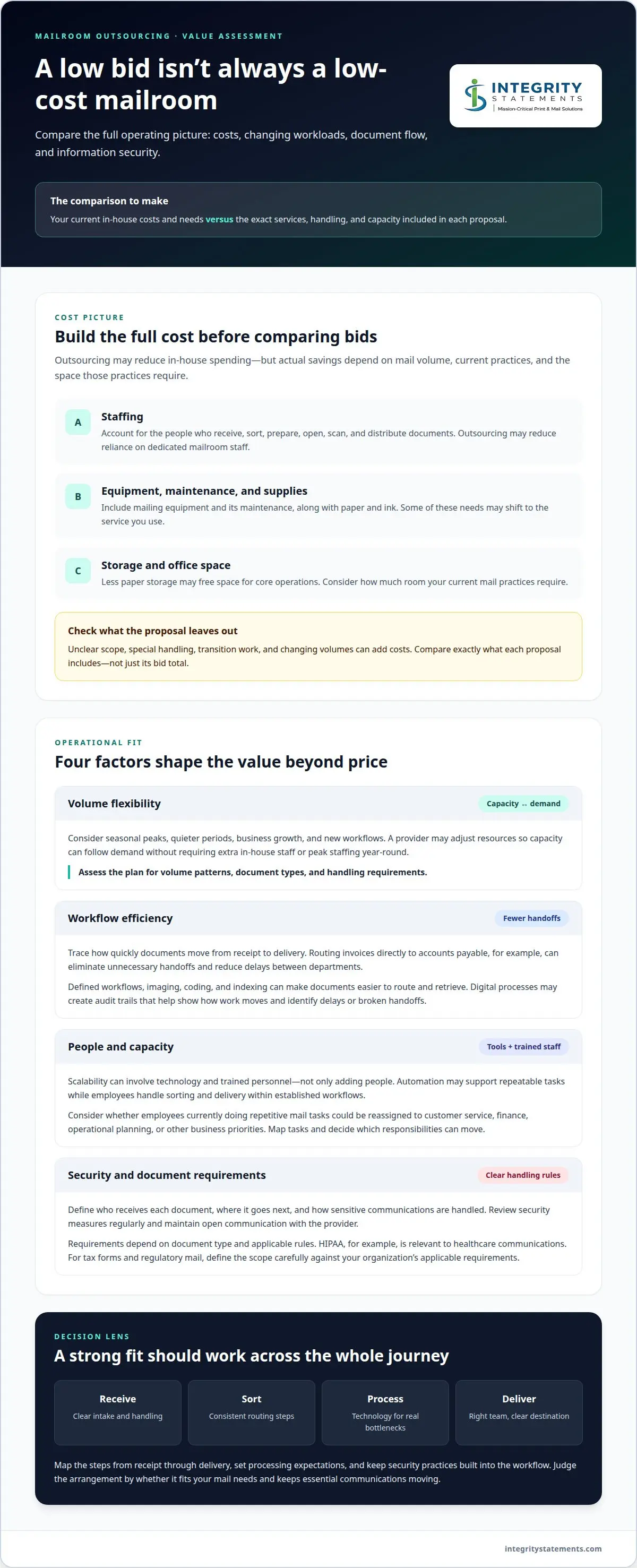
The lowest mailroom bid is not always the lowest-cost option. Outsourcing may reduce in-house spending on staff, equipment, maintenance, supplies, and storage while simplifying document handling. A cost analysis of outsourcing mailroom functions should compare those potential savings with your mail volume, workflow needs, and information security requirements.
Outsourcing is worthwhile when the financial and operational benefits fit your needs. Consider how reliably documents move through each stage, whether capacity can adapt to changing volumes, and whether the process reduces manual handoffs. A poor fit can add friction rather than remove it.
This article outlines the main costs and operational benefits to weigh, how flexibility and workflow efficiency affect bid comparisons, and which questions can help you decide whether outsourcing suits your organization.
Key Takeaways
- Compare the full cost of in-house mail handling with the proposed outsourced scope, including staffing, equipment, maintenance, and storage.
- Assess whether a service can adjust to changing mail volumes without adding pressure to internal staffing and space.
- Look beyond the bid total: workflow steps, document handling, and information sensitivity all affect the value of an arrangement.
- Use your organization’s mail needs and priorities to judge whether outsourcing can improve efficiency while keeping essential communications on track.
What benefits can one expect from outsourcing mailroom operations?
Outsourcing may lower mailroom costs by reducing staffing, equipment, supply, and storage needs. In the United States, requirements depend on the document type and applicable rules. HIPAA, for example, is relevant to healthcare communications.
Mailroom Operating-Cost Reductions
Potential savings come from moving mail handling and document storage outside your organization. Fewer in-house tasks may reduce staffing needs, while less paper storage can free office space. A team that no longer stores routine correspondence onsite, for instance, could use that area for core operations. Actual savings depend on mail volume, current practices, and the space they require.
Staffing, Equipment, and Supply Costs
Mailroom costs include the people, equipment, and supplies used to receive, sort, prepare, and send documents. Outsourcing may reduce reliance on dedicated staff, mailing equipment, maintenance, paper, and ink. It can also shift some fixed expenses to costs tied to the service you use, helping with monthly planning. Unclear scope, special handling, transition work, and changing volumes can add costs, so compare exactly what each proposal includes.
Reallocating Staff to Core and Strategic Work
Reallocating staff means shifting employees from repetitive mail tasks to work that supports business priorities. Staff who sort, open, or distribute mail might instead support customer service, finance, or operational planning. This is valuable when internal expertise is needed elsewhere, not simply when an organization wants fewer employees. Map current tasks, identify who performs them, and decide which responsibilities can be reassigned.
Security practices remain central to maintaining control of sensitive communications. Organizations should establish clear handling guidelines, review security measures regularly, and maintain open communication with the provider. For tax forms and regulatory mail, careful scope definition helps align document handling with the organization’s applicable requirements. These steps can reduce exposure to misplaced documents, processing delays, and avoidable exceptions while enhancing the value of outsourcing.
Flexibility and scalability of outsourced mailrooms
Flexible mail management lets an organization adjust resources as document volumes and workflows change. This matters when seasonal demand increases faster than employees can take on extra sorting and delivery work.
During a holiday-season increase, an outsourced partner can adjust resources to process more incoming mail without requiring your business to add in-house staff. The same approach can suit quieter periods, when lower volumes do not justify maintaining peak staffing. For an enterprise, matching capacity to demand helps avoid designing every workflow around the busiest weeks. Volume patterns, document types, and handling requirements all shape the plan.
Scalability also involves more than adding people. Mailroom providers may supply technology and trained personnel for sorting and delivery. As an organization grows, that combination can support higher volumes without requiring additional internal equipment or storage space. Automation may help manage repeatable tasks, while trained employees handle sorting and delivery within established workflows. The value comes from coordinating capacity, tools, and staff as requirements shift.
Training matters because increased capacity should not come at the expense of consistent handling. Employees processing unfamiliar document types need clear routing and delivery procedures. Defined workflows help maintain accuracy as volume changes, rather than relying on one person’s informal knowledge. When an organization adds a department, for example, it can map document flows, clarify destinations, and incorporate the steps into mail management.
Start planning by identifying when demand changes, such as seasonal peaks, business growth, or new communication workflows. Then align service capacity with those patterns and set clear processing expectations. Instead of treating every increase as a staffing emergency, the organization can adjust resources while keeping documents moving through established processes.
Productivity and workflow efficiency
Mailroom productivity depends on how quickly documents move from receipt to delivery. Established processes and technology can help sort, track, and distribute mail. Routing incoming invoices directly to accounts payable, for example, can eliminate unnecessary handoffs. Fewer internal transfers can also reduce delays between departments.
Employee time is another factor in office efficiency. A traditional mailroom requires staff to sort, open, scan, and distribute incoming mail. When those tasks take up employees’ time, less remains for their regular responsibilities. Outsourcing can move this work outside the daily office routine, leaving teams more time for customer requests, account work, and other priorities.
Digital workflows can handle paper and electronic mail together. Automated processes may sort files by document type, extract information, and save it for later use. Imaging, coding, and indexing can make documents easier for employees to find. For example, a searchable indexed record can help staff retrieve a specific communication without searching through a physical stack. Electronic delivery can also move documents to the right teams in real time.
Clear workflow design supports efficiency and data security. Defined routing steps show who receives each document and where it goes next. Digitized mail processes can create audit trails that document how work moves and help identify delays or broken handoffs. Keep security practices built into each workflow, especially for sensitive communications.
Technology is most useful when it addresses a specific process bottleneck. Data capture can reveal recurring delays or repeated handling, helping managers decide what to change. Map every step, from receipt through delivery, and look for duplicate entry or manual sorting. This makes it easier to assess whether a service can streamline particular tasks while preserving necessary controls.
Outsourced mailroom bid comparisons
In the United States, outsourcing costs depend on service scope, mail volume, locations, and required handling. A project price depends on the case and is provided after a quote request. A cost analysis of outsourcing mailroom functions helps compare the full service scope with the work currently performed internally.
Contract Inclusions and Extra Fees
A contract defines which handling, preparation, and distribution tasks the quoted price covers. Bids can appear similar while assigning different responsibilities. The Supply Chain Resource Cooperative identifies internal mail distribution as an outsourced support service. Compare routine work with separately charged services, and note what triggers extra fees, such as special processing or additional distribution.
Per-piece, per-employee, and monthly rates use different billing bases. Outsourced tasks may include sorting, tracking, and delivery, but the agreement should explain how each is counted. Review the full scope before comparing totals.
Factors Affecting Outsourcing Prices
Pricing factors are the requirements that determine the work and resources included in a bid. Mail volume affects processing needs, while the number and arrangement of locations shape distribution. Service levels matter too: routine sorting differs from workflows requiring extra handling or delivery steps. Compare these details to determine whether a lower bid covers the same requirements.
A single-site operation with consistent document flows has a different scope from a multi-location network. Define the comparison using mail types, volume patterns, destinations, and handling needs. A detailed cost analysis of outsourcing mailroom functions can clarify which services are essential and where you can optimize scope without reducing required service.
Contract Terms and Price Changes
Contract terms set the service period, volume commitments, and conditions for price changes. Minimum volumes can affect the effective cost if actual mail falls below the commitment. Price escalation clauses specify when and how rates may change, so compare their wording and timing across proposals.
Base volume assumptions on documented mail patterns. Review how each agreement handles higher or lower volumes, new locations, and changing distribution needs. This makes the commitment easier to assess throughout the contract period.
Map required handling and distribution tasks against each proposal’s scope to make a more consistent comparison. Discuss your mail distribution needs as you refine the requirements.
Integrity Statements
Integrity Statements helps organizations manage business-critical document distribution through secure print-and-mail services. If your review identifies statements, invoices, healthcare communications, or regulatory mail as suitable workflows to outsource, these services can address those specific needs without requiring you to outsource every mailroom function.
Consider the document types, volume patterns, handling requirements, and distribution steps that matter most to your operation. A defined scope makes it easier to assess how print-and-mail work fits your broader mailroom plan and compare relevant service needs. For a focused conversation about your organization’s document distribution requirements, contact Integrity Statements.
Make the Next Mailroom Decision Deliberate
Use your cost analysis of outsourcing mailroom functions to define a practical next step, not just choose a bid. Identify which communications create the greatest operational pressure, then decide whether outsourcing all mailroom work or a specific document workflow better suits your organization. A focused scope clarifies internal responsibilities and gives future service discussions a firmer basis.
For organizations reviewing statement, billing, or healthcare document distribution, Integrity Statements can help connect those needs with print-and-mail services. The right conversation starts with the documents involved, their handling requirements, and the workflow they must support. From there, you can consider how outsourced document distribution fits your broader mailroom plans.
Contact Integrity Statements to discuss your mailroom needs and take a considered next step toward a more manageable communications process.
Frequently Asked Questions
How does outsourcing the mailroom impact employee productivity and customer experiences?
Outsourcing can free employees to focus on work tied to their roles, while organized routing helps communications reach the right team. Sending an invoice directly to accounts payable rather than a shared office inbox, for example, can reduce internal forwarding. A defined process can also support consistent customer communications, though results depend on how the workflow is designed.
What are the advantages of leveraging specialized expertise for mailroom operations?
Specialized providers focus on document processing and distribution, bringing trained personnel and established handling practices to this work. That can help organizations manage recurring communications without building every process internally. For example, a business with sensitive healthcare documents may value clearly assigned handling steps and documented workflows. Expertise is most useful when the service scope, responsibilities, and communication channels are defined clearly.
How do outsourced mailroom costs compare with an in-house mailroom?
Outsourced charges replace some internal expenses, while in-house costs cover the resources needed to run mail operations directly. Compare staffing, equipment, supplies, maintenance, and space with the full outsourced service scope. For a Texas organization, the value depends on document volume, handling needs, and how much internal capacity outsourcing would free up.
How can businesses calculate the ROI and savings from outsourcing mailroom functions?
Estimate ROI by comparing avoidable in-house expenses with outsourced charges and transition costs over the same period. Include labor time, equipment upkeep, supplies, storage, and any work that remains internal. Then account for operational effects, such as fewer manual handoffs or more time for customer-facing work. Keep assumptions consistent, and separate direct savings from productivity improvements that are harder to measure.
How should a business estimate mailroom outsourcing costs and compare vendor quotes?
Start with an inventory of mail types, volume patterns, destinations, handling steps, and required service levels. Ask each proposal to use the same scope, then compare included tasks, extra charges, minimum-volume terms, and price-change clauses. Clarify the billing basis, such as per-piece or monthly. A consistent comparison makes differences in distribution requirements easier to assess.
What security, privacy, and regulatory requirements apply to outsourced mail handling in the U.S.?
Requirements depend on document type and applicable rules. HIPAA is relevant for healthcare communications. Set clear handling and security guidelines, review security measures regularly, and maintain open communication with your provider.