
Outsourcing Explanation of Benefits Mailing for Accurate Delivery
Accurate EOB delivery starts with matching each explanation to the right member and protecting it through production and delivery. Outsourcing explanation of benefits (EOB) mailing can coordinate document personalization with paper or electronic distribution, while keeping recipient details central to the process. Names, member IDs, and claim numbers help distinguish one statement from another.
An EOB explains how an insurer processed a claim. It is not the provider’s bill. That distinction matters when members compare coverage information with a separate bill for any amount they owe. If you prepare EOB communications, your process needs to support accurate matching and careful handling of sensitive information. This article explains how outsourced mailing works, what safeguards matter under HIPAA, and how paper and electronic delivery fit into the process, including considerations for preparing advance benefit communications.
Key Takeaways
- Match each statement to its intended recipient using key identifiers, and keep document personalization central to mailing accuracy.
- Protect sensitive information throughout production and delivery by understanding the safeguards required when a vendor handles health data.
- Compare paper and electronic delivery based on privacy, member preferences, and how recipients access their statements.
- Consider outsourced statement and healthcare communications printing and mailing when your team needs support managing recurring document distribution.
Document matching and mailing accuracy
An EOB may identify a patient or dependent, member ID, and claim number. Accurate mailing depends on keeping each statement connected to its intended recipient.
When selecting an EOB mailing vendor, insurers should assess variable data printing, document-matching controls, and exception handling. A member ID and claim number, for example, can help distinguish statements for people with similar names. The process should also account for insurance checks and EOBs arriving at different locations, so payment records and claim documents are not mistakenly treated as the same item.
EOB Production and Mailing Workflow
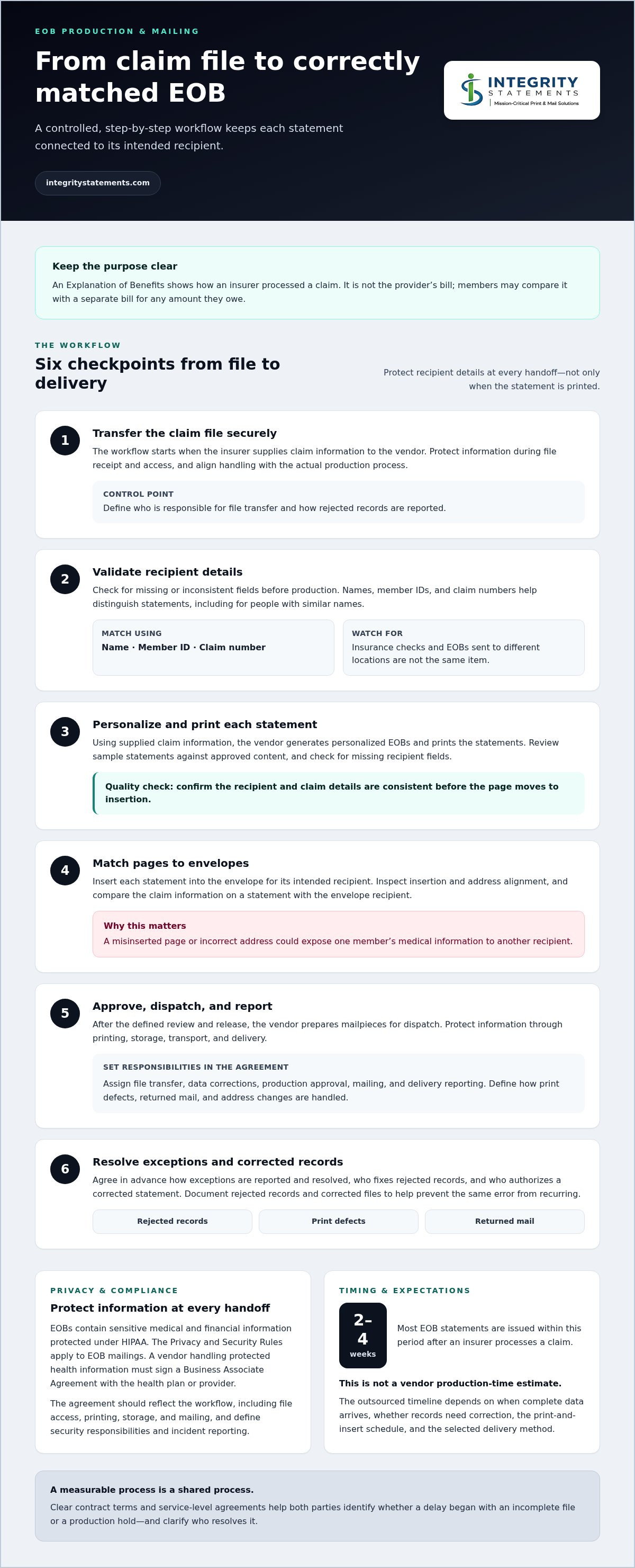
A third-party vendor uses supplied claim information to generate personalized EOBs, print statements, insert them into envelopes, and prepare them for mailing. Matching recipient details to every printed page is essential: an incorrect insert could expose one member’s medical information to another. A defined review step can catch missing or inconsistent fields before documents move to insertion and dispatch.
Processing Time and Delivery
The outsourced timeline runs from secure file transfer through production and postal delivery. Its duration depends on when complete data arrives, whether records need correction, the print-and-insert schedule, and the selected delivery method. Most EOB statements are issued within 2-4 weeks after an insurer processes a claim, but that is not a vendor production-time estimate. Set expectations around each stage instead.
Contract terms and service-level agreements should assign responsibility for file transfer, data corrections, production approval, mailing, and delivery reporting. They should also define how the vendor handles rejected records, print defects, returned mail, and recipient address changes. Clear terms make the workflow measurable. For instance, both parties can identify whether a delay began with an incomplete file or a production hold. Specify how exceptions are reported and resolved, and who authorizes a corrected statement.
HIPAA compliance in EOB production and mailing
EOBs contain sensitive medical and financial information protected under HIPAA. A mailing vendor may handle patient names, claim details, prescription information, and reimbursement amounts. Security risks can arise during file handling, printing, storage, transport, or delivery. Quality risks include a misinserted page, incorrect address, duplicate statement, or unreadable appeal instructions.
HIPAA’s Privacy and Security Rules apply to EOB mailings. Protect information at every handoff: file receipt, print production, envelope insertion, dispatch, and delivery. A page placed in the wrong envelope, for example, could disclose a patient’s care details to another recipient. Checking recipient data and finished mailpieces helps identify errors before dispatch.
A vendor handling protected health information must sign a Business Associate Agreement with the health plan or provider. The agreement sets out the vendor’s role in handling that information and gives both parties a basis for defining permitted processing, security responsibilities, and incident reporting. It should align with the actual workflow, including file access, printing, storage, and mailing.
Quality control should cover both data and physical output. Before production, review records for missing recipient fields or inconsistent member details. During production, compare sample statements with approved content, then inspect insertion and address alignment. For example, check that the claim information on a statement matches the intended envelope recipient. Documenting rejected records and corrected files helps prevent the same error from recurring in later mailings.
Dependent statements need particular care. In some cases, insurers may send confidential EOBs for minors or dependents, especially for sensitive services, depending on state law. The mailing process should preserve designated recipient information through printing and insertion. EOBs may also include appeal instructions or health plan details, so a misplaced page can affect privacy and a patient’s ability to understand a claim.
For a sound filing and review process, define who approves data, resolves exceptions, and releases each mailing. This keeps the insurance company and vendor aligned when an address correction or production issue arises. The same controls help distinguish routine claim statements from communications involving sensitive care or unexpected coverage decisions.
Paper and electronic EOB delivery
Health insurance EOBs typically arrive by mail and may also be available through an online member portal. Some insurers provide electronic delivery through portals or email. The channel changes how members receive a statement, not what the claim information explains, such as covered treatment or deductible amounts.
Outsourced mailing moves printing, inserting, and dispatch outside the health plan’s in-house workflow. Electronic delivery avoids printing and postal handling. In-house production keeps those tasks within the organization, while a portal lets members retrieve statements online. Each method needs a clear process for delivering the correct EOB to its intended member.
Plans can consider offering paper and electronic delivery options, while allowing members to choose an available format. HIPAA doesn’t prescribe paper or digital EOB delivery, but the method must protect patient privacy. A health plan weighing channels should account for member preferences, secure access, and how recipients can retain or retrieve claim records.
Paper statements can help members who need a physical copy for billing questions or records. Electronic access can make a processed claim available through an online account, while email can notify members or deliver information electronically. A member reviewing a facility bill, for example, can compare it with the EOB’s coverage and deductible details. The EOB itself is not the provider’s bill.
For USPS mailing, prepare each EOB as a correctly addressed, sealed mailpiece and keep its contents matched to the intended recipient. Delivery methods must protect patient information. HIPAA does not prescribe a paper or digital channel, so address accuracy and careful insertion remain practical controls for mailed statements.
Plans can make delivery easier to understand by explaining where members find statements and how to select an available format. A member using a portal may retrieve an electronic EOB, while someone who prefers paper can receive a mailed copy. Clear, consistent delivery information also helps patients distinguish an insurer’s claim explanation from a separate health care facility bill.
Which vendors provide outsourced EOB printing and mailing services in the United States?
U.S. organizations can work with print-and-mail providers that produce and distribute healthcare statements. Some focus on document production and postal preparation; others support broader healthcare communications. When assessing options, a health plan should distinguish a mailing partner from a medical billing firm. Billing firms handle claim and payment administration, while print-and-mail vendors focus on preparing documents for delivery.
Consider which tasks the vendor will own. A print-and-mail provider may receive statement data, format EOBs, print them, insert pages into envelopes, and prepare mail for dispatch. A plan sending claim statements by mail, for example, needs a process that connects each record to its printed document and outgoing envelope. Define where the provider’s responsibility begins and ends.
Healthcare communications providers may handle EOBs alongside other member-facing documents, which can suit organizations coordinating several statement types through one production workflow. A general print-and-mail provider may fit a narrower mailing project. Compare each provider’s services with the actual document, recipient, and delivery requirements.
Useful evaluation points include data intake, variable-data personalization, exception handling, production review, and delivery reporting. Ask how the workflow handles an incomplete address or conflicting member details. Make the question specific: does the record pause for correction or proceed to print? The answer shows how the vendor manages irregular files.
Include security in the same assessment. If a vendor handles protected health information, the health plan or provider must have a Business Associate Agreement with that vendor. Review the agreement alongside the production workflow, including data access, storage, and mailing responsibilities. The service description should make clear how these duties fit together.
Compare proposals by scope, handoffs, exception procedures, and reporting rather than relying on a broad “mailing” label. Establish, for example, whether the vendor receives ready-to-print files or also prepares the statement layout. Clear boundaries help prevent gaps between claim processing, document production, and delivery, while making it easier to identify who resolves a delayed or rejected mailing.
Integrity Statements: Statement Printing and Mailing
Integrity Statements provides Statement Printing and Mailing for organizations managing recurring, business-critical statements. Its Healthcare Communications Printing and Mailing service supports coordinated distribution of EOB communications. These services help organizations move statement production and mailing out of internal workflows while keeping document delivery at the center.
Turn to Integrity Statements when your team needs support producing and mailing healthcare statements, or when statement work sits alongside invoice and billing communications. The right scope depends on the documents and distribution process your organization needs to manage. Contact Integrity Statements to discuss your statement printing and mailing needs.
Set Up Your Next EOB Mailing With Confidence
Start by mapping EOB distribution to your organization’s wider statement workflow. Consider who prepares the source files, how recipients are assigned, and where paper or electronic delivery fits. This operational view helps determine whether outsourcing explanation of benefits (EOB) mailing suits your team and provides a clear basis for planning the transition.
Integrity Statements offers Statement Printing and Mailing, Invoice and Billing Printing and Mailing, and Healthcare Communications Printing and Mailing. These services support organizations managing recurring statements and healthcare communications within their broader document operations. Share the communication needs you want to address and request a quote to discuss a print-and-mail workflow that fits.
Contact Integrity Statements today to discuss your statement and healthcare mailing needs. A considered next step can help your team move toward a more manageable communications workflow.
Frequently Asked Questions
If You Outsource Advance EOB Printing, Can Your Vendor Keep Up?
An outsourced vendor can keep pace when its production capacity, schedule, and file readiness match the plan’s advance communication calendar. Integrity Statements lists a 24-48 Hour Turnaround; that stated window doesn’t establish capacity for every volume or timing pattern. Set file-arrival dates, content approval deadlines, and escalation steps so teams can identify schedule pressure before a mailing is due.
What Is an EOB?
An EOB is an insurer’s explanation of how it processed a health claim, not the provider’s bill. It can help members interpret a later billing statement by showing claim references, allowed amounts, or adjustment explanations. A denied service, for example, may include a remark code or appeal instructions. A remittance advice serves a different audience: it goes to the healthcare provider.
What does outsourcing explanation of benefits (EOB) mailing involve?
Outsourcing explanation of benefits (EOB) mailing means assigning statement preparation and distribution to an outside print-and-mail operation. Depending on the workflow, the handoff can include source data transfer, layout review, personalized pages, envelope insertion, and mail preparation. Agree on how incomplete records are flagged and corrected. For example, define who supplies updated addresses and who releases corrected statements after validation.
What HIPAA and privacy rules apply to outsourced EOB mailing?
HIPAA’s Privacy and Security Rules apply to EOB information, and a vendor handling protected health information must have a Business Associate Agreement with the health plan or provider. Define how information is protected during electronic transfer, production, storage, and delivery. Plans should also account for sensitive dependent communications where state law affects disclosure, so recipient handling reflects the circumstances of each mailing.