
Compliance Mailing for Texas Businesses: Who Must Comply
A Texas business isn’t automatically outside privacy rules just because it’s small. The Texas Data Privacy and Security Act (TDPSA) generally excludes small businesses as defined by the U.S. Small Business Administration, but they still can’t sell sensitive personal data without prior consumer consent. For compliance mailing for Texas businesses, promotional texts require careful attention to whether opt-in was clear and relevant to the message. According to the Texas Secretary of State, as of the November 2025 settlement guidance, registration requirements don’t apply to businesses that text only people who affirmatively opted in.
Treat consent as a recordkeeping and communication issue, not just a checkbox. A clear opt-in should show who agreed, to which brand and purpose, and how the agreement was captured. Keep auditable records of the time, source, and method of consent.
This guide explains which businesses the TDPSA covers, where its small-business exception ends, and what distinguishes genuine opt-in consent from permission that cannot support a promotional text. It also explains how these rules relate to business communications sent by mail.
Key Takeaways
- Separate privacy obligations under the TDPSA from routine business filing requirements; they address different responsibilities.
- The Texas Comptroller of Public Accounts says active business entities registered in Texas must file an annual franchise tax report by May 15, even if no tax is due.
- Learn how to distinguish official notices from third-party compliance solicitations before deciding whether a mailing requires action.
- Use the sender, stated requirement, and requested next step to assess what a compliance notice is asking your business to do.
Businesses covered by the TDPSA
The Texas Data Privacy and Security Act (TDPSA) is Texas’s consumer privacy law governing covered personal-data processing. A business’s first step is to assess the personal information it handles, why it processes it, and whether a small-business exception applies.
A controller is a person or entity that decides why and how personal data is processed. A processor handles personal data on a controller’s behalf. Understanding these roles helps businesses identify their privacy responsibilities and determine which relationships need documented terms.
Personal data is information linked or reasonably linkable to an identified or identifiable individual. Deidentified data and publicly available information are excluded from this definition. For example, a customer name tied to an account can identify a consumer, while information meeting the statutory exclusions is treated differently.
The TDPSA generally does not apply to small businesses as defined by the U.S. Small Business Administration. But the exception has an important limit: a small business remains subject to the restriction on selling sensitive personal data without prior consumer consent. Before acting, distinguish ordinary processing from a proposed sale of sensitive data.
The TDPSA separately excludes employment data collected and used in the context of an individual applying for or working in an employment or contractor role. When reviewing applicant information for a hiring decision, distinguish that use from personal data collected from customers for another purpose.
Covered controllers have operational duties beyond identifying personal data. They must provide at least two secure, reliable ways for consumers to submit rights requests. A controller must respond no later than 45 days after receiving a request, unless an extension applies. It may extend once by an additional period when reasonably necessary, provided it gives notice within the initial 45-day deadline.
Consumers can request access to, correction of, or deletion of their personal data; request a portable copy of certain data; and opt out of specified processing. A controller may require an existing account for a request, but cannot require the consumer to create a new one. If commercially reasonable efforts cannot authenticate a request, the controller may decline to act and must provide an appeal process.
A privacy notice explains how a controller handles personal data. Under the TDPSA, it must describe the categories of data processed and shared, the purposes of processing, the categories of third parties, and how consumers can submit rights requests. Controllers that sell personal data to third parties or process it for targeted advertising must clearly disclose that practice and explain how consumers can opt out.
Two business filing duties can also appear in official mail, but they are separate from TDPSA privacy duties. Active business entities registered in Texas must file an annual franchise tax report with the Texas Comptroller of Public Accounts by May 15, even if no tax is due. Texas businesses must notify the Attorney General within 30 days of a data breach affecting 250 or more Texans, according to the Texas Attorney General.
After receiving a compliance notice by mail, identify the sender, the entity and rule named, the requested action, and any stated deadline. Compare the notice with the relevant official agency communication, and keep the envelope and letter with your records.
A notice about a business license or annual filing does not, by itself, establish a TDPSA duty. First classify the issue: privacy processing, a consumer request, a breach, or a separate filing each requires a different response.
Controllers must document assessments. Processor contracts must require confidentiality and, as requested, deletion or return of data after services are complete. The Texas Attorney General has exclusive enforcement authority under the Act; there is no private right of action.
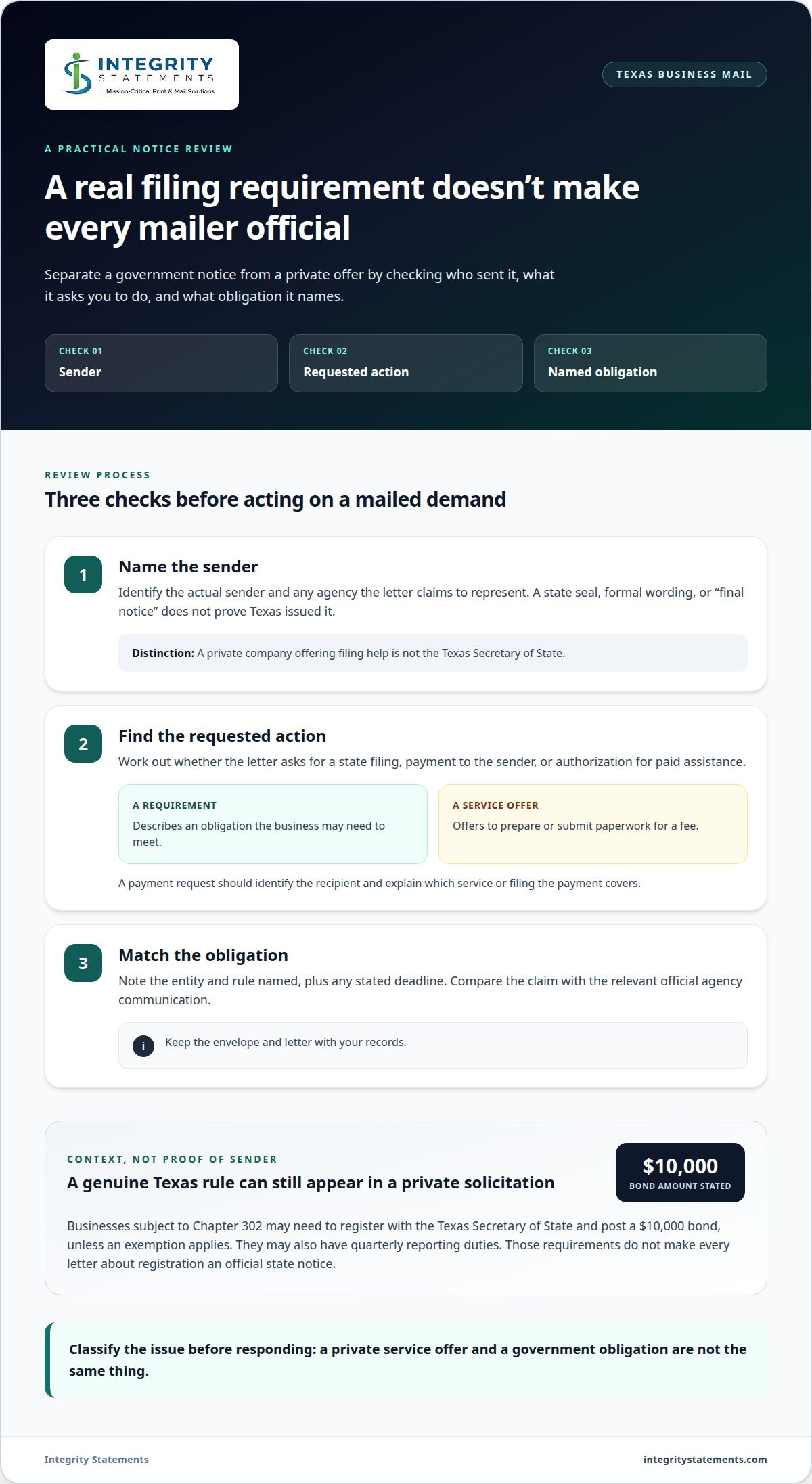
Are compliance mailings from third-party companies official or potentially misleading?
An official notice is a communication from a government agency about an obligation it administers. A third-party mailing comes from a private company, often offering filing assistance or another service. The distinction matters: a private offer can relate to a real filing without being a government demand or an agency-approved service.
Start with the sender, not the envelope design. A state seal, formal wording, or the phrase “final notice” does not prove Texas issued the letter. Identify the named sender, the agency it claims to represent, and the action requested. For example, a company offering help with an entity filing is not the Texas Secretary of State.
Check whether the letter describes a legal requirement or offers help completing a task. A notice may explain a filing obligation, while a solicitation may offer to prepare or submit paperwork for a fee. These are different propositions. A payment request addressed to your business should identify the recipient and explain which service or filing the payment covers.
Some private mailings refer to genuine Texas requirements. Businesses subject to Chapter 302 may need to register with the Texas Secretary of State and post a $10,000 bond, unless an exemption applies. They may also have quarterly reporting duties. Those requirements do not make every letter about registration an official state notice.
Use a short review process before acting on a mailed demand:
- Name the sender. Separate a Texas agency from a private filing or compliance company.
- Find the requested action. Note whether the letter asks for a state filing, payment to the sender, or authorization for paid assistance.
- Match the obligation. Compare the cited filing or rule with the business’s actual entity type and activity.
- Inspect the payment instructions. Confirm the payee and whether the amount is described as an agency fee or a private service charge.
- Preserve the notice. Keep the letter and envelope with business records, especially if it gives a deadline or claims a filing is overdue.
For example, a private company might offer to prepare a report that an entity must file. The filing obligation and the company’s offer are separate. Check whether payment goes to the state or the mailer, and whether the letter clearly describes the service being sold.
Texas rules also vary by activity, so a mailing about one program may not apply to every business. Under the Texas Secretary of State’s stated enforcement interpretation as of the November 2025 settlement guidance, registration requirements do not apply to businesses that text only people who affirmatively opted in. That example shows why the claimed activity and the business’s actual practices matter.
Urgent wording does not prove that a deadline is official. A private letter may use a due date to encourage a response, while an agency notice may identify a filing or action it administers. Before responding, compare the named authority, requirement, business entity, and requested payment.
When a letter cites a real Texas obligation but sells assistance, separate the decisions: determine whether the obligation applies, then decide whether to purchase the offered service. Keep copies of the notice, any completed filing, and payment records. This paper trail helps distinguish government action from a private transaction later.
Following the passage and implementation of SB 140, the Texas Secretary of State requested a written opinion from the Texas Attorney General, and the opinion had not yet been issued when the page was written. That status is relevant when assessing a mailing that describes the agency’s interpretation: distinguish a request for an opinion from an issued opinion. For data-processing matters, contracts between controllers and processors must specify data-processing instructions, purpose, data type and duration, and each party’s rights and obligations. For filings, Texas Secretary of State expedited service processes documents before other documents received the same day and sends the filing party written notice of the filing disposition by email.
Promotional-text rules are another distinct compliance subject. Texas promotional texts may be sent during 9 am – 9 pm Mon – Sat and noon – 9 pm Sun, Central Time. The page compares the federal TCPA texting hours of 8 am – 9 pm with Texas’s stricter hours. A communication about hiring policies concerns a separate issue: businesses should remove COVID-19 vaccine mandates from hiring policies in accordance with SB 7. Identify the topic and the action requested before treating a mailing as an official demand or paying a private company to assist.
Integrity Statements
Integrity Statements helps businesses prepare and send essential communications through professional print and mail services. When a compliance decision results in a required notice, statement, invoice, healthcare communication, or regulatory document, dependable delivery becomes part of carrying out that decision.
Organizations can use Integrity Statements for Statement Printing and Mailing, Invoice and Billing Printing and Mailing, Healthcare Communications Printing and Mailing, and Tax Forms & Regulatory Mail Printing and Mailing. These services support recurring, business-critical mail while keeping document delivery distinct from legal advice or determining whether a law applies.
If your organization needs help producing and mailing important business communications, contact Integrity Statements to discuss your print and mail needs.
Build a clearer communication process
Once you understand a notice’s purpose, make essential communications consistent and ready for delivery. Assign responsibility for each document, maintain accurate content, and coordinate mailing to keep routine communications orderly as requirements change. Effective compliance mailing for Texas businesses also considers how important information reaches customers, not just how the business responds to notices.
Integrity Statements provides Statement Printing and Mailing, Invoice and Billing Printing and Mailing, and Healthcare Communications Printing and Mailing. These services help businesses manage recurring, business-critical documents through a dedicated print and mail process.
For support with your organization’s essential communications, contact Integrity Statements. A clear process can make the next mailing easier to manage.
Frequently Asked Questions
Who Is Affected?
Businesses handling personal data from Texas consumers should assess whether the TDPSA applies to their activities. Start by mapping what information each business unit collects, why it uses it, and whether the business decides how that data is processed or handles it for another organization. Customer account records and applicant records, for example, may fall under different rules, so classify each data use separately.
What is a compliance mailing for a Texas business?
A compliance mailing is a physical business communication sent or received to meet an administrative, regulatory, or customer-notification need. Examples include tax forms, regulatory documents, and notices about an account or policy change. The term describes the communication’s purpose, not its legal status: a private company’s mailed solicitation is not automatically an official government notice, and sending a document by mail does not itself establish compliance.