

Medical Billing Mailing Services in Houston: Secure Patient Statement Delivery
What happens when the billing work is complete but patient statements still need to be printed, prepared, and mailed? For Houston healthcare organizations, medical billing mailing services Houston can handle that physical fulfillment step without taking over claims processing or revenue-cycle management. One function manages billing activity; the other turns approved statement data into patient mail.
It’s understandable to be cautious about outsourcing communications that contain sensitive patient information. A dependable workflow makes each stage clear, from receiving billing data and preparing statements to printing, assembling, and handing off mail. Outsourcing this work can also shift recurring statement production and distribution tasks away from in-house staff.
This article explains how patient billing statements move from billing data to the mailbox, what to consider when planning accuracy and secure handling, and how outsourced fulfillment can support an existing billing operation. You’ll also learn how Integrity Statements’ healthcare communications printing and mailing service supports statement delivery for Texas healthcare organizations.
Key Takeaways
- Distinguish claims billing and revenue-cycle management from the physical production and mailing of patient statements.
- Follow the statement workflow from approved billing data through print preparation, production, mail preparation, and handoff.
- Set clear responsibilities, production checks, and exception-handling steps to support accuracy and careful handling of patient communications.
- Understand how medical billing mailing services Houston can help healthcare organizations outsource recurring statement fulfillment while keeping their existing billing operation in place.
- See how Integrity Statements’ healthcare communications printing and mailing service supports patient statement delivery for Houston-area organizations.
Medical billing mailing services in Houston: what the term means
Houston searchers looking for medical billing mailing services may be seeking one of two things: help managing claims and patient accounts, or help producing and sending printed patient statements. These functions happen at different points in the billing process. A statement mailing service handles the physical communication, while the provider’s billing operation remains responsible for the account information and decisions behind it.
Here, medical billing mailing means producing and sending printed billing communications using data supplied by a healthcare provider. The work turns approved statement information into mail for patients. It doesn’t determine what a patient owes, submit an insurance claim, or follow up on unpaid balances.
A billing service manages billing activity; a billing statement mailing service prints and sends patient-facing communications using provider-supplied data.
What does a medical billing mailing service handle?
Statement fulfillment focuses on the printed communication: patient billing statements and related healthcare communications are prepared for mailing and sent to their intended recipients. Outsourcing this production and distribution can move recurring print-and-mail work outside the office, while the internal billing team continues managing patient accounts.
The provider’s billing operation remains the source of account and statement information. That boundary helps set expectations: the mailing function works from information the provider supplies rather than independently creating or adjudicating a balance. The workflow is shaped by the provider’s requirements. The broader Medical billing process includes administrative work beyond preparing a printed statement.
How is statement mailing different from medical billing?
Medical billing commonly refers to administrative work that supports payment for care, including coding and submitting claims to insurers. Statement mailing is a separate task: producing and distributing a patient-facing document. One helps manage billing activity; the other handles the statement’s journey into the mail.
For example, a provider’s billing team processes a claim and determines the account information to communicate. Once a patient statement is approved for mailing, a print-and-mail service can produce and send it. Outsourcing fulfillment doesn’t mean the mailing service manages the claim, posts a payment, negotiates with a payer, or collects money from the patient.
This distinction helps Houston healthcare organizations identify their operational need before choosing medical billing mailing services Houston. If the challenge is claim submission or denial follow-up, that’s claims or revenue-cycle work. If statement data is ready but staff spend time printing, assembling, and distributing recurring mail, the need is statement fulfillment. Integrity Statements prints and mails healthcare billing communications to support a provider’s existing billing operation.
How patient billing statements move from data to mail
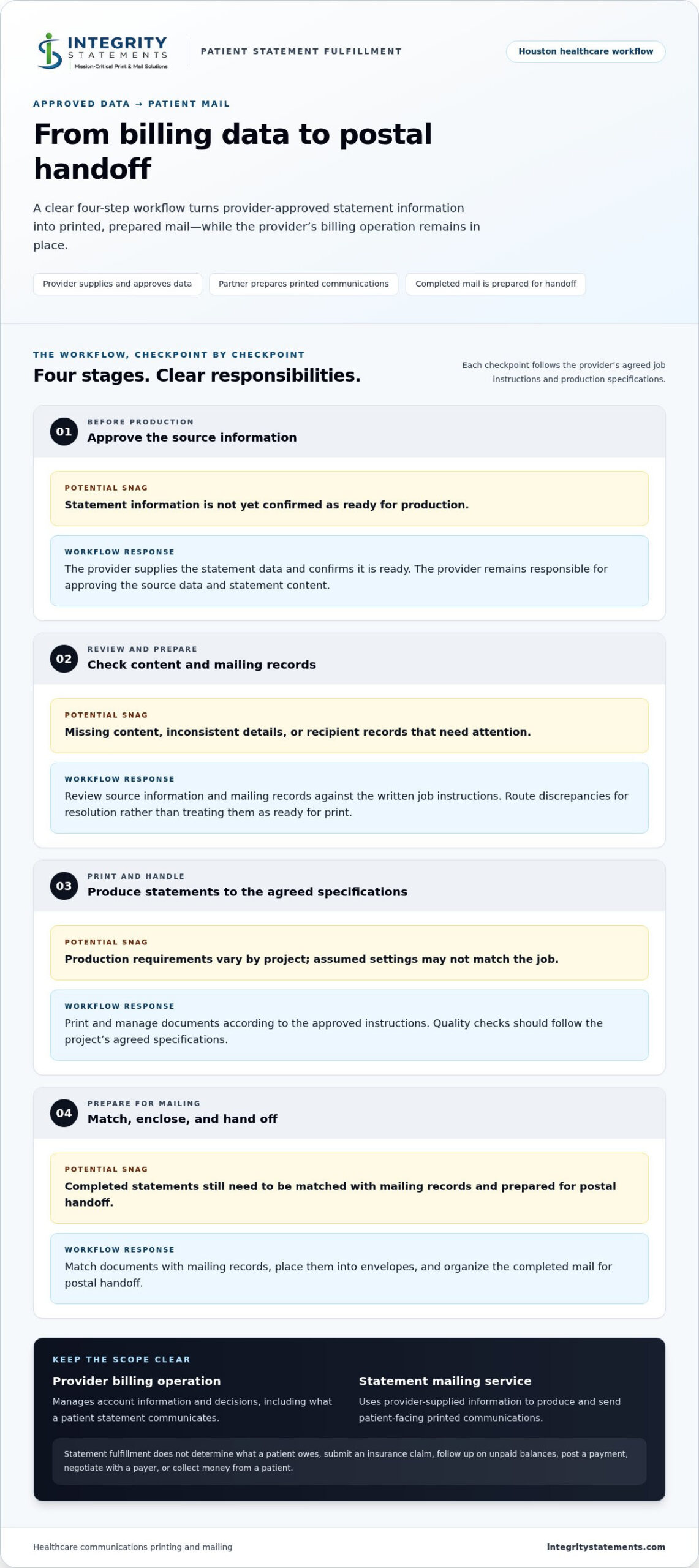
A dependable statement workflow starts before a page reaches the printer. It begins with approved billing data and clear production instructions, then moves through preparation, printing, mail preparation, and handoff. Each stage has a distinct purpose: confirm the information, produce the document as specified, and prepare completed statements for mailing.
What happens before patient statements are printed?
The provider and print-and-mail partner establish the job requirements, including what information is supplied and how finished statements should be prepared. The provider remains responsible for approving the source data and statement content. Written instructions give the production team a shared reference without assuming a particular file format or technology.
Before production, source information and mailing records can be reviewed against those instructions. Proofing helps identify issues such as missing content, inconsistent details, or recipient records that need attention. A discrepancy should be routed for resolution rather than treated as ready for print. The checks should match the agreed workflow. For a broader look at document controls, see this guide to secure statement printing and mailing services.
How are statements prepared for mailing?
Once information is approved for production, statements are printed and handled according to the agreed instructions. The documents are then matched with their mailing records, placed into envelopes, and organized for postal handoff. Because production requirements vary by project, quality checks should follow the approved specifications rather than assumed settings.
- Approve the source information. The provider supplies the statement data and confirms it is ready for production.
- Prepare and review. Content and mailing records are checked against job instructions, with discrepancies directed for resolution.
- Print and handle documents. Statements are produced and managed according to the approved specifications.
- Prepare and hand off mail. Documents are matched with mailing records, enclosed, and prepared for postal handoff.
Reconciliation adds a checkpoint between production and handoff. Comparing completed pieces or production totals with the job instructions can help surface omissions or mismatches before mail leaves the workflow. The method should fit the project, with responsibilities and exception handling defined in advance. Because patient statements contain sensitive information, handling expectations should also be clear. The U.S. Department of Health and Human Services explains the HIPAA Privacy Rule, a relevant reference when organizations consider privacy in communications involving patient information.
In short, approved data becomes a reviewed statement, a prepared mail piece, and a postal handoff through a workflow shaped by the provider’s requirements. For Houston organizations evaluating medical billing mailing services Houston, understanding these checkpoints helps them plan fulfillment without adding print-and-mail tasks to the billing team’s routine. Integrity Statements provides healthcare communications printing and mailing to support that work. Learn about healthcare print and mail support.
Medical billing mailing versus full-service revenue-cycle management
The two functions may touch the same patient account, but they solve different operational problems. Revenue-cycle management (RCM) supports the financial process around care, from preparing claims to tracking payments. Print-and-mail fulfillment handles the production and distribution of patient-facing documents. A practice can assign these responsibilities to separate internal teams or partners, with each working within a clearly defined role.
Claims and RCM work
- Purpose: Manage administrative billing activity connected to reimbursement and account processing.
- Typical work product: Coded claims, submitted claims, payment records, and follow-up on denials or outstanding balances.
- Operational owner: The practice’s billing or revenue-cycle team, whether internal or supported by an RCM partner.
- Place in the journey: Works across billing activity, including steps before a patient statement is ready.
Print-and-mail fulfillment
- Purpose: Produce and distribute approved patient billing communications in physical form.
- Typical work product: Printed statements and other prepared healthcare billing mail.
- Operational owner: The provider supplies and approves statement information; a print-and-mail partner handles physical fulfillment.
- Place in the journey: Supports delivery after the billing operation has prepared the information for communication.
The distinction is useful when defining a project’s scope. A print-and-mail partner doesn’t take over clinical billing operations, and statement delivery alone doesn’t resolve claim issues or manage patient accounts. A practice with an established billing function may not need to outsource that work just because staff spend time producing recurring mail.
When is a mailing partner the right operational fit?
A mailing partner may be a fit when statement production and physical distribution are recurring tasks that draw staff away from other responsibilities. The provider retains its billing process and approved account information, while the partner handles production and mailing. This separates operational roles without changing who manages claims or patient balances. Related transactional communications, such as invoices, can also involve invoice printing and mailing services.
When is the need broader than statement delivery?
If the workload centers on coding, eligibility, claim submission, denial follow-up, or payment posting, the need extends beyond physical statement delivery. These activities belong to the broader billing or RCM workflow. Naming the specific task helps a practice distinguish a claims-management need from a print-and-mail need.
For Houston healthcare organizations, the phrase medical billing mailing services Houston can point to either type of support, so start with the task causing the operational strain. Preparing claims or tracking payer responses is an RCM function. If approved patient statements are ready but recurring printing and distribution consume staff time, fulfillment is the more precise service category. Integrity Statements prints and mails healthcare billing communications to complement the billing operation already in place.
How to assess accuracy, privacy, and control in patient statement mail
Patient statement mail calls for clear controls from the moment information is approved through the point mail leaves production. A useful review looks beyond the printed page: who approves the data, who can access it, how completed output is checked, and what happens if something doesn’t match the instructions.
Mailing accuracy depends on controlled inputs and clearly assigned review responsibilities. This gives healthcare organizations a practical starting point for evaluating a workflow and clarifies which decisions belong to the provider and which production tasks are assigned to the print-and-mail partner.
Which quality checks matter before statements leave production?
Define checks around the provider’s approved content and agreed production instructions. A review can consider whether statement content is correct, whether the number of records received aligns with the expected job, whether mailing address data is present, and whether completed output follows the specifications. Checks should fit the workflow rather than rely on assumptions about a particular system or report.
Exceptions need a defined path. If a record is incomplete or an output doesn’t match its instructions, the process should identify who reviews it and whether it is held for resolution. Unresolved items shouldn’t proceed as though they were approved. Clear ownership helps prevent uncertainty from carrying through to the mail stream.
How should healthcare organizations think about sensitive mail?
Privacy and security responsibilities depend on the parties involved, the information being handled, their agreements, and applicable requirements. Healthcare organizations can document responsibilities across the workflow, including who authorizes statement data, who handles it during production, how questions or exceptions are escalated, and who is responsible at each handoff. These practices support accountability without treating a general checklist as a legal guarantee.
Access boundaries matter, too. The workflow should define which roles need access to information to perform their assigned tasks, and procedures should align with the organization’s privacy policies and applicable obligations. Documenting those expectations helps internal teams and external partners share a clear understanding of how sensitive communications are handled.
Mail tracking is a related but distinct consideration. Organizations assessing whether particular documents need tracking can review secure mail tracking for business documents as a separate topic; tracking isn’t part of every mailing workflow.
For Houston organizations considering medical billing mailing services Houston, a careful assessment connects accuracy checks with privacy responsibilities and exception handling. Integrity Statements provides healthcare communications printing and mailing with a focus on secure handling, accuracy, and timely delivery. Explore healthcare statement printing and mailing to see how outsourced fulfillment can support your existing billing workflow.
Outsource Houston patient statement mailing with Integrity Statements
For Houston-area healthcare organizations, Integrity Statements provides outsourced printing and mailing for healthcare billing communications. The service handles the physical statement workflow, shifting recurring production and mailing tasks away from internal staff while the provider retains responsibility for its billing operation, account information, and patient balances. Integrity Statements focuses on transactional mail, with attention to secure handling, accuracy, and timely delivery.
This is a focused operational partnership, not revenue-cycle management. It supports the point where approved billing information becomes a patient-facing mailed statement. A practice can consider print-and-mail support on its own merits without changing who manages coding, claims, or payment activity.
What can Houston healthcare organizations outsource?
Healthcare statement printing and mailing can move recurring document production and physical distribution out of the office. The provider’s billing team continues to determine and approve the information communicated, while fulfillment supports the printed communication. Organizations managing other transactional correspondence may also find custom print and mail solutions relevant to related business communications.
Before planning a transition, outline the work staff currently perform around a statement cycle. Consider which activities take time, where responsibilities pass between teams, and which requirements must be preserved in the outsourced workflow. A clear scope keeps the project centered on statement fulfillment rather than blurring it with claims or account management.
What should the next step look like?
Start with a practical summary of statement volume patterns, mailing frequency, and workflow requirements. Note how billing information is approved, which production instructions matter, how exceptions are handled, and which responsibilities remain with your organization. These details provide a useful basis for shaping print-and-mail solutions around operational requirements.
With that outline in hand, Houston organizations can define the intended scope and how statement fulfillment should fit alongside existing billing processes. Integrity Statements focuses on healthcare communications printing and mailing, with attention to careful handling and accurate production. The goal is to extend the workflow, not replace the provider’s billing team.
If your organization is evaluating medical billing mailing services Houston, discuss your healthcare statement mailing needs with Integrity Statements.
Plan the next step for patient statement delivery
Turn your current statement process into a short operational brief. Note when statement runs typically occur, which team approves the information, what requirements the mailing workflow must preserve, and where staff time is being spent. This gives your organization a clearer basis for deciding what to keep in-house and what recurring fulfillment work could move to a print-and-mail partner.
For teams researching medical billing mailing services Houston, the goal isn’t to change a billing operation that works. It’s to create a well-defined handoff for statement production and delivery, with responsibilities that fit the existing process. A thoughtful scope makes the transition easier to plan and keeps attention on reliable patient communications.
Integrity Statements provides healthcare communications printing and mailing to support that work. Discuss your healthcare statement mailing needs and take a practical next step toward a workflow that fits your organization.
Frequently Asked Questions
Can a medical billing mailing service process insurance claims?
No. A mailing service prepares patient statements for physical distribution; it doesn’t submit insurance claims, assign codes, or manage revenue-cycle work. The phrase “medical billing mailing services Houston” can describe a different need from outsourced medical billing. For example, a practice may keep payer follow-up with its billing team while assigning approved statement production and mailing to a fulfillment partner. Identify the task first to avoid overlapping scopes.
How does patient billing statement mailing work?
Patient statement mailing begins after the provider approves the account information and content intended for the patient. The production partner follows agreed instructions to prepare the statements, check the output, match pieces with mailing records, and ready them for postal handoff. If a record is incomplete or unclear, the workflow should specify how it is held and reviewed. The handoff is a process step, not a promise of arrival date.
Is patient statement mailing the same as medical billing?
No. Medical billing involves administrative work that supports payment for care, while a patient statement communicates account information to the patient. A claim is generally directed to an insurer; a statement is prepared for the patient after the provider’s billing process establishes what should be communicated. A mailing service handles production and distribution of that approved document, not coding or decisions about the underlying balance.
How much does outsourced medical billing statement mailing cost?
Outsourced statement mailing costs depend on the project’s scope, so planning starts with the work involved rather than a generic rate. Relevant details include how often statements are sent, expected volume patterns, content and mailing requirements, and which tasks remain with the provider. Texas organizations can describe their current workflow and priorities to clarify what fulfillment includes. A clearly defined scope makes the project easier to evaluate.
What information should a healthcare organization prepare for a statement mailing project?
Prepare a concise project brief with the purpose of the statements, approved content, expected mailing cadence, and organizational instructions that affect production or handling. Identify who approves account information, who resolves exceptions, and how sensitive data should be managed under your policies. Include how the current statement cycle works for your Texas organization, including handoffs that create staff burden. Requirements should shape the workflow rather than assume a single technical setup.
What happens if a billing statement contains an error before mailing?
If a potential error is found before mailing, the agreed exception process should determine how the affected record or piece is held and reviewed. The provider is the authority on account information and statement content, so it should decide what is correct before release. Clear responsibilities help distinguish a data issue from a production issue and establish the appropriate next step. Correction or reprinting depends on the circumstances and agreed workflow.
Can patient billing statements include custom notices?
Yes. Patient statements can be planned alongside related custom notices, such as an organization-approved message accompanying a billing communication. The healthcare organization should determine the wording, intended recipients, and when the notice applies, then approve the final content before production. Coordinating these materials within the statement mailing workflow can keep related communications organized, while the provider remains responsible for the accuracy and authorization of information sent to patients.


