
Variable Data Printing for Personalized Statements in Texas
What if a statement could surface the account detail a customer needs before they have to call? Generic statements can make balances, due dates, or account-specific notices harder to find. Variable data printing for personalized statements Texas businesses send can make recurring communications clearer by tailoring relevant content to each recipient while keeping the statement focused on business information.
Personalization can feel risky when data is sensitive or inconsistent. A dependable process starts with clear decisions about what belongs in the statement and careful coordination from data preparation through printing and mailing. The goal isn’t to turn an account document into promotional mail. It’s to present useful details in a way that’s relevant to the recipient and manageable for your team.
This article explains what statement content can be personalized, when variable data printing may fit recurring communications, and how to plan a reliable print-and-mail workflow for Texas recipients. You’ll also learn how to align your data, statement design, and mailing process so each piece is accurate, clear, and purposeful.
Key Takeaways
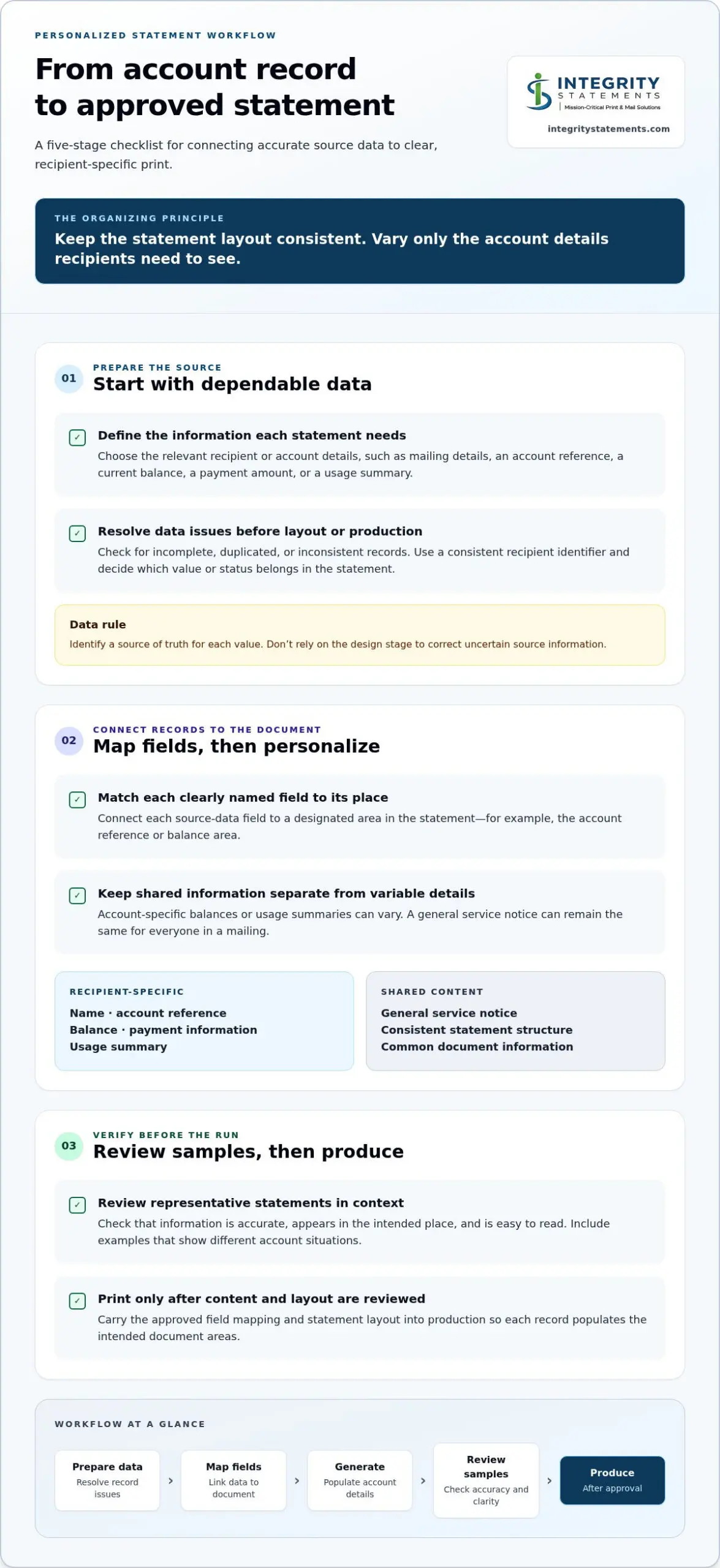
- Keep a consistent statement layout while varying only the account details recipients need to see.
- Map each source-data field to its intended place in the document, then review representative samples before production.
- Compare standard, segmented, and recipient-specific statements to determine whether customer differences call for individual personalization.
- For variable data printing for personalized statements Texas projects, define the audience, data fields, content variations, approval responsibilities, and mailing expectations up front.
- Outsourced statement printing and mailing can support recurring business communications alongside invoices, healthcare communications, and custom notices.
What Is Variable Data Printing for Personalized Statements in Texas?
A statement usually follows a familiar structure: it identifies the sender, summarizes an account, and presents information the recipient may need to review or act on. Variable data printing changes selected parts of a document according to recipient or account data while keeping the overall design consistent. The underlying approach is described in Variable Data Printing (VDP). For recurring statements, its practical value is that relevant details can appear in a familiar, organized format.
For statements, variable data printing uses recipient or account records to place the right details in designated areas of a consistent document. Those details can include more than a name. A name may help identify a recipient, but it doesn’t necessarily make a statement more informative. Personalization is useful when it helps explain that person’s account, activity, or next step.
Which parts of a statement can be personalized?
Depending on the document’s purpose and the information in its source records, variable fields can include a recipient’s name and mailing details, an account reference, a current balance, a payment amount, or a usage summary. For example, a utility statement could show account-specific usage, while a billing statement could display the relevant balance and payment information. Include data that supports the document’s purpose, not details that merely create visual variation.
It also helps to distinguish individualized content from shared content. A balance or usage summary may vary by account; a general service notice may be the same for everyone in a mailing. That distinction helps teams decide which information belongs in a variable field and which belongs in the standard statement design. The source record must supply accurate information, and the statement should present it where recipients can understand it easily.
Why Texas organizations use personalized business statements
Financial service providers, utilities, healthcare organizations, and other statement senders communicate about different accounts, services, and transactions. A consistent statement format makes recurring mail recognizable, while selected account-specific content helps recipients focus on information relevant to them. The value isn’t a promise that someone will take a particular action. It’s a clearer connection between the account record and the printed document.
Texas organizations serve customers across a large and varied state, from major metropolitan areas to smaller communities. Their accounts and service needs can differ, but that doesn’t mean every recipient needs a completely different document design. The value of variable data printing for personalized statements Texas organizations send depends on selecting useful information, distinguishing shared notices from account details, and matching each variable field to its source data. Personalization supports relevant communication; it doesn’t replace sound data handling or determine what information an organization must include.
How Variable Data Printing Connects Customer Data to Each Statement
Personalization depends on a clear link between an account record and the place its information appears on the page. A source record contains details for a recipient or account. A variable field is a designated space in the statement, such as the balance area, that receives a value from that record. A consistent identifier helps connect the right record to the right statement. If identifiers are missing or inconsistent, the match can be difficult to verify, so data preparation matters as much as document design.
Source data becomes recipient-specific print when each record is matched to defined document fields, reviewed in context, and carried into the approved statement layout. A practical sequence is:
- Prepare the data. Define which information is needed and resolve incomplete, duplicated, or inconsistent records.
- Map fields. Match each clearly named data field to its intended place in the statement.
- Generate personalized content. Use the mapped values to populate account-specific areas while shared content stays consistent.
- Review samples. Check representative statements for accurate information, placement, and readability.
- Produce the approved documents. Begin printing after the content and layout have been reviewed.
Prepare statement data before personalization
Start by defining a source of truth for each value. For example, decide which approved record supplies the account reference and which supplies the current balance. Use field names that make their meaning clear to everyone involved, and document how each field is used. This reduces ambiguity when data is matched to a statement template.
Before production, resolve incomplete, inconsistent, or duplicated records. A recipient identifier should match the intended account consistently, and values should be formatted so they can be placed and read properly. If an account has more than one relevant value or status, define which one belongs in the statement. Don’t rely on the design stage to correct uncertain source information.
Review personalized output before the full run
A single sample may not show how the statement handles different account situations. Review representative examples that cover the range of values and content variations expected in the mailing. Confirm that each variable field appears in its intended location, remains legible, and doesn’t crowd nearby text. Check both the printed details and the overall page flow.
Keep factual review distinct from design approval. The person responsible for statement information should verify account details and shared notices. A separate design review can assess hierarchy, spacing, and readability. Clear ownership helps teams resolve issues before they carry through the run. For organizations planning variable data printing for personalized statements Texas recipients receive, this review connects data quality to a more dependable print outcome.
For recurring business documents, outsourced statement printing and mailing brings document production and delivery together within one workflow.
When Personalized Statements Help, and When Simpler Mail Is Enough
Personalization is useful when recipients need different information to understand their statements. The right level depends on what varies, whether the difference matters to the recipient, and whether the data can be maintained and reviewed reliably. More customized content isn’t automatically clearer. A straightforward statement may work better when everyone needs the same information.
| Statement approach | What varies | A good fit when |
|---|---|---|
| Standard | The format and content are the same for all recipients, aside from basic addressing. | Everyone receives the same notice or account information. |
| Segmented | Content differs for defined groups, such as service type or account category. | Groups need distinct but shared explanations or notices. |
| Recipient-specific variable | Selected fields or content reflect an individual account or recipient record. | Personal account details materially affect what each person needs to review. |
Use this comparison as a fit test: does a recipient need different information to understand their account, activity, or notice? If so, segmentation or individual variation may make that information easier to find. If not, extra fields can add review steps and content complexity without serving a clear communication purpose. Aim for clarity, not maximum customization.
Good candidates for statement personalization
Personalization can suit a statement when account activity, usage, payment history, or notice details differ in ways recipients need to understand. For example, a billing document might distinguish a current charge from an adjustment, or a service statement might summarize the recipient’s activity for the period. In each case, the tailored content remains informational and supports the document’s central purpose.
Relevant differences are easier to find when they appear in a consistent, expected place. That can help recipients focus on the detail that applies to their account rather than search through generic text. It doesn’t ensure a particular response; it makes the document more specific to the record it represents.
When a standard statement may be the better fit
A standard statement can be the right choice when all recipients receive the same explanation, schedule, or general notice and individual account details don’t change what they need to understand. Adding variable fields just to make documents look different creates avoidable complexity. Each field needs a dependable source and a review process, so include personalization only when it solves a real communication need.
For teams assessing variable data printing for personalized statements Texas recipients receive, begin with the information need, then match the production approach to it. Keep shared content standard, segment only where groups genuinely differ, and use recipient-level variation when account-specific facts matter to the statement.
How to Plan a Variable Data Statement Project in Texas
A dependable statement project starts with written decisions, not the print file. Define who should receive the communication, what it needs to explain, and which details change by account. For organizations planning variable data printing for personalized statements Texas recipients will receive, a shared project plan helps align content, data, review, and mailing expectations.
Use this checklist to establish the scope before production:
- Define the audience and purpose. Specify which recipients receive the statement and what information it must communicate.
- Document the data fields. List each required field, its source, where it appears, and what should happen if its value is blank or unavailable.
- Set content variations. Describe which wording, figures, or notices vary by recipient, account, or defined group, and which content stays consistent.
- Set output expectations. Document the intended layout, page flow, readability needs, and mailing expectations.
- Assign review ownership. Identify who validates source information, approves statement language, reviews samples, and authorizes production.
- Verify applicable requirements. Privacy, data-retention, notice, and mailing requirements depend on the communication and information involved. Verify the rules that apply to your organization and project before final approval.
Set scope, content rules, and review ownership
Be specific about what varies. If one account value changes from recipient to recipient while the explanatory text stays the same, document that distinction. Identify who validates the source data and who approves the language, including required notices and deadlines. Assigning these responsibilities early helps prevent unresolved content questions from reaching production.
Mailing in Texas does not, by itself, establish that a particular personalization method is required. Requirements depend on the document type, data, and the organization’s obligations. Keep compliance review connected to the communication itself, and don’t treat a general project checklist as a substitute for verifying applicable rules.
Build a practical sample and approval checklist
Review representative samples before the full run. Include ordinary cases and edge cases, such as a long recipient name, a blank value, or a statement with different account content. For each sample, check that recipient details and account values are correct, variable content appears where intended, text remains legible, and the page flows properly.
Review factual accuracy separately from design. The content owner should validate figures, wording, notices, and deadlines; the design reviewer should assess layout and readability. Record the approved version, reviewers, and any changes made after review. This creates a clear reference for production and helps prevent an outdated version from being used.
For additional planning considerations around protecting and fulfilling statement communications, consult the secure statement printing and mailing guide. For a recurring statement project, include statement printing and mailing in your print-and-mail workflow planning.
Personalized Statement Printing and Mailing with Integrity Statements
Personalized content is one part of a larger statement program. The document must move from approved account information through production and into the mail as a clear, business-critical communication. Outsourcing printing and mailing brings those activities into one service relationship, giving organizations a coordinated option for recurring statements instead of managing document production and distribution separately.
Integrity Statements provides outsourced statement printing and mailing for Texas organizations. Founded in 1994, the company focuses on transactional mail, including statements, invoices, healthcare communications, tax forms, regulatory mail, and custom notices. These communications serve different purposes, but each depends on accurate information and a finished document that presents it clearly to the recipient.
Connect statement content with the mailing workflow
The appropriate print-and-mail approach depends on the project’s requirements, including document type, content, audience, and schedule. A recurring statement program may have different needs from a one-time notice, and an account-specific document may require different content planning from a shared communication. Aligning the statement and mailing workflow helps teams manage the path from approved content to delivery.
Invoices and statements both communicate account information, though their content and purpose differ. For related planning considerations, see the invoice printing and mailing guide. This can help organizations think across recurring business communications without assuming that every document should follow the same format.
Choose a next step for your Texas statement program
Before discussing a project, gather a few basics: the type of document, who receives it, which data fields or content vary, and how often the communication is mailed. Note any sample statements, content approvals, and review responsibilities that will shape the work. This gives the project conversation a practical starting point without requiring every production detail to be settled in advance.
For organizations exploring variable data printing for personalized statements Texas recipients receive, the goal is to connect useful personalization with dependable statement production and mailing. Integrity Statements supports business-critical communications through outsourced print-and-mail services shaped around project requirements.
To plan your Texas statement program, discuss your statement printing and mailing needs with Integrity Statements.
Make Your Next Statement Cycle More Intentional
Personalization works best as part of a communication plan, not as an extra layer added simply because it’s possible. As you prepare for a future statement cycle, choose one recipient need to address. Decide what information should be easier to understand, what should remain consistent, and how your team will keep those choices useful as account needs change.
That focus gives your organization a practical way to assess variable data printing for personalized statements Texas recipients receive: does the individualized content serve the statement’s purpose, and can it be supported by clear data and review ownership? A well-defined scope helps your team approach the next cycle with greater clarity, whether you’re refining an existing workflow or planning a new one.
Integrity Statements helps Texas organizations manage business-critical print-and-mail communications, including statements, invoices, healthcare communications, tax forms, regulatory mail, and custom notices. Discuss your Texas statement printing and mailing needs to plan a practical next step for your program.
Frequently Asked Questions
What is variable data printing for statements?
Variable data printing for statements means producing documents with selected content that changes according to recipient or account data. The statement can keep the same overall design while details such as an account reference or usage information differ for each recipient. Useful personalization helps explain the account or document; adding a name alone may identify the reader but doesn’t make the statement’s information more relevant.
How does variable data printing work for personalized statements?
The process begins with preparing source data and defining what each field means. Those fields are then matched to their intended places in the statement so recipient-specific content can be generated. Before production, review representative samples, including different account situations, to check that information is matched correctly and remains readable. Each field should connect to the appropriate recipient record and statement purpose, not be inserted without context.
Can variable data printing be used for invoices and billing statements?
Yes. Invoices and billing statements can include recipient-specific details such as an account reference, balance, usage summary, or payment information when those details are relevant. For example, an invoice may show charges associated with a particular account while keeping general payment instructions consistent. Accurate source information and careful review are essential. Personalization alone doesn’t ensure faster payment, fewer disputes, or another financial outcome.
Is variable data printing suitable for healthcare statements?
It can be used for healthcare statements when the document needs information specific to a recipient, such as a relevant account reference or amount due. Because healthcare communications may involve sensitive information, organizations should apply privacy and security practices appropriate to their work and verify requirements that apply to the specific communication. Variable data printing is a production method; using it does not, by itself, establish HIPAA compliance or guarantee compliance with other obligations.
What information can be personalized on a customer statement?
Possible fields include recipient details, account references, balances, usage summaries, and notices that apply to a particular account. The right selection depends on what the statement needs to communicate and what the organization’s source data can reliably support. Include only information that serves the document’s purpose. Don’t add a field simply because it can be printed, especially if it’s unnecessary or more sensitive than the communication requires.
Does variable data printing work for recurring statement mailings?
Yes, it can support recurring mailings if the organization maintains a defined source for statement information, consistent rules for content, and a repeatable review process. Before each cycle, records still need to reflect the current statement period, and the appropriate people should approve the content. For a Texas organization, the recurring workflow should also account for project-specific mailing or privacy considerations rather than assume one process suits every communication.
What should a Texas business prepare before starting a personalized statement project?
Start by identifying the document’s purpose, intended recipients, fields that may vary, and the person responsible for the source data. Name who approves statement wording and who reviews samples, then outline mailing needs and the expected schedule. Before production, verify privacy, data-retention, and mailing requirements relevant to your organization and communication. These considerations can differ by project, so don’t rely on a generic checklist as a substitute for review.