
Mail Deliverability for Critical Notices: Business Guide
What if a critical notice is delayed before it ever reaches the mail stream? Ensuring mail deliverability for critical notices starts well before postage is applied. An outdated address, a production error, or an unclear handoff can disrupt the entire mailing.
Address accuracy matters, but it is only one part of the process. Teams also need repeatable production checks and visibility into mailing stages and exceptions. Without those controls, preventable issues can lead to returned mail, rework, and delays.
This guide explains how to reduce avoidable errors by maintaining address data, setting quality checks, and coordinating the workflow from document preparation through mail handoff. You’ll also learn what to consider when managing high-volume business mail and how to handle exceptions consistently.
Integrity Statements provides print-and-mail services for business-critical communications, including statements, invoices, healthcare communications, tax forms, regulatory mail, and customer notices. The following sections outline practical ways to bring greater control to the journey from recipient data to the mail stream for Texas organizations.
Key Takeaways
- Mailing successfully doesn’t guarantee that a notice reaches a particular person by a specific date.
- Trace each stage, from approved recipient data through printing and mail handoff, to identify where address or production errors can arise.
- Use observable warning signs and assign responsibility for addressing data errors, mismatches, returned mail, and postal delays.
- Build a repeatable checklist with an accountable owner and approval point for each step, from data validation to exception review.
- Coordinating document processing and mailing can support a clearer workflow for ensuring mail deliverability for critical notices.
What does mail deliverability mean for critical business notices?
For physical business mail, deliverability is the ability to prepare and send a document to the address intended for its recipient. It starts with usable recipient information and continues through accurate document production and handoff to the postal system. It describes the quality of the mailing process, not proof that a specific person received, opened, or acted on a notice.
Several stages shape the outcome, and they aren’t interchangeable:
- Address quality: Recipient records need to reflect the intended destination. An outdated or incomplete address can undermine an otherwise accurate mailing.
- Production accuracy: The right document must be matched to the right recipient, with an address block that is legible and positioned for processing.
- Postal processing: After handoff, mail moves through postal operations that the sender doesn’t control.
- Recipient access: Even correctly addressed mail may not reach the intended person directly or prompt them to read and respond.
Ensuring mail deliverability for critical notices means managing the steps a business can control while recognizing where that control ends. It differs from email deliverability, which concerns whether an email reaches an inbox rather than being filtered or rejected. Both involve reaching an intended destination, but the practical factors differ. See Email Deliverability for an overview of the email-specific meaning.
Which business notices need dependable delivery processes?
Statements and invoices are often recurring communications, so a consistent process helps businesses prepare each cycle using current recipient data and accurate document matching. Healthcare communications, tax forms, regulatory mail, and customer notices also call for careful handling because errors can disrupt important exchanges or require follow-up. Texas businesses can reduce confusion by assigning clear ownership for address information, document approval, and mailing handoff, while tailoring checks to the notice being sent.
What deliverability can and cannot control
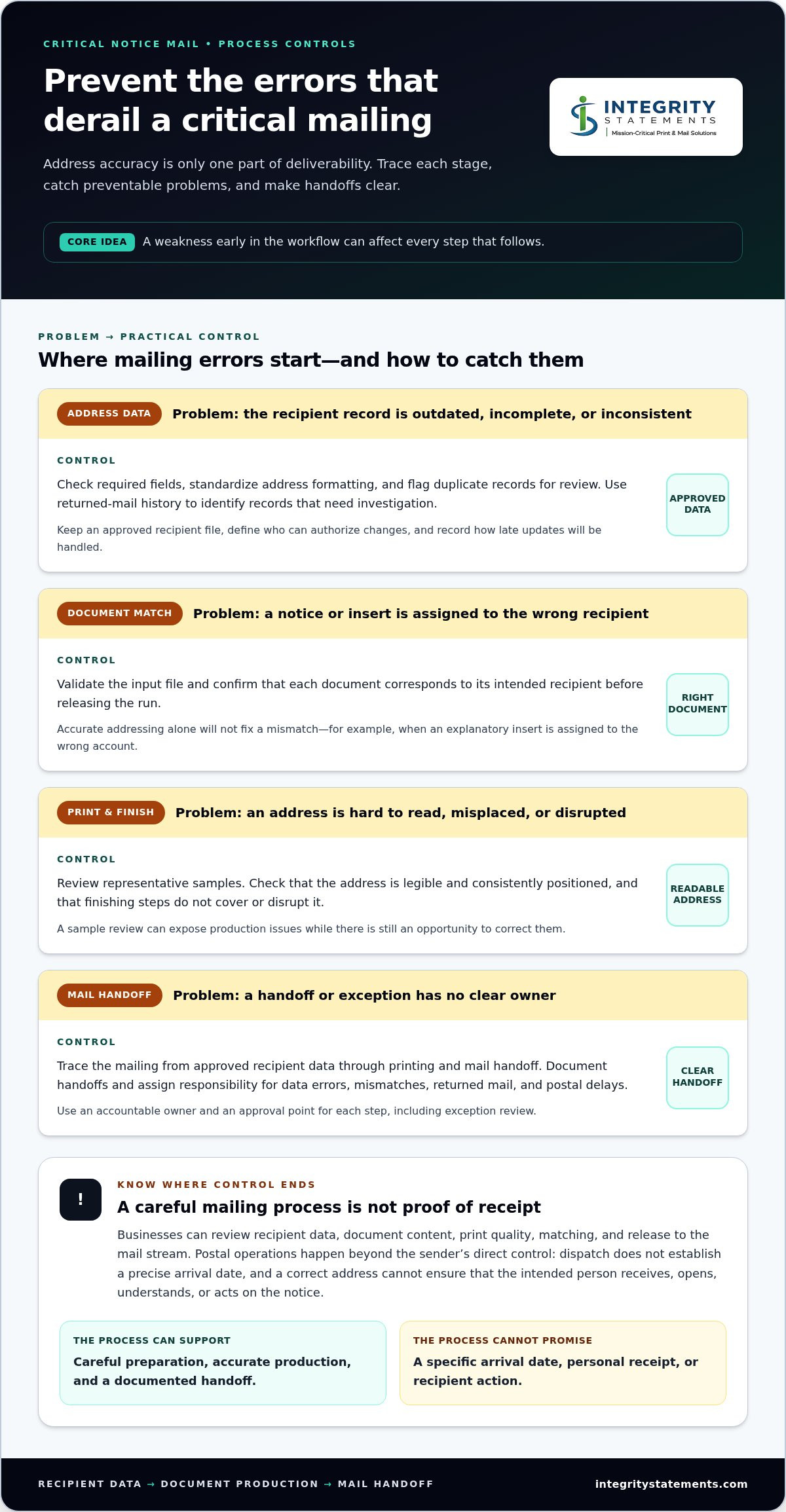
A business can set review points for recipient data, document content, print quality, matching, and release to the mail stream. These controls help reduce avoidable preparation and production errors. Postal operations happen beyond the sender’s direct control, so dispatch does not establish a precise arrival date. A correct address also cannot ensure that the recipient personally receives, opens, understands, or acts on the notice. A dependable workflow supports careful sending, not assured receipt.
For organizations managing statements, healthcare communications, tax forms, or regulatory mail, start by defining successful preparation, documenting handoffs, and treating delivery and recipient action as separate outcomes. That gives teams a practical basis for assessing risk without promising more than the mailing process can control.
How address data, document production, and mailing shape deliverability
A critical notice passes through connected stages before entering the mail stream: recipient data is approved, documents are composed, pages are printed and finished, and prepared mail is handed off. A weakness at any point can affect the result. An outdated address may send a piece to the wrong location; an insert matched to the wrong account can confuse a recipient; an obscured or difficult-to-read address can complicate processing.
A small upstream data error can be repeated across an entire mail run when the same incorrect field feeds multiple recipient records or documents. That is why ensuring mail deliverability for critical notices starts with controls on source information, not just an inspection of finished pieces.
Address data: start with the recipient record
Before production, check that required address fields are present, formatting is consistent, and duplicate records are flagged for review. Standardizing common elements, such as street details and unit information, makes records easier to compare and reduces ambiguity. Returned-mail history can also point to records that need investigation. Route updates through the organization’s established process rather than simply repeating the same address in the next cycle.
Keep a clear version of the approved recipient file and define who can authorize changes. If an address update arrives after approval, record how it will be handled so that edits don’t create competing file versions or disrupt document matching. Standardization and list review can catch incomplete fields and inconsistencies, but they cannot establish that the intended person will access mail at that location.
Production controls: match each notice to its destination
Before releasing a run, validate the input file, confirm that each document corresponds to its intended recipient, and review representative samples. Check that the address is legible and consistently positioned, and that finishing steps don’t cover or disrupt it. These control points cannot guarantee postal delivery. They help detect preventable errors while there is still an opportunity to correct them.
Consider a billing notice with a separate explanatory insert. If the insert is assigned to the wrong account, accurate addressing alone will not fix the mismatch. A sample review can expose that kind of issue, while file validation can identify missing records or unexpected fields before they flow into production. Document the review and release decision so there is a clear handoff from approved data to completed mail.
After handoff, postal processing becomes a separate part of the journey. The GAO Report on USPS Service Performance provides context for considering postal operations separately from the sender’s preparation work. A well-managed workflow can reduce avoidable data and production issues while keeping expectations realistic about factors outside the organization’s control.
For Texas organizations managing recurring statements or notices, coordinating document processing and mailing can make handoffs easier to define. Businesses planning recurring communication runs can explore print and mail services to bring these stages into a coordinated workflow.
How to assess delivery risks and respond to exceptions
A useful risk review links each possible failure to an observable warning sign, the workflow stage where it may originate, and a person responsible for follow-up. This prevents teams from treating every delay as an address problem or assuming an unknown status means a notice was returned. Identify what is known, investigate what is unclear, and make the next action visible.
- Address error: A returned piece or a record flagged for missing or inconsistent details points to recipient-data review. The data owner investigates the record and documents any approved correction.
- Production mismatch: A recipient reports receiving the wrong document or insert. The production or mailing workflow owner reviews the file, matching steps, and relevant quality checks.
- Returned mail: A piece comes back to the sender. The designated exception owner records the return, investigates the address and recipient record, and routes any update through the proper approval process.
- External postal delay or unknown status: A notice has been handed off, but its final delivery status is unclear or later than expected. The mailing owner records the status and reviews available information without treating uncertainty as proof of return.
What do returned or delayed notices indicate?
Returned mail and mail with an unknown final status are different exceptions. A returned piece has come back to the sender; an unknown status means the sender has no confirmation of the final outcome. Either may warrant review, but neither alone identifies the cause. Possible factors include an outdated recipient address, a recipient change, a production issue, or postal processing. Record the known facts and look for recurring patterns before the next mailing.
For each exception, capture enough information to support follow-up: the notice type, mailing cycle, recipient record reference, observed issue, assigned owner, and action taken. Keep sensitive document details out of general exception logs. A focused record helps distinguish an isolated issue from a repeated pattern, such as a group of records needing address review or a production step requiring closer inspection.
Tracking may provide useful context for a mailing, but it is not proof that the intended recipient has read or acted on a notice. For related considerations, see this secure mail tracking guide. Use available status information alongside internal records and a clearly assigned exception owner.
Which notices need tighter review and escalation?
Set review priorities based on the notice’s deadline, sensitivity, and potential consequences for the customer. Assign an internal owner to monitor exceptions and an escalation contact for issues requiring a business decision. Define escalation triggers, such as an unresolved address problem or a production mismatch, and document the decision. This framework supports timely attention without making assumptions about legal requirements or mailing sufficiency.
Ensuring mail deliverability for critical notices depends not only on preventing errors but also on responding consistently when they occur. Before a mailing begins, agree where exceptions will be recorded, who investigates each category, and who approves the next step. Afterward, review those records to improve data checks, production controls, and handoffs for the next cycle.
A practical checklist for improving critical notice deliverability
A repeatable workflow gives each mailing a clear path from preparation to review. Assign an owner to every stage and identify who approves the work before it moves forward. This makes discrepancies easier to catch, late changes easier to manage, and exceptions easier to investigate. Adapt the checklist below to the notice type and your organization’s internal policies.
Before release: confirm the mailing is ready
Before authorizing a run, reconcile recipient counts, address files, approved content, and document versions. Review representative output for legibility, recipient matching, and finishing accuracy. Decide in advance who can authorize release and how a late change will be assessed, approved, and recorded.
- Validate recipient data. The data owner checks that the approved file is complete, consistent, and aligned with the intended audience. Resolve discrepancies through the organization’s review process before composing documents.
- Approve content. The notice owner confirms that the correct content and version are ready for the intended recipients. Record the approval so production uses a clear, authorized source.
- Test production. The production owner reviews representative output, including document-to-recipient matching, address legibility, and finishing. A designated reviewer records whether the sample is approved or needs correction.
- Release the mailing. The release owner reconciles final counts and confirms that required approvals are complete. Define who can authorize release and how late changes are handled, including how affected files or documents are identified.
- Review exceptions. After handoff, the mailing or operations owner records available outcomes and exceptions, assigns follow-up, and shares findings with the relevant data or production owner.
For recurring statements, applying the same checks each cycle helps keep approvals and handoffs consistent. A statement printing and mailing guide can provide additional context for managing recurring statement workflows.
After handoff: review outcomes and improve the next run
Use available records to identify returned-mail patterns and operational exceptions. Compare documented issues by source file, notice type, or production stage, then update procedures based on what the review shows. Keep production and mailing records according to your organization’s policies, with access and retention managed through established practices.
Pre-mailing checklist: Validate the recipient file, approve the content, test representative production, reconcile counts and authorize release, then assign an owner to review exceptions and record findings.
Ensuring mail deliverability for critical notices takes coordinated attention at every stage, not just a final check. Integrity Statements provides coordinated print-and-mail support for business documents, including statements, invoices, healthcare communications, tax forms, regulatory mail, and customer notices. Explore print-and-mail support to see how coordinated document processing and mailing can fit your organization’s workflow.
How an experienced print-and-mail partner supports reliable notice workflows
Outsourcing can bring document processing and mailing into a coordinated workflow, with defined handoffs between a business and its print-and-mail partner. Instead of managing each production step separately, teams can establish how approved recipient data and content move through preparation, printing, finishing, and mail handoff. Clear responsibilities show who owns decisions and where the business retains review and approval authority.
This can be useful for recurring or high-volume communications that place ongoing demands on internal staff. Statements, invoices, healthcare communications, tax forms, regulatory mail, and customer notices each have distinct content and review needs. Integrity Statements provides business-critical print-and-mail services for Texas organizations.
When does outsourced print and mail make operational sense?
Consider outsourcing when recurring mailings require substantial coordination across data, document preparation, production, and mailing. A defined workflow can bring those stages together and reduce the number of separate handoffs business teams manage. The organization still sets its content, review requirements, and approval points. For communications that need a tailored format or process, custom print-and-mail solutions can be organized around the specific notice and workflow.
Fit depends on the work involved, not simply the number of pieces. A business with recurring invoices may need a dependable cycle that matches customer records with current billing documents. A team sending healthcare or regulatory communications may have different content reviews and internal approvals. In each case, map which tasks move to the print-and-mail partner and which decisions remain with your staff before establishing the handoff.
What should a business bring to a workflow discussion?
A useful discussion starts with a clear picture of current operations. Gather the details that define the mailing, review process, and points where exceptions arise:
- Notice profile: Document types, approximate volumes, and mailing schedules.
- Inputs: Data sources, document files, and the teams responsible for preparing them.
- Review needs: Content approvals, production checks, and who authorizes release.
- Current exceptions: Common error patterns, returned-mail handling, and unresolved handoffs.
These details help identify where coordination could simplify the workflow and which controls your organization wants to retain. They also help distinguish process improvements from delivery outcomes that no sender can promise.
For Texas organizations reviewing how they manage important recurring notices, ensuring mail deliverability for critical notices starts with a clear, shared workflow. Integrity Statements supports business print-and-mail needs across statements, invoices, healthcare communications, tax forms, regulatory mail, and customer notices. Discuss your print-and-mail workflow with Integrity Statements to identify a practical approach for your organization.
Make your next mailing workflow more resilient
A dependable notice process should adapt as your organization changes. New data sources, revised documents, and shifting approval responsibilities can affect how work moves from preparation to mailing. Build a review point into the process so meaningful changes and recurring exceptions lead to deliberate updates instead of becoming familiar problems each cycle.
Ongoing attention is central to ensuring mail deliverability for critical notices. Assign responsibility for maintaining the workflow, keep decisions visible to the people involved, and use documented findings to guide improvements. The aim is not to control every part of delivery. It is to make each controllable step clear, consistent, and easier to manage.
Integrity Statements helps businesses coordinate print-and-mail workflows for important communications. Explore a print-and-mail approach for your notices and identify a practical next step for your organization.
Frequently Asked Questions
Is mail deliverability the same as proof that a notice was received?
No. Mail deliverability describes the process of preparing and sending mail to an intended address; it isn’t, by itself, evidence that a specific person received or read the notice. For example, an organization may document when a mailing was released while still not knowing who accessed the mailbox. Keep mailing records distinct from evidence of receipt, and choose documentation based on the organization’s purpose and procedures.
Can a business guarantee delivery of a critical notice by a specific date?
No. A business can manage its preparation and release process, but it can’t control every postal operation or when a recipient accesses the mail. If a notice is time-sensitive, build time for document approval, production, and mailing into the plan rather than relying on an assumed arrival date. Texas organizations should also follow their own compliance and escalation processes for notices with important deadlines.
How long does business mail take to reach its recipient?
Timing depends on the mail class, route, and postal operations. USPS lists a service standard of 1 to 5 business days for First-Class Mail, but a service standard isn’t a guarantee that a particular notice will arrive within that period. Preparation and handoff also happen before postal transit begins. For planning, distinguish internal processing time from the postal service standard and leave room for potential variation.
What happens when a critical notice is returned as undeliverable?
Record the return and route it to an owner who can review the recipient record and decide the next step under your organization’s procedures. Check whether the address is incomplete, outdated, or associated with a recipient change, and preserve the reason for any approved update. For a time-sensitive notice, alert the responsible business team promptly so it can assess follow-up options instead of simply resending the same piece.
Does address standardization guarantee that a notice will be delivered?
No. Standardizing address fields can make records more consistent and easier to review, but it can’t confirm that a recipient still uses an address, that access is available, or that postal processing will proceed without interruption. For example, a well-formatted address may still be outdated after a customer moves. Treat standardization as one data-quality measure, and maintain a process for reviewing returned pieces and updating records appropriately.
Is certified mail necessary for every critical business notice?
No. Whether to use a particular mailing method depends on the purpose of the communication, the organization’s policies, and any requirements that apply to the notice. Don’t assume a mailing method alone makes a notice legally sufficient or proves that its contents were read. For a notice with legal or regulatory implications, have the appropriate legal or compliance professional determine the documentation and process your organization needs.