

Streamlining Billing Cycles with Outsourced Mail: A Practical Guide
What if the biggest source of billing delays isn’t printing, but the handoffs before mail production even begins? Streamlining billing cycles with outsourced mail means creating a controlled path from billing-file readiness to physical mail, with clear owners, review points, and timing for each step.
Billing preparation and mailing can create a recurring workload crunch. Manual file transfers may lead to delays, rework, or errors, while sensitive customer information calls for careful handling. Outsourcing can move internal production tasks to a print-and-mail provider, but your team still needs clear oversight of data, approvals, and exceptions.
This practical guide explains how to build a repeatable billing-mail process, from preparing and approving files to coordinating document production and mail handoff. You’ll learn how to set realistic cycle expectations, assign responsibilities, and track useful process measures so you can spot bottlenecks. With a defined workflow, outsourced invoice and billing printing and mailing can become a dependable part of your billing operation rather than another source of uncertainty.
Key Takeaways
- Streamlining billing cycles with outsourced mail starts with clarifying what your team owns and where the print-and-mail provider takes over.
- Use a documented workflow to move billing data through validation, document approval, production, mailing, and reconciliation.
- Compare current and proposed processes across ownership, handoffs, visibility, and exception handling, using a baseline to assess changes.
- Reduce transition risk by mapping the existing cycle, setting acceptance criteria, and testing a representative billing run before launch.
- Assess whether recurring volume, capacity constraints, and quality-control needs make outsourcing a practical fit for your billing operation.
Why outsourced mail can make billing cycles more predictable
Recurring billing deadlines put pressure on more than the team that creates invoices. Billing staff may be preparing account data while another group reviews document content, and internal print or mailroom tasks still require time and attention. If one handoff slips, the planned mail date becomes harder to manage.
Outsourced mail means a business sends approved billing data to a print-and-mail provider for document production and mailing. This gives the production portion of the cycle a defined owner and process. For organizations streamlining billing cycles with outsourced mail, predictability comes from setting responsibilities, file requirements, approvals, and handoffs in advance. It does not guarantee postal delivery dates, faster customer payments, or a particular cash-flow result.
Where billing cycles tend to lose time
Delays can build at several points: preparing and checking billing files, resolving data questions, approving document proofs, producing the documents, and handing finished mail to the postal service. Each step depends on the previous one being complete. If no one knows who can approve a corrected file, a small issue may pause the entire run.
Consider a business that prepares customer invoices on a recurring schedule. A late account adjustment changes the data after documents enter review. The billing team must confirm the correction, document content may need another approval, and production must wait for the revised file. If the file owner, approval authority, and cutoff for changes were agreed in advance, the team would know how to resolve the exception and assess its effect on the schedule.
Ownership matters as much as task speed. A cycle is easier to plan when the business knows who prepares and approves billing data, who authorizes documents for production, and who handles questions during processing. Without those boundaries, teams may repeat checks or wait for another department to act.
What outsourced mail changes, and what it does not
Outsourcing moves defined production tasks, such as printing and preparing billing documents for mailing, outside the business. It doesn’t transfer responsibility for creating accurate invoices, setting billing terms, managing receivables, or deciding how customer payments are collected. The business retains billing ownership and oversight; the print-and-mail provider completes the agreed production work using approved data.
A clear handoff can reduce the internal work involved in managing print runs, assembling mail, and coordinating mailing tasks. It also gives both teams a shared reference for file acceptance, approvals, production status, and exceptions. These steps support a more orderly process, but they don’t control what happens after mail is handed off. Postal delivery timing can vary, and customers decide when to pay under the business’s billing terms.
The practical aim is a dependable workflow, not a promise about outcomes beyond production. With roles and handoffs defined, teams can plan around known steps, identify issues sooner, and keep billing decisions where they belong.
How the outsourced billing mail workflow moves from data to delivery
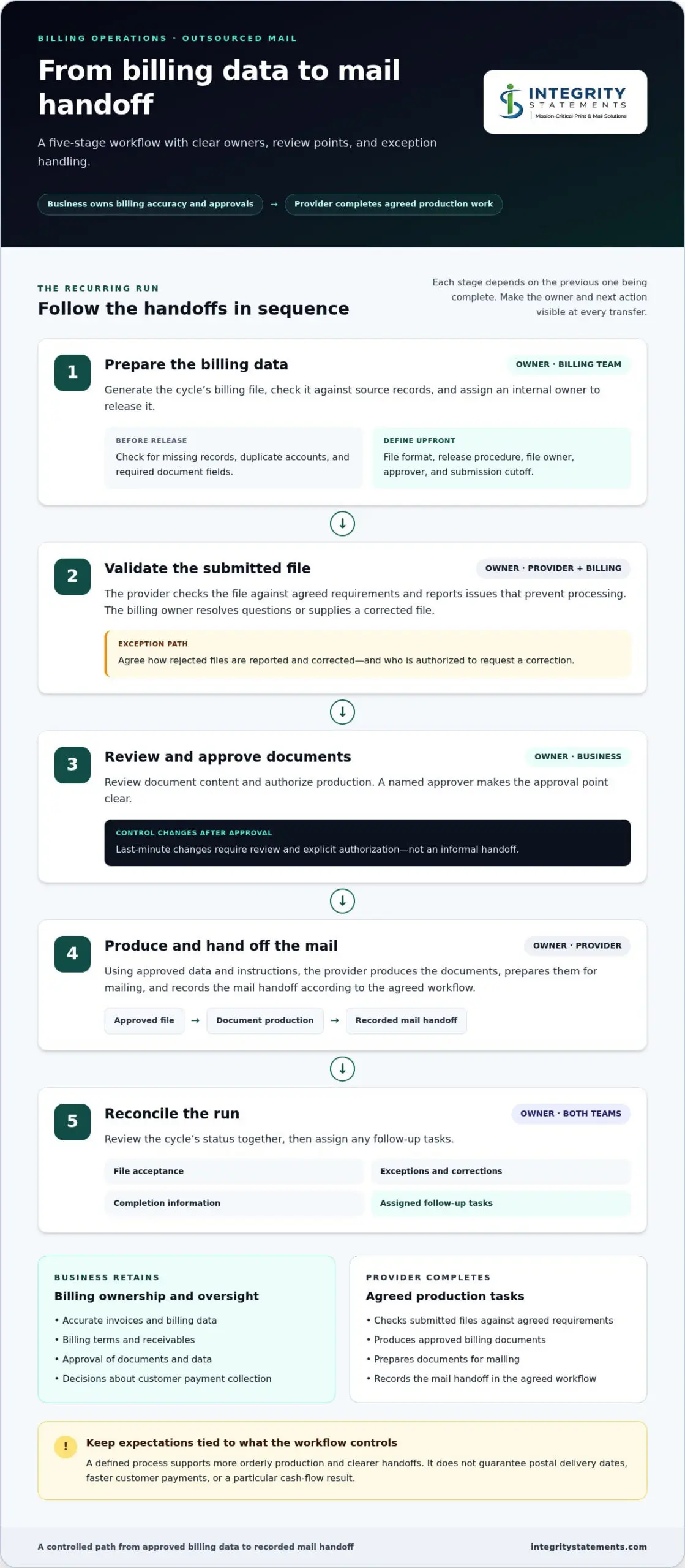
A reliable recurring run depends on clear handoffs, not just a production date. The billing team should own the accuracy and approval of its account data. The print-and-mail provider should work from approved files and agreed instructions. Documenting each transfer helps both teams see what is ready, what is waiting, and who will resolve an exception.
A practical workflow follows this sequence:
- Prepare the data. The billing team generates the cycle’s billing file, checks it against source records, and assigns an internal owner to release it.
- Validate the file. The receiving provider checks the submitted file against agreed requirements and reports issues that prevent processing. The billing owner resolves data questions or supplies a corrected file.
- Approve the documents. The business reviews the document content and authorizes production. A named approver ensures that changes after approval are controlled rather than passed informally.
- Produce and mail. The print-and-mail provider produces the approved documents, prepares them for mailing, and records the mail handoff according to the agreed workflow.
- Reconcile the run. Both teams review the cycle’s status, including file acceptance, exceptions, corrections, and completion information, then assign follow-up tasks.
Prepare and validate billing files before release
Start by defining a consistent file format and release procedure for each cycle. Identify the internal file owner, approver, submission cutoff, and person authorized to request a correction. Before release, check for missing records, duplicate accounts, and required document fields. Agree on how rejected files will be reported and corrected. A documented approval step establishes a clear point after which last-minute changes require review and explicit authorization.
Cutoffs make the workflow easier to coordinate. For example, teams can agree that data changes received before approval are included in the current run, while later changes follow a documented exception path. Set the schedule around the organization’s billing cycle and the steps both teams have agreed to perform.
Coordinate production, mailing, and exception handling
After approval, production may include printing, folding, matching documents with envelopes, preparing mail for dispatch, and handing it to the postal service. The business remains responsible for authorizing content and resolving account-data questions. The print-and-mail provider carries out the production instructions and communicates processing issues through the agreed channel.
Keep an exception record that identifies the affected file or document batch, the issue, its owner, the correction, and whether reprocessing was approved. This helps prevent a corrected item from being confused with the original run and gives both teams a useful history for reviewing the cycle. For a closer look at the physical document process, statement printing and mailing connects production steps with secure document fulfillment.
These defined handoffs are central to streamlining billing cycles with outsourced mail. Integrity Statements provides invoice and billing printing and mailing for businesses planning an outsourced invoice workflow. You can explore Integrity Statements’ billing mail services as part of your review.
How to assess billing-cycle performance without relying on broad promises
Evaluate the workflow by comparing what happens today with what the proposed process is designed to change. Start with a baseline from representative billing runs, if records are available, and document how each measure is counted. That gives your team a grounded point of comparison instead of assuming outsourcing will automatically improve speed, accuracy, or cost.
Ownership
Current workflow: Tasks may be spread across billing, document review, and internal mail staff, with unclear responsibility for delays.
Proposed workflow: Identify which tasks stay with the billing team and which production tasks transfer to the print-and-mail provider.
Handoffs
Current workflow: File transfers, approvals, or corrections may happen through informal steps that are hard to trace.
Proposed workflow: Record submission, approval, production, and mail handoff points, including agreed cutoffs.
Visibility
Current workflow: Teams may have limited shared information about file status or unresolved issues.
Proposed workflow: Define how acceptance, exceptions, and completed batches are reported and reviewed.
Exceptions
Current workflow: Corrections and rework may be handled inconsistently or without a clear owner.
Proposed workflow: Assign an owner and record the issue, correction, approval, and any reprocessing.
Choose measures that reflect the actual billing process
Track measures that show how the work moves: file acceptance, correction frequency, approved release timing, completed mail batches, accuracy issues, schedule adherence, and rework. Define each measure consistently. For instance, agree whether a corrected file counts as a rejection, a revision, or both. Compare like with like across current and future cycles, then set targets from your own baseline rather than an unsupported industry benchmark.
Keep production measures separate from outcomes the production team can’t control. File acceptance, document accuracy, approved release timing, and batch completion can be reviewed within the workflow. Postal transit and customer payment behavior depend on factors beyond document production. A mail batch completed on schedule doesn’t establish when recipients will receive it or pay an invoice.
Keep visibility and customer communications aligned
Make ownership clear for billing questions, returned mail, and account-level corrections. The billing team should retain responsibility for account decisions and customer inquiries, while the print-and-mail provider reports production exceptions through the agreed process. Consistent document layouts and planned billing schedules can also help customers recognize recurring communications and understand the information presented.
For invoice-specific considerations, the invoice printing and mailing guide offers relevant context on producing and mailing billing documents. A disciplined measurement plan makes streamlining billing cycles with outsourced mail easier to assess: compare the same measures, review exceptions, and adjust the workflow based on what the records show.
How to transition billing mail with control and minimal disruption
A careful transition protects the billing cycle while moving production work to a new process. Keep internal oversight at each decision point: the business remains responsible for billing data and document approval, while the print-and-mail provider follows agreed production instructions. A phased plan makes responsibilities visible before a live mailing depends on them.
- Map the current cycle. Record cycle dates, file preparation steps, approval points, internal cutoffs, and how exceptions are handled today.
- Define ownership. Name the internal file owner, document approver, and contacts responsible for billing changes, production questions, and mailing status.
- Agree on acceptance criteria. Specify what makes a file and document proof ready for production, how errors will be reported, and who can authorize corrections.
- Test a representative run. Choose a billing run that reflects ordinary account and document needs, then compare test output with the approved source data.
- Launch and review. Proceed with the agreed rollout, record exceptions, and review the results before adjusting the next cycle.
Plan a controlled pilot and launch
Put the process in writing before the pilot: cycle dates, file owners, approval points, cutoffs for internal changes, and expected responses to exceptions. For Texas customer mail, review the address records and geographic coverage represented in the test file. This can help identify missing or inconsistent address information before production. Use acceptance criteria that can be checked, such as confirming that approved document content matches its source data and that the intended batch is accounted for.
Don’t authorize production mail until the designated business approver has reviewed the test output and resolved discrepancies. A parallel review or staged rollout can help maintain oversight when it suits the organization’s operations. Decide in advance how late billing changes will be handled, who can approve a reprocessed batch, and whether a change moves into the current run or a later cycle.
Set ongoing review and escalation practices
After launch, schedule periodic reviews of accuracy, adherence to the agreed cycle, rework, and exception patterns. Assign owners for billing changes, mailing questions, and process updates, then keep a written escalation path for urgent corrections or delayed approvals. Clear escalation doesn’t remove every disruption, but it gives both teams a known route to make decisions and document follow-through.
These controls make streamlining billing cycles with outsourced mail a managed operational change rather than a handoff without oversight. If you’re planning a transition, discuss your business billing mail workflow with Integrity Statements.
When outsourced billing mail is the right operational fit
Outsourced billing mail may be worth evaluating when recurring production work competes with the time your team needs for billing operations. The decision depends less on a single mail-volume threshold than on how reliably your current process handles volume, deadlines, quality checks, and exceptions. A steady schedule paired with limited in-house capacity can make an external production workflow a practical extension of your operation.
Consider how the work affects the full billing team. If staff regularly pause account work to manage print tasks, coordinate mailroom activity, or recover from production backlogs, outsourcing may shift that workload while your business retains control of billing decisions, approved data, and customer account responsibilities.
Signals that a business may benefit from outsourcing
Review the process if mail production repeatedly strains available resources or makes cycle planning difficult. These signs don’t prove that outsourcing is the right choice, but they can help identify where a closer assessment is useful:
- Recurring production backlogs or deadline pressure around billing runs
- Staffing constraints that leave little room for printing, document preparation, or mailing tasks
- Multiple streams of statements, invoices, or customer notices competing for internal production capacity
- Quality-control needs that call for a consistent, clearly assigned production process
- Defined billing schedules that could support a repeatable handoff from approved data to mail production
High-volume statements and invoices can make consistent handling especially important, but volume alone doesn’t guarantee a better outcome. Consider the workload’s complexity, how often exceptions occur, and whether internal capacity can support the schedule without displacing other responsibilities.
In-house production may remain workable when volumes are stable, staffing and equipment capacity are sufficient, and the process runs without recurring delays or avoidable rework. If the team can meet its schedule while maintaining clear oversight, changing the production model may not address a meaningful operational problem. Compare the current workload and process needs before deciding.
Build a billing mail partnership around clear responsibilities
With outsourced production, the business continues to own billing accuracy, account decisions, document approval, and customer service. Integrity Statements provides printing, processing, and mailing for business-critical invoices and other transactional documents. A well-defined working relationship clarifies what approved data and instructions are handed off, how questions and corrections are managed, and how production status is communicated.
Careful coordination and accuracy matter throughout the handoff, particularly when billing documents contain sensitive customer information. Agree on file ownership, approval steps, exception handling, and the process for resolving issues before a recurring run begins. These responsibilities connect outside production to the existing billing cycle without shifting ownership of the customer relationship.
If you’re assessing whether outsourced production fits your billing operation, talk with Integrity Statements about outsourced billing mail. A practical discussion can help you consider the workflow, responsibilities, and mail requirements that matter to your organization.
Set a Clear Direction for Your Next Billing Cycle
Your next step doesn’t need to be a full-scale process change. Start by identifying one recurring billing run to review: where preparation slows, which handoffs need clearer ownership, and what your team wants to monitor. That focused view can help determine whether streamlining billing cycles with outsourced mail fits your operation and where a production provider could take on defined tasks while your team retains billing oversight.
Integrity Statements is privately owned and operated, with a focus on transactional mail since 1994. Its business document services include invoice and statement printing and mailing, supporting organizations that need an orderly path from billing information to physical mail.
Use the workflow you’ve outlined as a starting point for a practical conversation about responsibilities, review points, and cycle expectations. Discuss a dependable outsourced billing mail workflow with Integrity Statements, and take the next step toward a billing process your team can manage with greater clarity and confidence.
Frequently Asked Questions
How does outsourced mail help streamline a billing cycle?
Outsourced mail can support streamlining billing cycles with outsourced mail by giving approved billing data a defined route into document production and mailing. For example, if a billing team releases separate invoice batches, an agreed cutoff and status check can show which batch is ready and which needs correction. This can reduce internal production tasks and clarify ownership, but results depend on data readiness and the organization’s workflow.
Can a business outsource invoice mailing without changing its billing system?
Yes. Outsourcing invoice production and mailing doesn’t automatically require replacing the billing system. The business and mail provider need an agreed method to transfer approved billing data and resolve exceptions. For example, a team might document how it prepares files, who reviews them, and how corrections are communicated. The right workflow depends on existing processes, file requirements, review steps, and the billing schedule.
What information should a company prepare before outsourcing billing mail?
Prepare sample documents, a description of the recurring cycle, required document fields, and details about file ownership and approval responsibilities. Also record how billing changes and address corrections are handled, including who can authorize an update. Avoid sending sensitive customer information through an unsecured channel. Having these process details ready helps the teams identify open questions, assess readiness, and plan a controlled test using appropriate data.
How can a company check that outsourced invoices are accurate before mailing?
Compare test documents with approved billing data before authorizing a live mailing. Check that key fields, such as account details, amounts, and mailing addresses, appear as intended, and review the document layout for readability. Assign who signs off and decide how errors will be reported, corrected, and reviewed before production. These documented checks can help teams identify and resolve exceptions, though no process can eliminate every possible error.
Does outsourcing billing mail guarantee customers receive invoices sooner?
No. Outsourcing can help organize production and clarify when approved documents are prepared for mailing, but it can’t guarantee postal transit time or when a customer will pay. Those outcomes are separate from production. To assess a billing process fairly, track measures the teams can influence, such as approval timing and completed mail batches, separately from delivery and payment results. This distinction helps set realistic expectations for the cycle.
Is outsourced billing mail suitable for businesses serving customers across Texas?
It can be a fit for Texas businesses that want to assess recurring mail across customer groups. Start by reviewing billing schedules, document volumes, address data quality, and approval steps, then define how batches and exceptions will be handled. Integrity Statements serves business document mailing needs in Texas, including invoice and statement printing and mailing, and can tailor the workflow to the project without promising specific postal delivery times.


