Secure Mailing Services for Texas Government Agencies
Government mail must reach the right people with the right documents while protecting sensitive information. For Texas agencies considering mailing services, eligibility usually depends on the agency’s procurement requirements and the work involved, rather than a single statewide category for mailing support.
That distinction matters: a state office, county department, city, or other public agency may have different approval steps and document-handling needs. You’ll learn what to consider when assessing eligibility, how secure document fulfillment can move from print preparation to mailing, and which questions help define a reliable process. The focus is practical: match the service to the documents, recipients, and internal requirements your agency must meet.
Key Takeaways
- Map fulfillment needs around document sensitivity, recipient accuracy, print requirements, and delivery so the process fits the agency’s communications.
- Assess providers by how their mail processing approach aligns with your documents, internal controls, and delivery requirements.
- Understand the procurement route before starting a contract, including whether a state or cooperative purchasing option applies.
- For recurring statements, invoices, healthcare communications, or tax and regulatory mail, consider a service that can manage printing and mailing together.
Secure document fulfillment
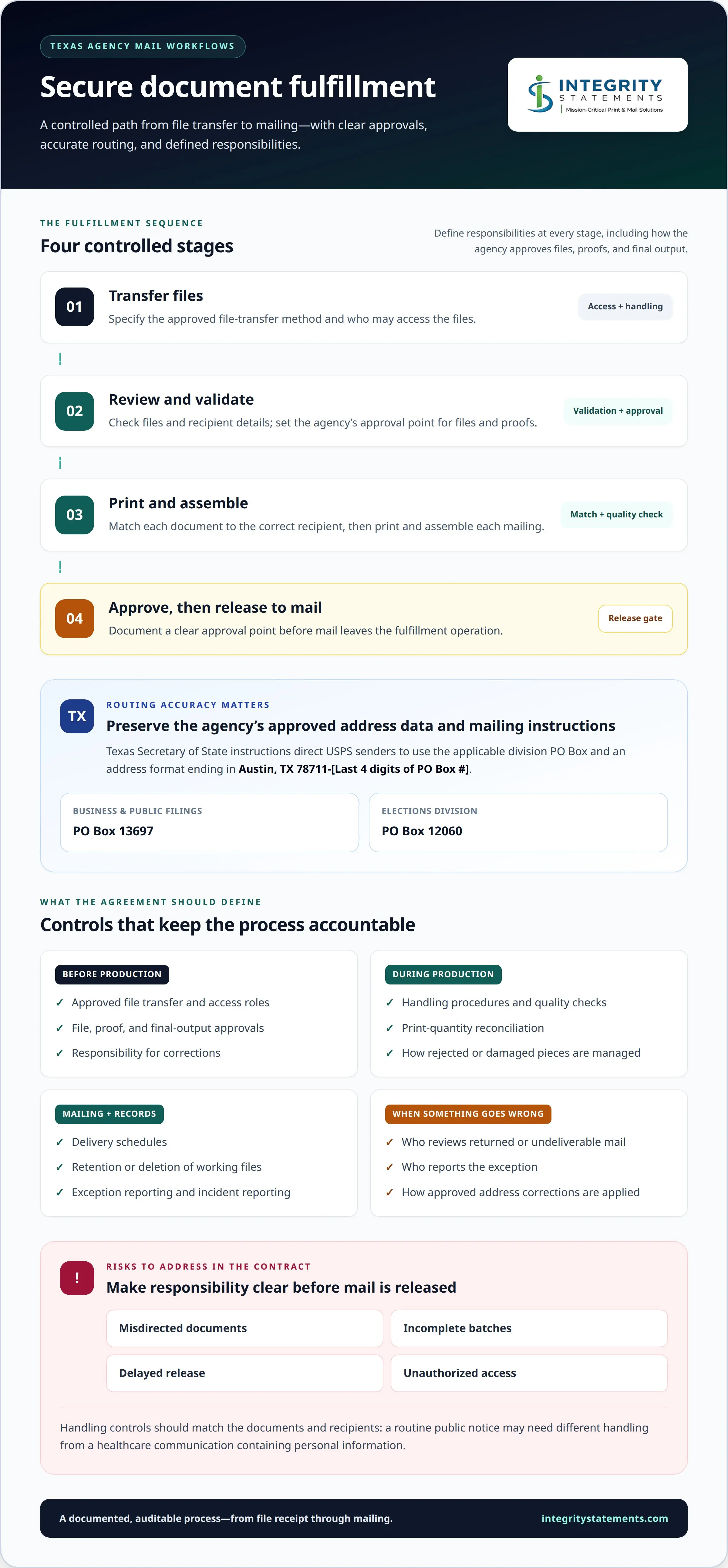
Secure fulfillment follows a controlled sequence: transfer files, review and validate them, print and assemble each mailing, then send the finished pieces into the mail stream. A contract should define responsibilities at each stage and how the agency approves files, proofs, and final output. For example, a notice with a variable recipient address needs a clear process for matching each document to the correct recipient.
Texas address instructions show why routing accuracy matters. The Texas Secretary of State directs USPS senders to use the applicable division PO Box and an address format ending in Austin, TX 78711-[Last 4 digits of PO Box #]. Its Business & Public Filings division uses PO Box 13697, while its Elections Division uses PO Box 12060. A fulfillment workflow should preserve the agency’s approved address data and mailing instructions.
What risks and contract terms should Texas agencies consider when outsourcing mail services? Address misdirected documents, incomplete batches, delayed release, and unauthorized access through clear roles, handling procedures, quality checks, and incident-reporting terms. The agreement should also define approved file transfer, proof approval, correction responsibility, delivery schedules, retention or deletion of working files, and how exceptions are reported.
The right controls depend on the document and its recipients. A routine public notice may need different handling from a healthcare communication containing personal information. The contract can identify who may access files, how print quantities are reconciled, and how rejected or damaged pieces are managed. Establish a documented approval point before mail leaves the fulfillment operation.
Finally, define how performance issues are recorded and resolved. For a returned or undeliverable item, specify who reviews the address, reports the exception, and applies any approved correction. Clear terms give the agency an auditable process from file receipt through mailing and clarify responsibility when a document is inaccurate, incomplete, or delayed.
Which Texas vendors provide government mail processing and fulfillment services?
Texas agencies can source mail processing from commercial print-and-mail firms, transactional mailing specialists, and broader document fulfillment providers. These providers differ in how they combine printing, inserting, addressing, and mailing. First identify whether your agency needs finished mail processed or documents produced and mailed together.
Some firms focus on mailing agency-prepared pieces, handling sorting, preparation, and dispatch after receiving completed, addressed documents. Others manage print production and mailing as one workflow. For example, a public agency sending forms that vary by recipient may need variable data printing as well as envelope preparation.
Providers also differ in the communications they support. Transactional mail specialists commonly handle recurring statements and billing notices, while general print-and-mail firms may support public information mailings or campaign-based notices. Healthcare communications and regulatory documents can require different controls from routine correspondence. These distinctions help agencies identify a provider suited to their materials.
Texas public entities may encounter vendors through state or cooperative purchasing channels. A listing or contract vehicle is a procurement pathway, not proof that every mailing task falls within its scope. Match the service description to the work required, such as print production, address processing, or mailing preparation.
For mailing services for government agencies in Texas, begin the vendor search with the document and production stage that need support. Name the material, describe how it reaches recipients, and determine whether the requirement covers printing, mail processing, or both. This distinction helps agencies identify relevant provider categories and frame a focused procurement request.
The Texas Board of Nursing accepts complaints through its online portal, by fax, or by mail. The Texas Health and Human Services complaint intake office accepts complaints through its online system, by mail, fax, or telephone.
What are the Texas state procurement requirements for mailing service contracts?
Texas agencies should first identify the procurement rules that apply to their organization and funding. State agencies, local governments, and public institutions may follow different procedures. The procurement office can identify the appropriate route before a solicitation is prepared. This matters when planning mailing services for government agencies in Texas, because one purchasing process may not apply to every public entity.
Next, define the work in clear, measurable terms. A solicitation for recurring statements, for example, can specify document formats, proof approvals, print requirements, mailing schedules, and reporting. Separate required tasks from preferences. For mailing services for government agencies in Texas, a well-defined scope helps potential vendors respond to the same requirements and gives the agency a consistent basis for evaluation.
State the evaluation criteria in the procurement documents and apply them consistently. An agency might assess whether proposals address the required scope, production workflow, quality controls, implementation approach, and proposed cost. For a customer-notice project, the solicitation could distinguish essential address processing from optional reporting. Criteria tied to the actual work make proposal comparisons more useful.
Before an award, route the proposed agreement through the agency’s required reviews. Procurement, program, finance, records, and information-security staff may each assess different terms. The agreement should define responsibilities for file transfer, approvals, corrections, delivery schedules, incident reporting, and working files. These terms connect purchasing decisions to the day-to-day handling of agency mail.
Keep a procurement record from planning through approval. It can include the scope, solicitation, vendor responses, evaluation rationale, required approvals, and signed agreement. For a project involving several departments, identify which department owns each approval. That detail helps prevent confusion after award and gives the agency a clear record of the selected mailing services for government agencies in Texas, expected deliverables, and procedures for managing changes.
How can a mailing services provider support a Texas government agency buying mailing services through DIR or cooperative contracts?
A print-and-mail provider can help translate a mailing requirement into a clear scope for a DIR or cooperative purchasing route. The agency still determines which contract vehicle it may use and follows its own purchasing approvals. Start by describing the document type, recipient data, print work, mailing tasks, and expected reporting. A recurring notice program, for example, needs a scope that distinguishes production from distribution.
Next, compare that scope with the applicable contract’s terms. The agency’s procurement staff can confirm whether the contract covers the required services, whether the provider is an awarded vendor, and which ordering steps apply. A contract for printing alone may not cover mailing fulfillment. Confirm the fit before ordering to avoid a mismatch between the agency’s need and the contract’s scope.
A provider can support the process by preparing a work description, identifying production requirements, and clarifying operational handoffs. For example, a statement mailing may require the agency to supply approved files and recipient information, while the provider explains proofing, print preparation, and mailing responsibilities. These details help procurement assess the purchase without assuming a cooperative contract covers every task.
Before an order proceeds, align the purchase document with the contract’s ordering process and the agency’s internal approvals. Record the selected scope, deliverables, pricing basis, schedule, and responsible agency contacts in the appropriate procurement documents. If a requirement changes, procurement staff can determine whether the existing vehicle and order still accommodate it.
This coordinated approach keeps the contract path and fulfillment plan connected. The provider clarifies what work it will perform; the agency confirms purchasing authority, contract coverage, and approval steps. For a Texas agency planning print-and-mail work, discuss document mailing requirements as the scope takes shape.
Integrity Statements
Integrity Statements supports organizations that need essential documents prepared and mailed through a defined fulfillment process. For a Texas agency, that can include coordinating print-ready files, document production, and mailing requirements for recurring or time-sensitive communications.
Agencies can turn to Integrity Statements for statement, invoice and billing, healthcare communication, tax form, regulatory mail, and customer notice printing and mailing. The right fit depends on the document type and the work your agency needs handled. Clear requirements for file preparation, approvals, and delivery help shape an orderly process from production through mailing.
If your agency is planning a mailing project, contact Integrity Statements to discuss the documents and fulfillment needs.
Set the next mailing project up for success
Before launching a new communication, bring procurement and program staff together around a shared scope. Identify the document’s purpose, recipients, approval owner, and purchasing route. Early alignment helps Texas agencies connect operational needs with contract decisions before production begins.
For teams assessing mailing services for government agencies in Texas, the next step is to define what a successful fulfillment process must deliver. Consider how statements, invoices, or healthcare communications move from approved files to completed mailings, and clarify responsibilities along the way. A well-framed project gives internal stakeholders a practical basis for moving forward.
Integrity Statements provides printing and mailing support for these business-critical communications. When your agency is ready to discuss a project’s document and fulfillment needs, contact Integrity Statements. A clear conversation can help shape a practical next step for your agency’s mailing work.
Frequently Asked Questions
What mailing services are available to Texas government agencies?
Texas agencies can outsource printing and mailing for recurring or project-based communications. Common needs include statements, invoices and billing documents, healthcare communications, tax forms, regulatory mail, and customer notices. For example, an agency can arrange to produce personalized notices from approved files, then have the finished documents prepared for mailing. The appropriate scope depends on document type, recipient data, and agency workflow.
How do mailing service providers handle sensitive government data and comply with Texas privacy laws?
Providers can use controlled file-transfer methods and defined handling procedures, while agencies set requirements for their data and documents. Integrity Statements lists secure transfer options and HIPAA and SOC compliance, including SOC 1 Type II and SOC 2 Type II. Those credentials don’t by themselves establish compliance with every Texas privacy requirement. Agencies should align vendor procedures and contract terms with the information being mailed.
What security and accessibility standards should Texas agencies require from mail vendors?
Texas agencies should define security and accessibility expectations in the contract rather than rely on broad claims. Specify approved file-transfer methods, access responsibilities, proof review, production quality checks, exception reporting, and rules for handling working files. For accessibility, define readable formatting, clear language, and a suitable way for recipients to request assistance. Tailor each requirement to the document, audience, and agency policy.
How do in-house government mailrooms compare with outsourced mailing services in Texas?
Outsourced providers may process agency-prepared, addressed pieces or manage printing, assembly, and mailing as one workflow. The agency should define responsibilities, approvals, quality checks, and delivery requirements; the article does not describe in-house mailroom operations.