
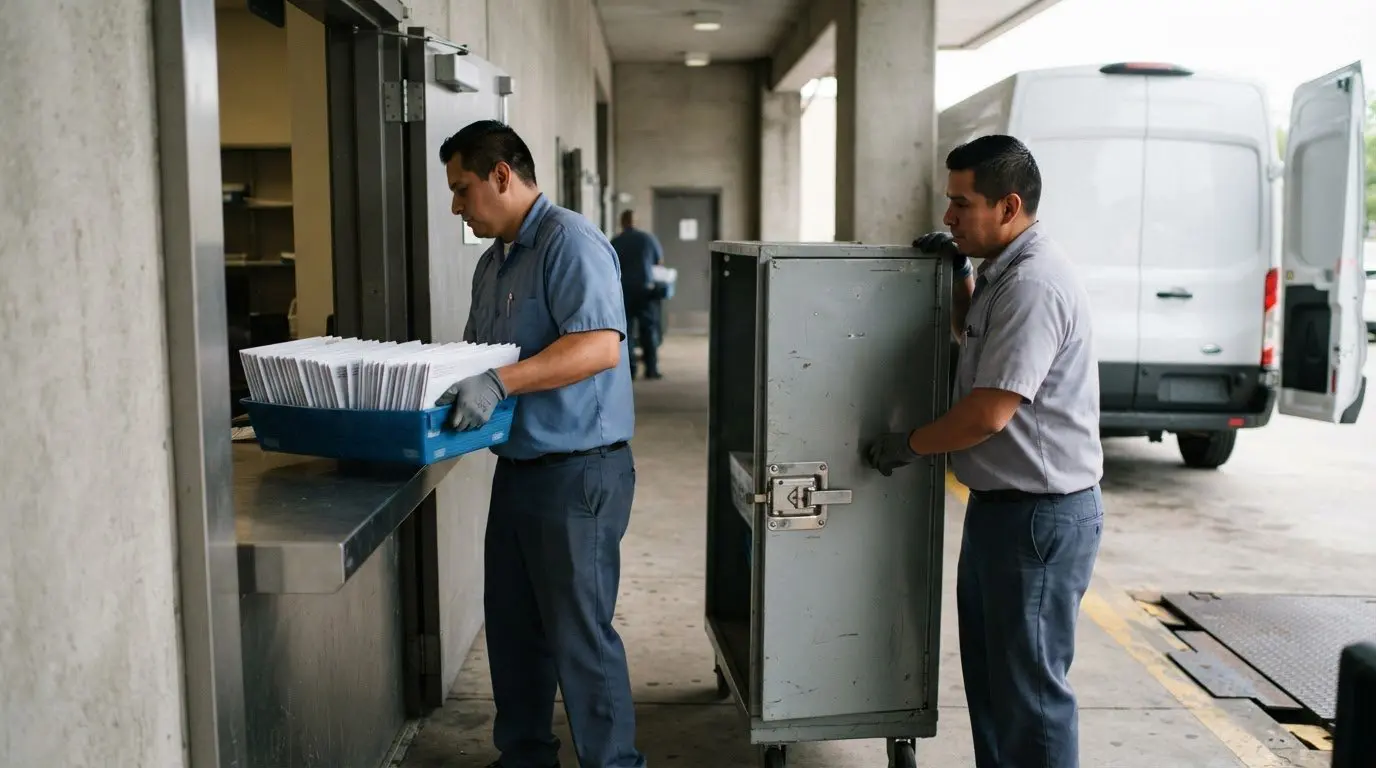
Austin secure document handling and mailing turnaround times
Speed matters, but dependable mailing starts before documents enter the mail stream. Austin secure document handling and mailing timelines depend on when complete files are ready, the print and mailing requirements, and postal transit time. Production and delivery are separate stages.
It’s reasonable to want a clear timeline, especially when statements, invoices, healthcare communications, or regulatory mail need careful handling. Understanding what affects processing helps you set expectations and prepare an orderly handoff.
This article explains how Austin service availability relates to business mailings, what information and files are needed to prepare them, and how processing moves from receipt through mailing. It also clarifies how to think about same-day or rush requests without assuming every job follows the same schedule. The goal is a practical view of the process, so you can plan communications with greater confidence.
Key Takeaways
- Understand how Austin service availability relates to business mailings and why the mailing destination matters.
- See which document and mailing details help prepare a project for accurate processing.
- Separate production time from postal transit time to plan a more realistic mailing schedule.
- Learn what can affect rush requests and how professional print-and-mail services support recurring business communications.
Austin address locations and shipping availability
Austin has several listed pickup addresses, but a pickup point isn’t automatically a secure document-mailing provider. Local pickup is listed at 13359 North Highway 183, 1401 Lavaca St, and 8911 North Capital of Texas Highway. The Texas Address Confidentiality Program uses P.O. Box 12199, Austin, Texas 78711-2199, for mailed applications. That program address is for applications, not a general business drop-off destination.
For Austin businesses, a print-and-mail workflow can include document printing, envelope preparation, and postage. Drop-off and return shipping are separate logistics choices. A tracked return requires a destination, a shipping method, and a label matched to the recipient and package.
Certified mail and courier delivery meet different routing needs. Choose based on the recipient, the delivery record required, the destination, and whether the documents need coordinated print preparation. Couriers use their own delivery networks, while certified mail follows a postal route.
There is no single certification label that establishes suitability for every document workflow. Relevant standards depend on the information handled and the obligations applicable to that business. A company should describe its actual handling process, access controls, and how documents move from receipt to dispatch, rather than relying on a label alone.
Austin businesses can use print-and-mail services for statements, invoices, healthcare communications, tax forms, regulatory mail, and customer notices. Scanning, shredding, and storage are separate service categories, not automatic parts of mailing. Define those needs separately from printing, envelope preparation, and delivery.
Protection during pickup, processing, and delivery depends on controlled handoffs and clear routing instructions. The workflow should identify who receives files, how print-ready documents are associated with the correct recipients, and how finished mail is prepared for dispatch. For example, separate recipient records help keep each statement paired with its intended address.
Setup starts with defining document types, recipient data, mailing frequency, format, and delivery needs. The provider then aligns file preparation, print specifications, envelope work, postage, and any return-shipping labels. Using an unverified provider can expose a business to misrouted documents, processing errors, or unclear custody during handoffs, so those process details matter.
Document preparation requirements for professional secure handling and mailing
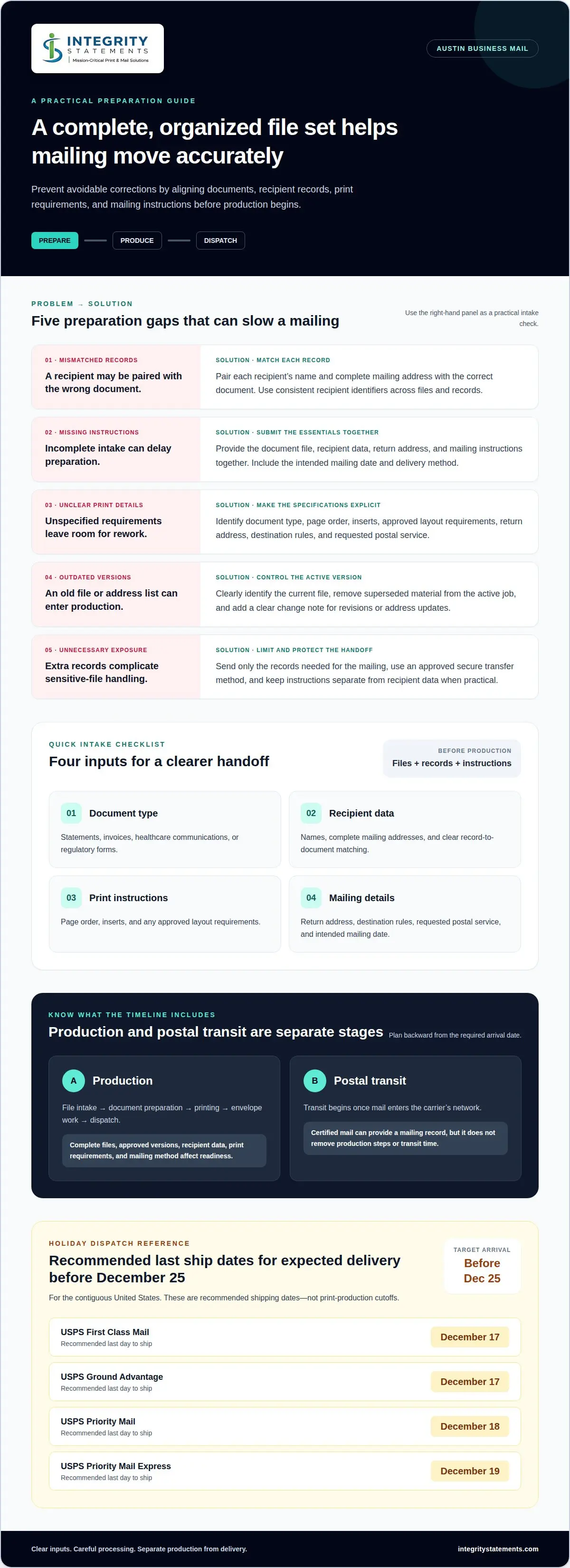
Reliable Austin secure document handling and mailing starts with complete, organized source material. Provide the document file, recipient data, return address, and mailing instructions together. For a statement run, pair each customer’s name and delivery address with the correct statement. Missing fields or mismatched records can delay preparation and require corrections.
Keep the mailing list consistent with the documents. Use the same recipient identifiers across records and files, and clearly mark exclusions or address changes. Separate communication types, such as invoices and government forms, so each can follow the appropriate print and envelope requirements. Include the intended mailing date and delivery method in the instructions.
Useful details include:
- Document type: statements, invoices, healthcare communications, or regulatory forms.
- Recipient data: names, complete mailing addresses, and record-to-document matching.
- Print instructions: page order, inserts, and any approved layout requirements.
- Mailing details: return address, destination rules, and requested postal service.
Version control matters. When a revised file replaces an earlier one, identify the current version and remove outdated material from the active job. A clear change note helps prevent an old address list or superseded notice from entering production. For recurring mail, consistent file names and field definitions make each submission easier to process accurately.
Sensitive content calls for deliberate file-transfer and access practices. Send only the records needed for the mailing, using an approved secure transfer method. Keep instructions separate from recipient data when practical. These steps help the team identify the right files and limit unnecessary exposure during preparation.
A well-prepared file set supports Austin secure document handling and mailing by giving the processing team clear, consistent inputs. For recurring statements or invoices, a documented intake format can make each cycle more orderly. Prepare business documents for printing and mailing by aligning files, recipient records, and mailing instructions before production begins.
Processing cutoffs and turnaround times
A mailing schedule has two distinct stages: production and postal transit. Production covers file intake, document preparation, printing, envelope work, and dispatch. Transit begins once mail enters the carrier’s network. Certified mail can provide a mailing record, but it does not remove production steps or transit time.
For a business project, processing can begin when complete files and instructions are ready. Recipient data, approved document versions, print requirements, and the mailing method all affect readiness. A late address correction or replacement file can change the production sequence. Plan backward from the required arrival date, allowing time for preparation and delivery.
Holiday shipping dates illustrate why dispatch timing matters. For expected delivery before December 25 in the contiguous United States, the recommended last day to ship USPS First Class Mail and USPS Ground Advantage is December 17. For USPS Priority Mail, it is December 18; for USPS Priority Mail Express, it is December 19. These are recommended shipping dates, not print-production cutoffs.
Postal closures also affect transit. USPS will be closed Thursday, November 26th, in observance of Thanksgiving Day. A mailing ready near a holiday should account for the closure when setting its dispatch schedule. For Texas Address Confidentiality Program participants, forwarding mail to a real address may add three to four days. Most applications are reviewed and completed within two weeks of receipt, a separate timeline from mail forwarding.
To manage a deadline, define the in-home date, mailing method, and file approval point first. Then schedule production so complete materials are ready for dispatch before the relevant postal cutoff. For example, a December 25 arrival target calls for distinguishing the December 17, 18, or 19 shipping recommendation from the earlier work needed to prepare the mailing. Separate those dates in the project plan, and track dispatch and delivery as different milestones.
For Texas Address Confidentiality Program participants, returned mail can also affect continued participation: participation may end if mail is returned to the program 4 times. This is a separate consideration from forwarding time, so keeping the forwarding schedule and participation status in view can help avoid treating delivery timing as the only mailing concern.
Same-day and rush delivery availability
Same-day processing and same-day delivery are different outcomes. Mail can be prepared and dispatched quickly, while the carrier still needs transit time. For Austin businesses, the arrival date, destination, mail class, and production readiness shape the plan. Rush handling cannot eliminate postal transit.
Before requesting rush handling, assemble the final document files, recipient records, mailing instructions, and approvals. A complete, approved file can move into production more directly than one needing address corrections or content changes. For example, a revised invoice file arriving after setup may require the team to pause and match the new version to its recipient data.
Production timing also depends on the work involved. A short notice with a ready-to-print file differs from a mailing that requires extensive sorting, multiple inserts, or separate recipient groups. The team coordinates file intake, print preparation, envelope assembly, postage, and dispatch, with each stage aligned to the mailing method and destination.
Rush planning works best when you specify a required arrival date, rather than simply asking for delivery “as soon as possible.” The team can plan backward from dispatch and identify decisions that affect readiness. Clarify whether you need faster production, expedited transit, or both. Certified mail may provide a mailing record, but it does not shorten preparation.
For recurring business communications, a defined approval path helps prevent avoidable pauses. Assign responsibility for releasing the final file, approving proofs, and resolving address or content changes. Include those instructions with each submission so the team can distinguish an urgent new mailing from a correction to an existing job.
For time-sensitive statements or notices, request help planning a business mailing around document readiness, production steps, and the selected delivery method.
For questions about address confidentiality, the Texas Address Confidentiality Program is available by phone Monday through Friday, 8:00am – 5:00pm Central Time. Use that contact window to ask about program-related questions before finalizing recipient details, and keep any mailing plan consistent with the guidance received. Address handling belongs in the readiness check alongside files, approvals, and dispatch decisions.
Integrity Statements
Integrity Statements helps businesses prepare essential communications through a coordinated print-and-mail process. Services include statement printing and mailing, invoice and billing printing and mailing, healthcare communications, and tax forms and regulatory mail.
Turn to Integrity Statements when recurring or sensitive business mail needs professional processing and distribution. Clear files, recipient records, and mailing instructions establish each project’s requirements and support an orderly handoff through production and mailing.
If your Austin business is planning a mailing or reviewing its current process, contact Integrity Statements to discuss your document and delivery needs.
Build a Mailing Process You Can Plan Around
Reliable Austin secure document handling and mailing starts with treating each mailing as a defined business process, not a last-minute task. Set approval points, keep file versions clear, and plan production and postal transit separately. These habits help your team manage sensitive communications as needs change.
Match your document workflow with the support it requires. Integrity Statements handles business-critical print-and-mail projects, including statements, invoices, and healthcare communications. Share the communication type, mailing requirements, and workflow you want to establish to give the conversation a practical starting point.
Contact Integrity Statements today to discuss a print and mailing process that fits your organization. With clear requirements and a thoughtful plan, your next mailing can move forward with greater clarity.
Frequently Asked Questions
Which Austin neighborhoods and nearby areas do secure document handling providers serve?
Integrity Statements serves organizations throughout Texas and beyond from its strategically located Central Texas facility. For an Austin business, the fit depends on the document workflow and mailing needs, not a neighborhood boundary. Transfer files through a portal, SFTP, API, or another approved method, without needing to deliver every document in person.
What security certifications and compliance standards should Austin document service providers meet?
No single certification establishes suitability for every document workflow. Relevant standards depend on the information handled and the business’s obligations. Review the provider’s handling process, access controls, and document handoffs.


