

Secure mail services for mortgage companies and their key features
Mortgage mail security doesn’t end when borrower data is transferred. Secure mail services for mortgage companies bring together protected data handling, accurate statement production, and controlled mailing, while servicing disclosures must also meet their deadlines. In the United States, lenders must send Form 1098 mortgage interest statements by January 31 of the year following the tax year.
It’s reasonable to expect a provider to safeguard sensitive information and deliver documents accurately. But certifications are only one part of the picture: how borrower data moves into production, how statements are printed and mailed, and how disclosures are managed also matter.
This article explains how these elements fit together, from protected borrower-data transfers to statement mailing and servicing disclosures. You’ll learn what to look for in a secure process and how these details help mortgage companies manage essential communications carefully.
Key Takeaways
- Assess security practices alongside certifications; a credential alone doesn’t describe how borrower information is protected through production and mailing.
- Understand how borrower data is transferred into document production, since the transfer method affects how sensitive information is handled.
- See how accurate statement production and timely servicing disclosures support clear, dependable mortgage communications.
- Recognize how communication volume and operational complexity shape secure email needs for smaller brokers and larger lenders.
Industry certifications and regulatory compliance
For U.S. mortgage companies, GLBA and the FTC Safeguards Rule are relevant to discussions about borrower information and email security. The requirements that apply depend on an organization’s role and activities, so this section doesn’t assign specific duties. In practice, email controls should fit the company’s security program and the sensitivity of the information being sent.
Certification can help assess a vendor’s security practices, but a certificate alone doesn’t explain how a specific mailing workflow is protected. Review the certificate’s scope, the processes it covers, and whether the work includes data intake, document production, or mailing. For example, a credential covering a vendor’s general environment may not describe every step in preparing mortgage correspondence.
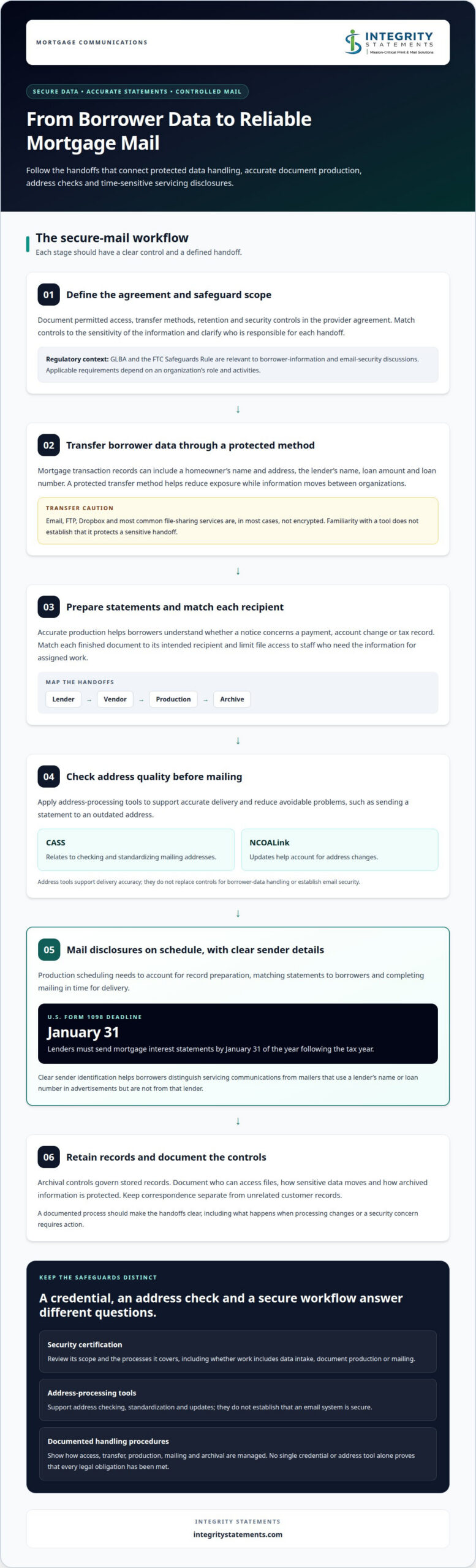
Address quality also affects reliable delivery. CASS address certification relates to checking and standardizing mailing addresses, while NCOALink updates help account for address changes. These checks can reduce avoidable delivery problems, such as sending a statement to an outdated address. They don’t replace controls for handling borrower data or establish that an email system is secure.
A useful review connects each safeguard to a specific risk. For email, consider who can access borrower records, how sensitive files are transferred, and how activity is documented. For physical mail, consider how address updates are applied and how each finished document is matched to its intended recipient. A vendor’s documented process should make these handoffs clear rather than treating “secure” as a standalone label.
Keep the distinctions clear: security certifications describe assessed practices, while address tools support accurate delivery. Neither alone proves that every legal obligation has been met. Mortgage companies can assess a vendor’s certification scope alongside its documented handling and address-processing procedures. That provides a more useful basis for evaluating secure communications than relying on a badge or a single claim.
Secure handling and encrypted transfer of borrower data
Borrower information needs protection from intake through document processing and archival. A written provider agreement should define permitted access, transfer methods, retention, and security controls. Those controls should reflect the sensitivity of the information being handled.
Secure Data Transmission and Archival
Secure transmission protects borrower data as it moves between a lender and a service provider, while archival controls govern stored records. Mortgage transaction records can include a homeowner’s name and address, the lender’s name, the loan amount, and the loan number. Email, FTP, Dropbox, and most common file-sharing services are, in most cases, not encrypted. A protected transfer method helps reduce exposure during handoffs.
Provider Agreements and Security Controls
A provider agreement documents how a vendor may handle customer information and which safeguards apply. It gives both parties a defined basis for managing access, transfer, storage, and retention. Mortgage companies should document who can access files, how sensitive data moves, and how the provider protects archived records. Clear terms also help teams identify responsibilities when processing changes or a security concern requires action.
Public records don’t make every borrower detail harmless. A public mortgage record may contain a loan number or loan amount, and combining those details with private account information can increase exposure. For example, a file pairing a borrower’s address with credit card details or a payment balance needs careful control throughout transfer and storage.
Map each handoff in the communications process: lender to vendor, vendor to production, and production to archive. Limit access to staff who need the information for their assigned work, and keep correspondence separate from unrelated customer records. These practices help mortgage teams manage sensitive files without assuming ordinary email or familiar file-sharing tools provide encryption.
Some companies use services that notify them about title changes or new mortgage-related credit reporting, then use publicly available information to market to homeowners. Firms that use public information to market products to homeowners aren’t acting illegally, but their mailers can be misleading. The key distinction is between the use of public information for marketing and the possibility that the resulting mailers mislead homeowners. Public availability doesn’t remove that concern.
Mortgage servicing and disclosure mail
Mortgage servicing mail carries payment information, account notices, and disclosures from lenders to borrowers. Each piece needs a clear purpose and accurate recipient details. Production errors can leave borrowers unsure whether a notice concerns a payment, an account change, or a tax record. Some mortgage-mail scams imitate a lender to obtain personal information, making accurate sender identification important.
Form 1098 is a key example of time-sensitive mortgage disclosure mail. In the United States, lenders must send Form 1098 mortgage interest statements by January 31 of the year following the tax year. That deadline makes production scheduling important: records must be prepared, statements matched to the right borrowers, and mailing completed in time for delivery.
Choosing secure mail services for mortgage companies means considering how servicing documents are prepared and delivered, not just how borrower data is handled. Some mortgage-related mailers use a lender’s name or loan number in advertisements even when they aren’t from that lender. Some include fine print stating they aren’t affiliated with or endorsed by a bank. Clear sender identification helps borrowers distinguish servicing communications from marketing.
For each mailing, a controlled workflow connects source records to the finished notice. A payment notice, for example, should use the correct borrower and account details, approved document version, and intended mailing address. Keeping a production record also helps teams trace which communications were prepared and sent if questions arise.
Secure mail services for mortgage companies can support a clear distinction between recurring servicing notices and annual disclosures. Form 1098 has a specific annual mailing deadline, while payment notices serve account communication needs. Separating each mailing by purpose, source data, document version, and delivery record helps lenders manage essential correspondence and reduce confusion between tax forms and third-party advertisements.
Because some mortgage-mail scammers try to obtain personal information for fraud by making messages appear to come from a homeowner’s lender, borrowers should treat an apparent lender identity as something to verify, not proof of origin. A request for personal details in a message that merely looks familiar warrants caution. Confirming the communication through a trusted lender channel before responding can help distinguish servicing correspondence from impersonation attempts.
What secure email options are available for small mortgage brokers versus large lenders, and how do their needs differ?
Small brokers and large lenders both need a protected way to communicate sensitive borrower information. Their choice depends less on company size alone and more on user access, file volume, recipient workflows, and record management.
A small broker may prioritize a straightforward way to send individual borrower documents, such as an encrypted email service or secure message portal. The key question is whether borrowers can receive and respond through a controlled process without exposing sensitive details in ordinary correspondence. Brokers should also consider how staff handle files outside the message itself.
A large lender may need to account for more teams, systems, and recurring communication workflows. A secure portal or managed file-transfer process may suit exchanges involving multiple departments or repeated document batches. Access rules, record retention, and clear ownership become important as more people participate in processing and delivery.
For either organization, compare workflows rather than relying on a label such as “secure.” Identify who sends files, who receives them, what information is included, and how access is controlled. For example, a broker sharing one borrower’s documents has different coordination needs from a lender distributing recurring account notices across several internal teams.
The earlier distinction still matters: email, FTP, Dropbox, and most common file-sharing services are, in most cases, not encrypted. A service’s name alone doesn’t establish how a particular transfer is protected. Mortgage companies should match the method to the information being sent and the number of people involved, then document how files move into and out of the process.
For lenders managing printed statements or notices alongside digital correspondence, separate workflows can clarify responsibility for each communication type. Choose an approach that matches the organization’s scale, borrower interactions, and document flow, rather than assuming one email setup fits every mortgage operation.
Integrity Statements
Integrity Statements supports mortgage companies that need business-critical documents printed and mailed as part of borrower communications. When a workflow includes statements, billing documents, tax forms, or regulatory correspondence, its print and mail services offer a practical next step after data handling and disclosure requirements are planned.
Turn to Integrity Statements when recurring statements or notices need coordinated print and mail production. The team also handles tax forms and regulatory mail, helping organizations manage essential document distribution alongside wider servicing communications. These services complement secure email and data-transfer practices; they don’t replace them.
If your mortgage communications include documents for print and mail, contact Integrity Statements to discuss your needs.
Make your next communication workflow clearer
Choosing secure mail services for mortgage companies is only one part of a dependable borrower communication process. Map which documents need digital handling and which are produced for physical delivery. Define ownership at each handoff, from preparing records to approving the final document, so teams can manage distinct workflows more clearly.
For communications that need print and mail production, Integrity Statements offers Statement Printing and Mailing, Invoice and Billing Printing and Mailing, and Healthcare Communications Printing and Mailing. These services support organizations managing recurring statements and other essential business documents alongside broader communication processes.
Bring your document needs and workflow priorities into the conversation, then decide what support fits. Contact Integrity Statements to discuss your needs. A clear next step can help your team move forward with confidence.
Frequently Asked Questions
How can mortgage companies securely email loan applications, tax returns, bank statements, and other sensitive documents?
Use an approved secure transfer channel and limit each file to the borrower and staff who need it. For a loan application, tax return, or bank statement, send a protected upload invitation, confirm the intended recipient, and avoid putting account details in the message subject. Keep each document associated with the correct application record, and remove access when the exchange is complete.
What are the risks of sending mortgage documents through ordinary email or consumer file-sharing services?
Mortgage documents can reach unintended recipients through a mistyped address, a forwarded attachment, or a sharing link with broad access. Copies may also remain in inboxes or shared folders after the original exchange, making access harder to manage. For example, a bank statement sent to the wrong recipient could expose account details. Restrict recipients and use an approved, protected transfer process for sensitive files.


