

First-Class vs Marketing Mail: Compare Costs for Business Notices
Lower postage doesn’t automatically make Marketing Mail the right choice for a business notice. In first-class vs. marketing mail for business notices, the key distinction is purpose: bills, account statements, and personalized correspondence belong in First-Class Mail, while Marketing Mail is for advertising and other promotional material. The United States Postal Service (USPS) lists delivery standards of 1-3 business days for First-Class Mail and 2-9 business days for Marketing Mail within the United States.
It’s understandable to focus on postage when sending notices in volume, but a mailpiece’s content and delivery needs matter just as much. Choosing the wrong class can lead to reclassification, additional postage, or delays. This guide compares First-Class and Marketing Mail for business notices, including postage, eligibility, timing, and compliance, so you can make an informed choice for each piece.
Key Takeaways
- Match each notice’s content and purpose to the mail class to reduce the risk of reclassification, extra postage, or delays.
- Find out whether your mailing qualifies for presorted First-Class rates and what preparation the mailing requires.
- Choose a class with delivery timing that fits the notice, while accounting for the fact that transit estimates can vary.
- Understand how notice type, personalization, and compliance needs shape the mailing decision before production begins.
Potential reclassification, postage charges, and delays
Marketing Mail may cost less, but the content must qualify. If USPS determines a piece should have been sent as First-Class Mail, it may reclassify the mailing, charge the postage difference, or hold it until the issue is resolved. Sending an invoice, account statement, or personalized compliance notice as promotional mail can therefore lead to extra charges or delays.
There is no single postage rate for either class. The cost depends on the piece’s format, weight, and mailing preparation. Weigh the budget against the notice’s purpose and delivery needs, then choose a class that fits its content and format.
State or local delivery and proof-of-mailing requirements depend on the notice and applicable rules; the USPS class alone doesn’t establish what proof is required. For returned correspondence, Business Reply Mail is First-Class Mail, and the sender pays postage due on each returned piece. A Business Reply Mail envelope needs at least a one-inch margin between the address and both side edges.
The Postal Regulatory Commission received a USPS notice of market-dominant price changes on August 11, 2023, under docket R2023-3. That filing concerned two mail growth incentives, not a universal rate for every business notice.
| Mail option | Typical fit | Timing and cost consideration |
|---|---|---|
| First-Class Mail | Invoices and personalized notices | Typically faster; postage depends on format and weight |
| Marketing Mail | Promotional correspondence | Lower postage may apply; misclassification can add charges or delay delivery |
Choose based on the notice’s purpose first, then consider budget, format, and delivery timing.
The postage prices discussed reflect a USPS postage increase effective July 10, 2022. A Business Reply card can be no larger than 4 1/4 inches by 6 inches, so its dimensions should be checked alongside the envelope requirements before production.
Presorted First-Class eligibility and savings
Presorting can lower First-Class postage when a mailing meets automation requirements. First-Class Mail automation prices require at least 500 mailpieces. Mailing lists must be checked using CASS-certified software within 180 days of mailing. This address-quality step helps standardize addresses before pieces enter the postal system. It matters for undeliverable mail, since inaccurate addresses can undermine an otherwise carefully prepared mailing.
Presorted First-Class postage offers around 20% savings. The reduction makes it worth considering for recurring invoices, statements, or other eligible correspondence sent in volume. Presorting does not by itself determine which mail class is appropriate; consider the notice’s purpose and content.
USPS Marketing Mail has specific eligibility requirements. Mailers preparing it themselves must presort pieces by ZIP Code. Eligible content includes printed matter such as flyers, circulars, advertising, newsletters, bulletins, catalogs, and small parcels. Personal information qualifies only when the piece contains advertising or solicitation, the information directly relates to it, and it exists exclusively to support that promotion.
First-Class Mail covers letters, flats, and small packages, and is used for invoices, statements, and personalized correspondence. Typewritten or handwritten pieces, bills, and statements of account must be sent by First-Class Mail. A sensitive account notice is therefore different from a promotional flyer, even when both go to the same mailing list. Before choosing how to prepare a mailing, assess its purpose, format, address quality, and class eligibility.
For a recurring mailing, professional presort preparation can help align address processing and class selection with the notice’s purpose.
USPS First-Class Mail is suitable for invoices, statements, delinquency notices, insurance information, and other personalized correspondence. USPS Marketing Mail was previously known as Standard Mail.
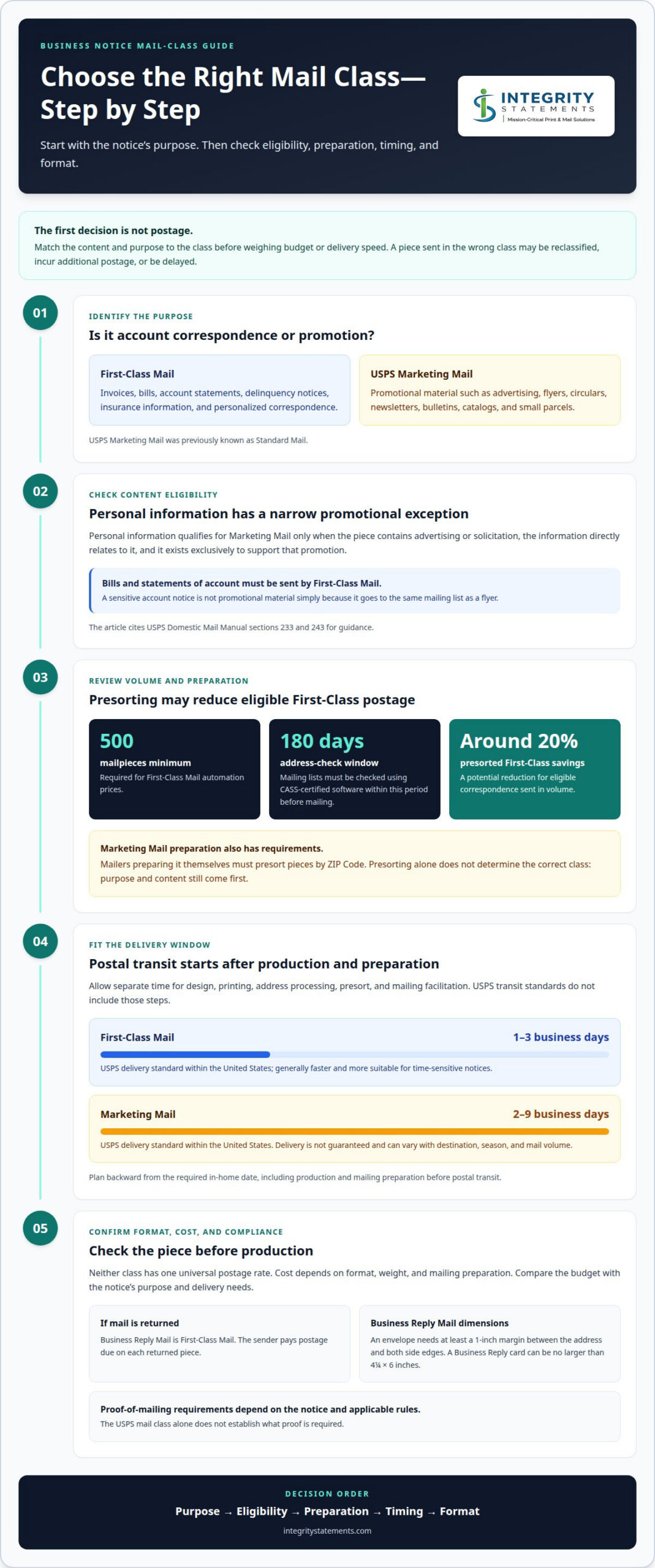
First-Class Mail versus USPS Marketing Mail
Notice purpose, production time, and USPS transit standards all shape the choice. The class also affects content eligibility and delivery expectations.
Business notice eligibility by mail class
First-Class Mail is used for invoices, statements, bills, and personalized correspondence. USPS Marketing Mail covers promotional pieces, including advertising, flyers, circulars, and newsletters. Personal information belongs in Marketing Mail only when it supports related advertising or solicitation exclusively. The USPS Domestic Mail Manual sections 233 and 243 provide the cited guidance. Marketing Mail Flats qualified for a growth incentive from January 1, 2024 through December 31, 2024.
Production time and USPS transit time
USPS transit estimates begin after production and mailing preparation, not when a notice enters design or printing. Production, address processing, presort, and mailing facilitation therefore need separate time in the schedule. A First-Class estimate of 1-3 business days does not include those steps. Marketing Mail’s 2-9-business-day standard also excludes production and preparation. Plan from the required in-home date backward, accounting for both stages.
Delivery speed and date guarantees
Within the United States, USPS sets a 1-3-business-day delivery standard for First-Class Mail and 2-9 business days for Marketing Mail. First-Class is generally faster, making it more suitable for time-sensitive notices. Marketing Mail has no guaranteed delivery timeline, and transit can vary with destination, season, and mail volume. Neither standard includes production time, so the mailing schedule must allow for preparation before postal transit.
Mailpiece size, weight, and content rules
First-Class Mail letters generally measure at least 3 1/2 inches high and 5 inches long. They must be no more than 6 1/8 inches high, 11 1/2 inches long, or 1/4 inch thick. The applicable weight limit is 13 ounces. Its eligible products include printed matter and promotional material, rather than ordinary bills or account statements.
First-Class Mail compared with Marketing Mail
Choosing first-class vs marketing mail for business notices starts with the communication’s purpose, not the postage budget. First-Class Mail suits personalized letters and account communications, while Marketing Mail is intended for advertising and eligible promotional pieces. That distinction matters when a notice includes recipient-specific information: adding a promotional insert doesn’t automatically make an invoice or account notice advertising.
Undeliverable-mail handling also differs. First-Class Mail includes forwarding and automatic returns at no additional cost when a piece cannot be delivered. Marketing Mail does not include those services unless they are specifically requested and paid for. For mailings with outdated addresses, this affects whether pieces can be forwarded or returned to the sender.
Only First-Class Mail can be sent as Certified Mail. Certified Mail provides a sender receipt and a delivery record at the addressee’s post office, but it does not provide insurance. This matters when a business needs a record of mailing and delivery rather than insurance for the contents.
Marketing Mail can suit a broad advertising campaign where recipients receive the same promotional message. First-Class Mail is a better fit for individualized correspondence, such as a notice tied to a specific account. Personal information qualifies for Marketing Mail only when it relates directly to advertising or solicitation and exists exclusively to support it. Choose the class based on each piece’s content, not the mailing’s volume.
For teams weighing first-class vs marketing mail for business notices, the practical test is whether personalization, forwarding, returns, or a certified delivery record matters. Choose an eligible class that fits the message and its handling needs. Plan your business notice mailing with those requirements in view.
Integrity Statements: Customer Notices Printing and Mailing
Integrity Statements handles Customer Notices Printing and Mailing for organizations that need business communications prepared and mailed with care. This is a practical next step when a notice’s content, audience, and delivery requirements need to align with the selected mail class.
For account-specific communications, Statement Printing and Mailing or Invoice and Billing Printing and Mailing can fit the document’s purpose. Healthcare Communications Printing and Mailing supports organizations sending healthcare-related communications. Start with the notice type and its requirements so the print-and-mail process reflects the communication being sent.
Ready to plan a business notice mailing? Contact Integrity Statements to discuss your needs.
Put the Next Mailing on a Clear Path
Treat each notice as a distinct communication, not simply another piece in a batch. Consider what recipients need to know, how personalized the message is, and what delivery expectations apply. This practical review makes it easier to choose consistently between First-Class and Marketing Mail for business notices.
For organizations preparing recurring statements, invoices, or healthcare communications, coordinated print-and-mail services can help align document handling with the selected mailing approach. Integrity Statements supports these business-critical communications through its printing and mailing services, with the notice’s purpose guiding the work.
When you’re ready to plan an upcoming mailing, contact Integrity Statements to discuss your mail. A clear plan for each notice is a steady foundation for accurate, well-managed communication.
Frequently Asked Questions
What’s the difference, and why does it matter for compliance?
The key difference is whether a piece is transactional correspondence or promotional content, which affects its mailing class. An account-specific renewal notice, for example, differs from a flyer promoting a renewal offer. Misclassifying a notice can lead to reclassification, additional postage, or a hold. Make the decision based on the notice’s actual purpose and the information it contains.
What is USPS First-Class Mail and what is USPS Marketing Mail?
USPS First-Class Mail is used for letters and business correspondence such as invoices, statements, and personalized notices. USPS Marketing Mail is intended for eligible promotional material, including advertising, flyers, and newsletters. A mailing’s audience or volume alone does not determine its class. The message and its purpose matter, especially when a piece combines promotional material with recipient-specific information.
Can legally required or time-sensitive business notices be sent by USPS Marketing Mail?
Not simply because Marketing Mail may have lower postage. The notice’s content and purpose determine whether it qualifies; bills, statements, and personalized account notices are First-Class Mail items. For a Texas business with a deadline, distinguish production and mailing preparation from postal transit, then choose a class appropriate to the notice. A delivery standard is not a guaranteed date.
How can a professional mailing provider choose the right USPS mail class for a notice, and what information does a business need to provide?
To plan a mailing, assess the notice’s purpose, personalization, format, weight, address data, volume, and required timing. Share a representative document, recipient and quantity details, the target mailing date, and any return-mail or proof needs with Integrity Statements. These details help distinguish a promotional campaign from account-specific correspondence and plan production alongside postal preparation for a Texas mailing.


