Prevent Returned Business Invoice Mail With Clear Follow-Up
A returned invoice is a reason to review the process, not simply resend the same envelope. Preventing returned mail for business invoices starts with accurate customer details, a clear invoice, and consistent follow-up. Confirm the mailing address and contact information, make payment terms easy to understand, and follow up promptly when payment is due.
It’s frustrating when an invoice doesn’t reach the right person or a customer delays payment because they have questions. Clear follow-up can reveal address problems, clarify billing details, and resolve misunderstandings before they linger.
This article explains how to maintain customer records, make invoices easier to act on, and standardize follow-up when mail is returned or payment is overdue. It also covers how a reliable print-and-mail workflow can support consistent invoice communications.
Key Takeaways
- Build a consistent invoice follow-up sequence, and confirm receipt before treating a late payment as a payment issue.
- Review customer contact records and invoice details to spot common causes of returned mail and billing confusion.
- Learn how address correction, change-of-address services, and validation tools can support cleaner mailing records.
- See how Integrity Statements’ Custom Print & Mail service can support dependable invoice communications.
2. Standardizing invoice recovery workflows
A consistent recovery workflow helps staff distinguish delivery problems from payment delays. Before treating an overdue invoice as a refusal to pay, confirm that the customer received it. Use the contact details on file to ask whether the billing information is clear, correct, and addressed to the right person. A process for preventing returned mail for business invoices can uncover a changed address, missing purchase reference, or contract question.
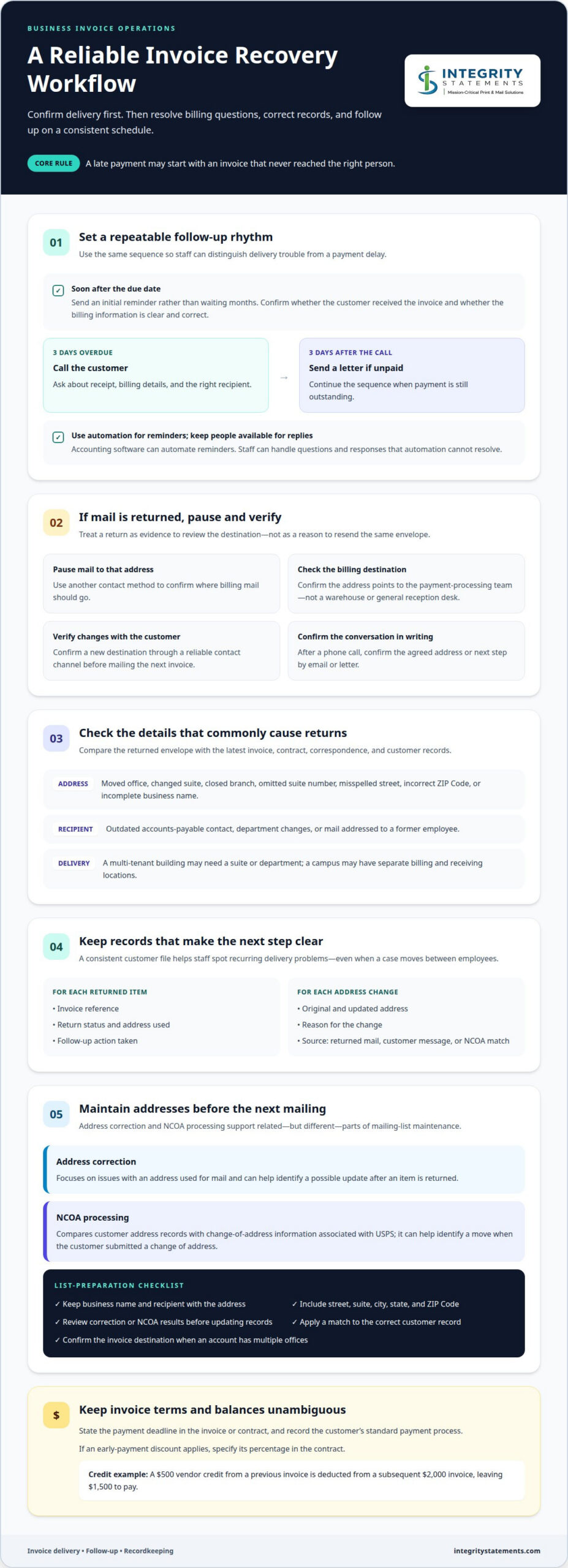
Set a repeatable schedule for emails, phone calls, and letters. For example, call three days after an invoice becomes overdue, then send a letter three days after the call if payment is still outstanding. Send an initial reminder soon after the due date rather than waiting months. Accounting software can automate reminders, while staff handle replies and questions that automation can’t resolve.
When a customer moves, keep their name, email address, phone number, and mailing address current. Ask customers to report changes, then confirm the new destination through a reliable contact channel before mailing the next invoice. If mail is returned, pause further mailings to that address and use another contact method to confirm where billing mail should go.
Record each returned item in the customer file, including the invoice reference, return status, address used, and follow-up action. Verify any new address and keep the return details with the billing correspondence. This recordkeeping supports preventing returned mail for business invoices by helping staff identify recurring delivery problems, even when cases move between employees. After a phone conversation, confirm the agreed address or next step by email or letter.
Keep payment terms consistent, too. State the deadline in the invoice or contract, and record the customer’s standard payment process. If an early-payment discount applies, specify its percentage in the contract. Clear terms give staff a reliable reference and help customers understand what is due and when.
3. What causes business invoices to be returned as undeliverable mail?
An invoice may be returned when its address no longer points to a deliverable destination. The customer may have moved offices, changed suite numbers, or closed a branch without updating the billing record. For example, a company that relocates to another office suite may still receive deliveries elsewhere, while mail sent to its old suite can’t reach the billing team.
Missing or inaccurate address details are another common obstacle. An omitted suite number, misspelled street name, incorrect ZIP Code, or incomplete business name can make a familiar address difficult to match. Compare the returned envelope with the customer’s latest invoice, contract, and correspondence. Look for a mismatch between the billing address on file and the destination the customer currently uses.
Recipient details matter, too. A business may remain at the same address but reorganize departments, change the person responsible for accounts payable, or stop accepting mail for a former employee. An invoice sent to an outdated contact may be delayed or returned if that person is no longer associated with the location. Keep the company name and billing contact aligned with current customer records.
Physical access and delivery instructions can affect delivery as well. A multi-tenant building may require a suite or department, while a campus may have separate locations for its billing office and receiving dock. Check that the address points to the customer’s payment-processing team, not a warehouse or general reception desk. Note the reason shown on returned mail, then compare it with the saved address before making changes.
Returned mail provides useful evidence, but it doesn’t reveal every underlying cause by itself. Treat each return as a prompt to review the destination, business name, recipient, and address details together. Correcting the record can prevent the same invoice from being sent repeatedly to an address the customer no longer uses.
Separately, accurate invoice records should carry forward prior credits: a $500 vendor credit from a previous invoice should be deducted from a subsequent $2,000 invoice, leaving $1,500 to pay.
4. How do USPS address correction and National Change of Address services work for businesses?
USPS address correction and National Change of Address (NCOA) processing help businesses identify address changes before sending another invoice. Address correction focuses on issues with an address used for mail. NCOA processing compares customer address records with change-of-address information associated with USPS. These methods address related problems, but they serve different steps in maintaining a mailing list.
For example, an invoice may be returned after a customer relocates. The accounts team can record the returned address, use an address-correction process to identify a possible update, and compare the result with its customer file. NCOA processing can help identify a move when the customer has submitted a change of address. Apply any match to the correct customer record rather than replacing addresses across an entire account.
Build address maintenance into regular list preparation. Before mailing, organize customer records so the business name, recipient, street address, suite, city, state, and ZIP Code stay together. Run the records through the chosen correction or NCOA process, review the results, and update the billing system when the customer match is clear. If an account has multiple offices, confirm which location receives invoices before changing the billing destination.
Keep a record of the original address, the updated address, and the reason for the change. For instance, note whether the update came from returned mail, a customer message, or an NCOA match. This creates a clear trail when later mail goes to a different destination and helps distinguish a relocation from a typo or outdated suite number.
These tools support address maintenance, but they don’t resolve every delivery issue. A customer may move without submitting a change, or a record may point to a branch rather than the billing office. Treat USPS-related results as a cue to review the account and keep the invoice destination aligned with the customer’s current billing instructions.
4. What are USPS address validation tools and their costs for businesses?
Address validation tools help businesses review mailing addresses before sending invoices. They can check whether an address follows a recognized format, identify missing details, and suggest standardized formatting. This is different from confirming that a customer still receives mail there. A correctly formatted record can still be outdated.
For example, an accounts team might enter a customer’s street address without a suite number. A validation check can flag the missing detail so staff can correct the record before preparing a mailing. Keep the customer’s business name and invoice destination together, since a valid street address alone may not identify the right office or billing department.
Businesses can use validation during data entry, before preparing a mailing, or when cleaning an existing customer list. Choose the point that best fits the workflow. A check at entry can catch a typo early; a review before mailing can flag records imported or changed since the last invoice. Staff should resolve flagged records rather than assume every suggested correction applies to the right customer.
Address-validation costs depend on how the tool is supplied and used. Relevant factors include the number of records processed, whether checks happen individually or in batches, and whether the business needs an ongoing subscription or system integration. A small team reviewing occasional changes has different needs from a billing operation validating a large customer file. Compare the pricing structure with the volume and frequency of checks, not just the headline fee.
Also account for staff time spent reviewing exceptions and maintaining customer records. A low-cost check may still leave manual work if it flags many addresses for human review. An integrated process may reduce duplicate entry, but its value depends on how well it fits existing billing systems. To align invoice production and mail preparation, review invoice mailing workflow options.
Address records are only one part of invoice preparation. State the payment deadline clearly in invoices or contracts, and ask customers about their standard payment process or policy. Consistent follow-up with the buyer before an account is due can help address problems before they become disputes that delay payment.
The Association of Certified Fraud Examiners estimates that businesses lose 5% of their total revenue to fraud every year. Among companies that encountered fraud in 2019-2020, 27% reported that fraud-induced losses exceeded their anti-fraud expenditures. Companies recover an average of 25% of what they lose to fraud.
Integrity Statements: Custom Print & Mail
Integrity Statements provides Custom Print & Mail for businesses that need a dependable way to prepare and send invoice communications. It can be a natural next step when your team wants a more consistent print-and-mail workflow alongside the address checks and follow-ups described above.
Consider this service when invoice mailings need a tailored approach or internal processes make it difficult to keep each communication moving smoothly. A defined workflow connects accurate customer records with prepared, clearly presented mail, while your team maintains current billing details and responds to customer address changes.
For support with print-and-mail needs connected to your invoice process, contact Integrity Statements to request a quote.
Make invoice delivery part of your ongoing process
Reliable invoice delivery depends on treating mailing records as working business information, not details to update only after a problem. Review returned-mail patterns as part of your regular billing process. Repeated issues tied to an office, department, or customer record can show where closer attention is needed. This ongoing discipline supports preventing returned mail for business invoices as customers and their business details change.
For organizations managing recurring communications, Integrity Statements provides Statement Printing and Mailing, Invoice and Billing Printing and Mailing, and Healthcare Communications Printing and Mailing. These services help teams coordinate print-and-mail needs through a consistent process, with accurate customer records remaining central to delivery.
If you’re ready to discuss your print-and-mail needs, contact Integrity Statements today. A careful next step can help your team build a more orderly approach to business communications.
Frequently Asked Questions
What should a business do when an invoice is returned as undeliverable?
Pause further mailings, then contact the customer using a trusted phone number or email already on file. Keep the returned envelope with the invoice record, note any delivery marking, and confirm the correct billing recipient and destination. In your accounts receivable system, record whether the invoice was corrected and resent so staff don’t issue a duplicate or lose track of the outstanding balance.