

Ways to weigh costs and protect confidential business mail
Postage is only one part of a secure mailing decision. For confidential document mailing for businesses, weigh the full print-and-mail process against the sensitivity of the contents, the controls at each handling step, and the delivery evidence you need. The right approach protects information without adding unnecessary complexity.
It makes sense to consider cost and confidentiality together: a lower mailing expense matters little if sensitive documents are exposed or you have no useful delivery record. This article explains how chain of custody, production and postage choices, delivery records, and everyday document handling shape the decision. You’ll learn what each factor tells you, where its limits lie, and how to match safeguards to the documents you send.
Key Takeaways
- Map how sensitive documents are handled from preparation through delivery, and identify where custody records strengthen oversight.
- Compare the full print-and-post process, including material use and mailing choices, rather than weighing postage alone.
- Choose delivery records that help your team document what was sent and support follow-up when questions arise.
- Reduce exposure by limiting access, setting clear handling procedures, and selecting a secure channel suited to each document.
1. Chain of custody
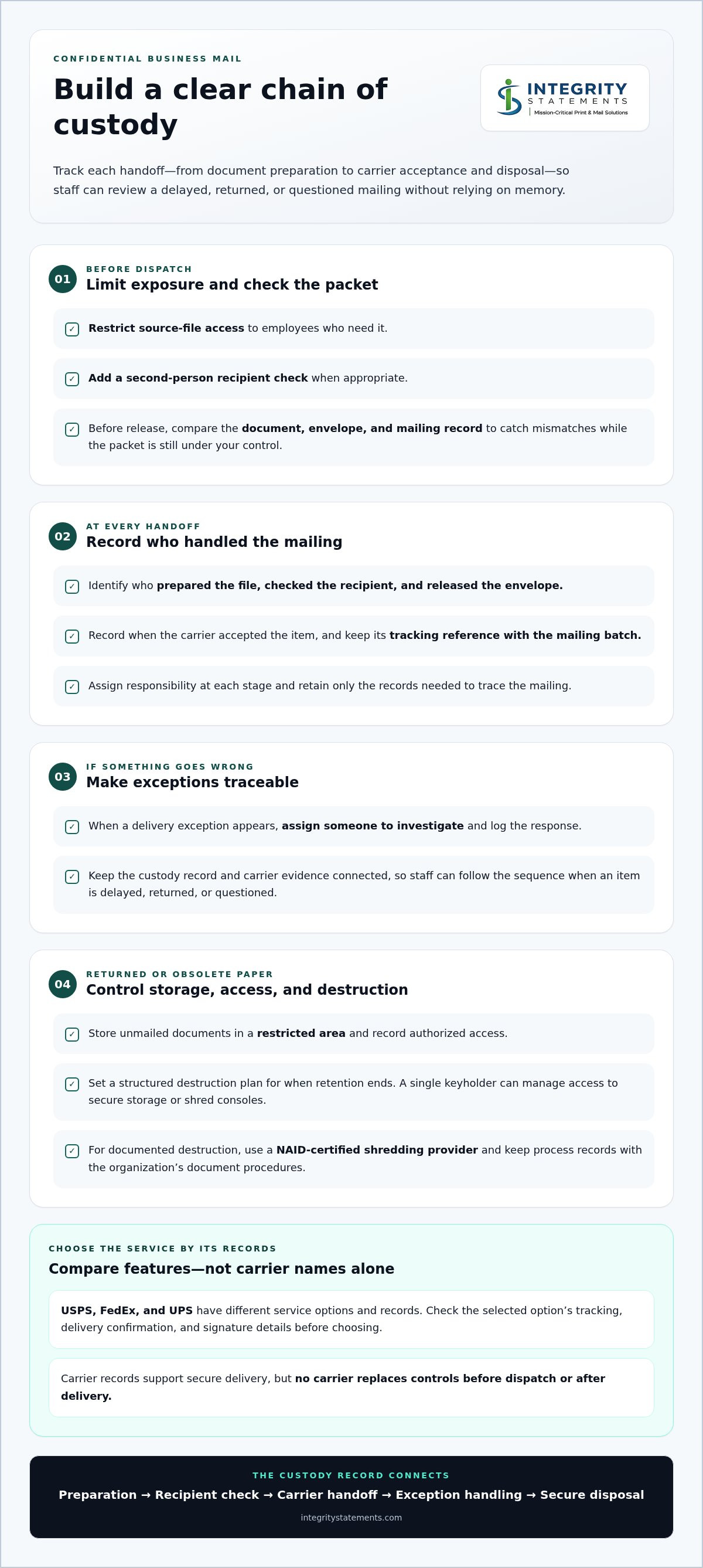
For confidential document mailing for businesses, compare service features, not carrier names alone. USPS, FedEx, and UPS have different service options and records. Check the selected option’s tracking, delivery confirmation, and signature details before choosing. No carrier replaces controls before dispatch or after delivery.
Build a custody record around each handoff. Identify who prepared the file, checked the recipient, and released the envelope. Record when the carrier accepted it, then keep the tracking reference with the mailing batch. If a delivery exception appears, assign someone to investigate and log the response. These steps help staff review a missing item without relying on memory.
Limit exposure before dispatch. Restrict source-file access to employees who need it, and add a second-person recipient check when appropriate. For example, a statement intended for one client could create a breach if another client’s pages are inserted. Compare the document, envelope, and mailing record before release. This can catch mismatches while the packet remains under your control.
Set rules for returned or obsolete paper. Store unmailed documents in a restricted area, record authorized access, and use a structured destruction plan when retention ends. A single keyholder can manage access to secure storage or shred consoles. For documented destruction, use a NAID-certified shredding provider. That supports secure handling and irreversible destruction. Keep process records with the organization’s document procedures.
A documented process for confidential document mailing for businesses links preparation, carrier handoff, exception handling, and disposal. Assign responsibility at each stage, and retain only the records needed to trace a mailing. This gives staff a defined path when an item is delayed, returned, or questioned, while limiting unnecessary access to sensitive documents.
USPS, FedEx, and UPS offer different service options and records. Compare tracking, delivery confirmation, and signature details, then use your own custody records and recipient checks to support secure delivery.
2. Costs and environmental impact of print and post
To compare print-and-mail costs, map each stage from file preparation to dispatch. Count pages, paper stock, printing, finishing, envelopes, postage, and any return handling. A two-page notice in a standard envelope has different inputs from a multipage statement with inserts. Compare equivalent batches, not just postage, so production choices remain visible. The project quote reflects factors such as page count, paper, finishing, envelope, postage, and volume.
Volume and accuracy also affect the overall effort. Planning documents in batches can reduce repeated setup, while last-minute changes may require new proofs or reprints. Before production, check the recipient file, page count, and approved message against a sample. Correcting a wrong address beforehand, for example, can avoid printing and mailing a replacement. Track returned mail and reprints alongside postage to identify where process changes could reduce waste.
Environmental impact also depends on production choices. Each unnecessary page uses paper and adds weight; extra inserts and oversized envelopes add material. Review recurring documents for repeated content and remove pages recipients don’t need. Duplex printing can reduce sheet use when the document remains legible and suitable for its purpose. Consolidate inserts only when doing so won’t obscure information or affect how the recipient uses the document.
Consider digital delivery for documents that don’t require paper, but assess confidentiality before changing channels. Sensitive files should use secure file transfer rather than standard unencrypted email. Control stored copies and define how long working files and print-ready versions remain accessible. A practical review weighs paper and postage against access controls, delivery needs, and reprint risks. For example, retain paper mail for recipients who need a physical record, while using a secure digital channel for suitable ongoing exchanges. Choose the channel for each document rather than treating every message alike.
3. Delivery records for disputes and audits
Certified mail, registered mail, and tracked delivery are different mailing options, but the records they provide depend on the selected service. Certified and registered mail are USPS services, while tracking records scan events as an item moves through delivery. Compare the proof each option supplies, not just its label.
For proof of delivery and a recipient signature, choose a mailing service that explicitly includes both. USPS, FedEx, and UPS offer options with different records, so check the selected option’s stated features before preparing the mailing. Tracking alone may show movement without documenting a signature.
Build records that connect each mailed document to its delivery evidence. Retain the mailing date, recipient name, destination, tracking reference, document type, and any available delivery confirmation. For example, an audit file for a customer notice can pair its approved version with the address record and carrier receipt. Limit access to the file because it may contain sensitive recipient details.
Set a consistent retention and retrieval process. Give each mailing batch a reference that staff can search by client, document type, or dispatch date. If a recipient disputes delivery, retrieve the record, compare its destination with the account, and note the response. Keep corrections and follow-up together instead of scattering them across inboxes. This creates a clearer timeline for internal review.
Delivery evidence is only part of the record. For digital sharing, use encryption and access controls suited to the documents, and log who sent or received files. Don’t treat an email confirmation as proof that the intended person opened a message. A mailing record should show what was prepared and dispatched; a carrier record should show the events reported by that service. Keep the records distinct but clearly linked, so an auditor can follow the sequence without seeing unrelated files.
4. Maintaining documents in confidence
For confidential business mail in the United States, select a service based on the document, delivery evidence, and handling controls it provides. Match those features to the recipient and the sensitivity of the contents, rather than choosing by carrier name alone.
Physical mailing isn’t the only option. Secure file transfer can support confidential digital documents, e-signature tools suit forms requiring sign-off, and customer portals can support ongoing servicing. Choose the channel that fits the task, and control access to stored files with internal permissions. Sending a password separately from an encrypted file can reduce exposure if one message reaches the wrong person.
No single law covers every sensitive business, financial, or personal document. Applicable federal and state requirements depend on the information and business activity, so identify the data involved and review the rules that apply before sending. A name combined with identifying numbers, for example, can reveal private details and calls for restricted handling.
International mailing requires attention to the destination as well as the document. Before dispatch, identify the destination country, the document’s contents, and any customs declarations or privacy requirements that apply to that route. Don’t assume a domestic process transfers unchanged across borders. Record the approved handling steps and limit access to mailing data.
Everyday controls matter, too. Keep invoices out of shared work areas while awaiting filing, restrict access to secure storage, and train employees to verify sender details before opening digital attachments. Clear procedures should explain how staff prepare, send, store, retrieve, and dispose of confidential records. These steps help trace access and reduce avoidable exposure.
For recurring business mail, review your confidential mailing workflow and identify where controlled print and distribution can support your document process.
Choose a service by matching its handling controls and delivery evidence to the document’s sensitivity and recipient. For digital documents, secure file transfer, e-signature tools, or customer portals may fit better than physical mailing.
Integrity Statements: Statement Printing and Mailing
Integrity Statements provides statement printing and mailing for organizations managing recurring customer communications. When preparing statements, invoices, healthcare communications, or tax and regulatory mail takes time away from internal work, outsourcing printing and mailing can bring those steps into one process. This is a fit for businesses that need to distribute essential documents in print and want a consistent approach to production and dispatch. Choose the document type and consider how outsourced mailing could simplify your workflow. For statement distribution, start with Integrity Statements’ Statement Printing and Mailing service. Contact Integrity Statements to discuss your business mailing needs.
Make your next mailing decision with confidence
Use your next mailing cycle to turn confidentiality priorities into a clear operating process. Decide which documents need physical delivery, what evidence your team needs, and who owns each handoff. Then review whether the process remains practical as customer communications change. A thoughtful approach to confidential document mailing for businesses can keep information handling aligned with everyday operations.
For recurring communications, Integrity Statements offers Statement Printing and Mailing, Invoice and Billing Printing and Mailing, and Healthcare Communications Printing and Mailing. These services can suit organizations looking to manage essential printed communications while focusing their own attention on customer needs and internal priorities.
Consider which document workflow would benefit most from a closer review, then take the next step at a pace that works for your organization. Contact Integrity Statements today to discuss your business mailing needs and move forward with a clear plan.
Frequently Asked Questions
How much does secure document mailing cost for businesses?
Pricing depends on the mailing project and is provided through a quote request. Key factors include document length, paper and finishing choices, envelope requirements, postage, and mailing volume. A recurring statement run, for example, differs from a one-time customer notice with special inserts. Integrity Statements serves Texas organizations with business print-and-mail needs. Request a quote to align production details with the documents you’re sending.
How can a business securely prepare and package confidential documents for mailing?
Prepare each mailing by matching the approved document to its intended recipient, then protect the contents in a sealed envelope. Use an envelope that conceals the pages, and keep sensitive details off the exterior unless delivery requires them. Before dispatch, compare a sample with the approved file and confirm that each recipient’s inserts are correct. Separate completed mail from unprepared documents to prevent mix-ups.
What are the risks of mailing confidential documents, and how can businesses reduce them?
Common risks include misaddressed envelopes, pages inserted into the wrong recipient’s packet, loss in transit, and sensitive information visible through packaging. Reduce these risks by limiting access to mailing files, checking recipient data against the source record, and examining sample packets before release. Set a clear process for escalating returned or misdirected mail, so staff can contain exposure and record corrective action.
What are the best confidential document mailing services for businesses in the United States?
USPS, FedEx, and UPS each offer different service options. Choose based on the document’s sensitivity and the tracking, delivery confirmation, and signature details provided by the selected service.
How do USPS, FedEx, and UPS compare for secure business document delivery?
Records vary by service option, so compare its stated tracking, delivery confirmation, and signature features. Tracking alone may show an item’s movement without documenting a recipient signature, so maintain your own custody records and recipient checks as well.


